




Skid Steer or Track Loader: How to Choose
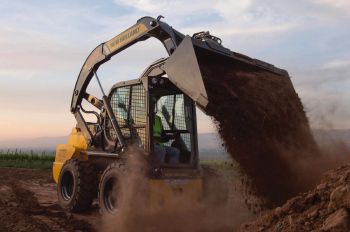
Start with a compact track loader for soft ground, slopes, and grading. Its rubber tracks spread the machine’s weight, so it stays on top of mud, sand, and fresh topsoil and keeps its grip on a slope. The long, flat track also keeps the bucket steady when you grade. A skid steer belongs on hard surfaces, because its tires skid as it turns and can tear up a lawn or fresh topsoil. On pavement, concrete, and packed gravel, either machine does the work. So if a good share of your work is in the dirt, buy the track loader, since it covers the paved jobs too.
Why tracks work on soft ground
A track loader rides on two long rubber tracks instead of four tires. The tracks spread the machine’s weight over a long, flat footprint, so it presses down lightly and stays on top of the mud instead of sinking in. The tracks also keep their grip on uneven sites and slopes.
The long, flat track helps with grading, too. The machine rocks forward and back less as it travels, so the bucket holds a steadier line.
A track loader works on pavement and concrete too. Go easy on sharp turns there, because turning hard on concrete can wear or damage the tracks.
Where a skid steer fits
A skid steer runs on four tires and turns by skidding them. On pavement, concrete, and packed gravel, it does the same loader work a track loader does: loading trucks on a gravel pad, cleaning up a slab, and moving material around a parking lot.
The skidding is its weak spot: on anything soft, the tires can tear up the surface as the machine turns, so keep it on hard surfaces.
Which one to buy
A track loader handles soft ground and pavement, while a skid steer is limited to hard surfaces. So if a good share of your jobs are dirt work, landscaping, or grading, buy the track loader, and it will cover your paved jobs too.
If nearly all of your work is on pavement, concrete, and gravel pads, either machine does it. Our lightest skid steer, the New Holland L320, weighs 6,470 pounds, less than any track loader we rent, which helps if you tow it yourself. When a wet or soft job comes up, rent a track loader for it.
Every rental machine has a rent-to-purchase option, so you can also rent the one you’re leaning toward and see how it handles your work before you buy. Rentals do not include an operator. Our guide to how renting works covers hours, fuel, insurance, and returns.
Comparing what they lift
Skid steers and track loaders are sized by capacity, the most the machine can safely lift and carry. The capacity starts from the weight in the bucket that would tip the machine forward, and our rate guide lists the two kinds at different shares of it: the skid steers at New Holland’s 50 percent figures, and the track loaders at 35 percent, the way Takeuchi lists its own.
That makes a track loader’s number look small next to a skid steer’s. New Holland lists the C345 track loader both ways: 3,150 pounds at 35 percent and 4,500 pounds at 50 percent, which is more than the L334 skid steer’s 3,400. Use the 50 percent figures to compare the two machines, and on the job, stay within the rated operating capacity in the operator’s manual for the machine you have.
We rent three New Holland skid steers and nine track loaders from Takeuchi and New Holland. Our guide to skid steer and track loader sizes lists them all and shows how to compare their ratings.
Attachments for both
Our rate guide lists the same rental attachments for skid steers and track loaders: buckets, pallet forks, an auger, a breaker, brooms, a brush cutter, grapples, rakes, and a trencher. The powered ones, like the auger, breaker, brush cutter, and trencher, run off the loader’s hydraulics, and some need more flow than others. So when you reserve one, tell us which machine it’s going on, and we’ll match the two. Our guide to loader attachments covers what each one does.
Daily care for tracks and tires
Quick turns and fast changes between forward and reverse wear tracks and tires faster, so drive smoothly on either machine.
- Tracks. Check the track tension every day, and our guide to undercarriage wear and track tension shows how. Avoid sharp turns and spin turns on concrete, keep the sides of the tracks off curbs and walls, and take it easy on snow and ice, where rubber tracks tend to slip.
- Tires. Skidding is hard on tires. Check the pressure every day, because the right pressure keeps the tread from wearing early. Look the tires over for cuts, chunking, and stones drilled into the tread, and clean out debris every day.
Run it safely
Wear the seatbelt every time, even with the roll-over frame (ROPS) over the seat. In a rollover, the seatbelt is what keeps you inside the frame’s protection. Never carry anyone in the bucket or on the machine.
Travel and turn with the bucket as low as it will go, and on a slope, drive straight up and down, never across. Both keep the machine steady and cut the risk of a rollover. Keep the heavy end of the machine pointed uphill. With the bucket empty, the back is usually the heavy end.
Never leave the seat while the engine is running or the arms are raised, because a raised bucket can drop without warning. Never let anyone walk under raised arms, and never start the machine from outside the cab. Our Best Practices article on operating track loaders and skid steers covers the seatbelt, slope, and raised-arm rules.
What to tell us
When you call, tell us what the machine will be driving on, the heaviest load you’ll lift and carry, the attachments you need, and the narrowest opening on the way in. That tells us whether to start you on a skid steer or a track loader, and which size.
Talk to a location near you
Call or text, or send us the question through our contact page.