




Renting a Skid Steer or Track Loader: What to Ask When You Reserve
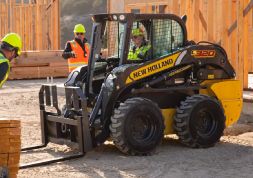
When you’re renting a skid steer or track loader, the first thing to figure out is what the machine will be driving on, because that decides which of the two to rent. On pavement, concrete, and packed gravel, either machine does the work. On a lawn, soft ground, or a slope, rent the track loader, because its tracks spread its weight and keep their grip where tires would sink or tear up the surface. After that, pick the size by the heaviest load you’ll be lifting and the narrowest opening the machine has to get through, and name the attachments you need when you reserve, so they go out with the machine. We rent three New Holland skid steers, nine track loaders from Takeuchi and New Holland, and fourteen attachments that go on them.
Tracks or tires
A track loader rides on two long rubber tracks that spread the machine’s weight over a big footprint, so it stays on top of mud, sand, and fresh topsoil and keeps its grip on a slope. A skid steer runs on four tires and turns by skidding them, so it’s the machine for pavement, concrete, and packed gravel. On a lawn or soft ground, the tires dig in as they skid and tear up the surface, so that’s track loader work. If the job has both kinds of ground, rent the track loader, because it does the paved work too. Our guide to choosing between a skid steer and a track loader goes through that choice in more detail.
Which size
Every machine has a limit to how much it can safely lift and carry, and that limit is the capacity we list for each one. Our skid steers run from the New Holland L320, with a capacity of 2,000 pounds, to the L334 at 3,400, and our track loaders from the Takeuchi TL6R at 1,841 pounds to the TL12V2 at 4,107. Pick a machine that handles your heaviest load with room to spare. Then check the bucket width against the narrowest opening on the way in. Our guide to skid steer and track loader sizes lists all twelve with their capacities, bucket widths, and weights, and explains why a track loader’s capacity looks low next to a skid steer’s.
Attachments
We rent fourteen attachments for these machines: an auger with bits from 6 to 36 inches, a breaker, an angle broom and a bucket broom, a 72 inch brush cutter, a brush grapple, a root rake grapple, a grapple bucket, an extra bucket, a rock bucket, a Harley rake, a Rockhound, pallet forks, and a trencher. The powered ones run off the machine’s hydraulics, and some need a high flow machine, so tell us the attachment and we’ll put it on a machine that runs it. Our guide to loader attachments says what each one does.
For snow
A skid steer is the machine for a small parking lot and the corners around dumpsters and islands, because it turns in a tight space. If you’re renting one for snow, say so when you reserve, and ask us what we can put on the front of it. Our guide to wheel loaders for snow removal compares the skid steer, the track loader, and the wheel loader for the parking lot you’re clearing.
Getting it to the job site
To haul the machine yourself, the combined weight of the machine and your trailer has to come in under the load rating on the trailer’s plate, and your truck has to be rated to tow that total. Our lightest skid steer, the New Holland L320, is 6,470 pounds, and our heaviest track loader, the Takeuchi TL12V2, is 13,190. If you haul for your business, check the license too. The driver needs a Class A CDL once the truck and trailer together are over 26,000 pounds and the loaded trailer alone is over 10,000, counting the rating or the actual weight, whichever is higher (49 CFR 383.91). Even the L320 can put a loaded trailer over 10,000 pounds, and five of our track loaders, the New Holland C345 and the Takeuchi TL10V2, TL11R3, TL12R2, and TL12V2, are over 10,000 before they go on the trailer. Every weight is in our guide to skid steer and track loader sizes. If you’d rather not haul it, we deliver and pick up with our own trucks and trailers. Tell us the job site address and the dates when you reserve, and we’ll set up the delivery and give you the rate.
The terms
A rental day is 8 machine hours, a week is 40, and four weeks are 160, and hours past that are an additional charge. The tanks are full when the machine leaves and have to be full when it comes back. Nothing goes out until your account or prepayment is set up and we have proof of insurance naming us as additional insured and loss payee, so call your insurer the day you reserve. You supply a trained operator and handle the routine upkeep, and on a track loader the daily walkaround includes a track tension check. If the tension is off, call us before you adjust it. Our guide to how renting works covers the rest of the terms.
What to tell us when you reserve
Tell us what the machine will be driving on, the heaviest load you’ll be lifting, the narrowest opening on the way in, and the attachments you need. Give us the dates and the hours you expect to run each day, and tell us whether we’re delivering or you’re hauling it. With that, we can have the right machine ready to go out.
Talk to a location near you
Call or text, or send us the question through our contact page.