





Mini Excavator Sizes, Weights, and Dig Depths
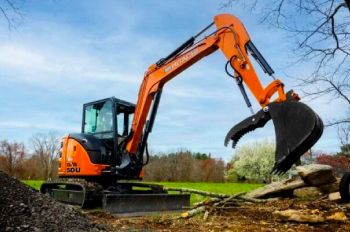
For drain lines, irrigation, and fence or deck footings, start with the 1 and 2 ton machines. For water and sewer lines, patios, and walls, start with the 3 and 4 ton machines, and go bigger for deeper trenches and site work. Then check the individual model, because it has to dig deeper than your trench and fit through the narrowest opening on the way in. Our compact rental excavators, from Takeuchi, Hitachi/Landcros, and Link-Belt, run from 2,535 to 19,200 pounds.
Which size to start with
Use the job to pick a size group. Then compare your trench depth and the opening on your job site with the models in that group. The depths in this table are the most our machines in each group dig, not how deep those jobs have to go.
| Work you are planning | Sizes to start with | Listed dig depths in that group |
|---|---|---|
| Drain lines, conduit, irrigation, and fence or deck footings | 1 and 2 ton | 5′ 9″ to 7′ 10″ |
| Water and sewer lines, patios, and walls | 3 and 4 ton | 8′ 6″ to 11′ 4″ |
| Deeper trenches and site preparation | 5 to 7 ton | 11′ 9″ to 13′ 6″ |
| Larger site work and loading trucks | 8 to 10 ton | 14′ 10″ to 15′ 4″ |
These are starting points. Two water line jobs can need different machines, because one trench is deeper or one way in is narrower.
Leave digging depth to spare
The listed dig depth is the most the machine can reach, and a trench with straight walls comes in shallower. Takeuchi’s spec sheet for the TB216 lists 7 feet 10 inches of maximum dig depth, but 6 feet 9 inches for a straight vertical wall. So avoid a machine whose listed depth barely reaches the depth you need. For a 7-foot trench, the Hitachi/Landcros ZX17U-5N’s 7 feet 2 inches leaves almost nothing.
Moving up a size is not the only way to get more depth. The Takeuchi TB250-2 and TB350R are both 5-ton machines, and the TB250-2 is 7 inches narrower and digs 8 inches deeper. The TB350R is Takeuchi’s short tail swing 5-ton: the back of the machine stays close to the tracks when the upper part turns, which matters when you dig right beside a house or a wall. When the opening and the depth are both tight, compare the models inside a size group before you go up a size.
Measure the opening and the height
Measure the narrowest opening the machine has to pass through, and leave room on each side for the operator to steer. Compare that with the width of the model, not the size label. Among our 4-ton machines, the Takeuchi TB235-2 is 5 feet 3 inches wide and the other three are 5 feet 9 inches, a six-inch difference at a tight gate.
At 2 feet 6 inches, the Takeuchi TB210R is the only machine in our rental fleet narrower than a 3-foot gate. The two 2-ton machines, the Hitachi/Landcros ZX17U-5N and the Takeuchi TB216, pull their undercarriage in to 3 feet 2 inches and 3 feet 3 inches. The width listed for those three machines is with the undercarriage pulled in. Once the machine is through, spread the tracks back out before you dig. With the tracks spread, the machine sits on a wider stance and has better balance while it works.
If the way in passes under a porch roof or a garage door, or into a building, check the height too. The TB210R is 7 feet 3 inches tall, and its ROPS, the roll-over frame over the seat, folds down for a lower opening. The ZX17U-5N is 7 feet 9 inches tall and the TB216 is 7 feet 5 inches. Every machine from 3 tons up is 8 feet or taller.
Every compact excavator in our rental fleet
These are the 22 compact excavators in our 2026 rental rate guide. The ton sizes are the trade’s shorthand and only approximate, so the weight in pounds is the number to go by. The size groups tell you which machines to compare, and the measurements show how they differ. Width on the TB210R, ZX17U-5N, and TB216 is with the undercarriage pulled in.
| Model | Size | Weight (pounds) | Height | Dig depth | Width |
|---|---|---|---|---|---|
| Takeuchi TB210R | 1 ton | 2,535 | 7′ 3″ | 5′ 9″ | 2′ 6″ |
| Hitachi/Landcros ZX17U-5N | 2 ton | 3,800 | 7′ 9″ | 7′ 2″ | 3′ 2″ |
| Takeuchi TB216 | 2 ton | 3,902 | 7′ 5″ | 7′ 10″ | 3′ 3″ |
| Hitachi/Landcros ZX26U-5N | 3 ton | 5,556 | 8′ 0″ | 8′ 6″ | 4′ 11″ |
| Takeuchi TB230 | 3 ton | 6,360 | 8′ 0″ | 9′ 4″ | 4′ 9″ |
| Hitachi/Landcros ZX30U-5N | 3 ton | 7,055 | 8′ 2″ | 9′ 2″ | 5′ 1″ |
| Takeuchi TB235-2 | 4 ton | 7,639 | 8′ 3″ | 10′ 8″ | 5′ 3″ |
| Hitachi/Landcros ZX35U-5N | 4 ton | 7,959 | 8′ 2″ | 11′ 4″ | 5′ 9″ |
| Takeuchi TB335R | 4 ton | 8,310 | 8′ 3″ | 10′ 7″ | 5′ 9″ |
| Takeuchi TB240 | 4 ton | 8,990 | 8′ 2″ | 11′ 4″ | 5′ 9″ |
| Hitachi/Landcros ZX50U-5N | 5 ton | 10,957 | 8′ 4″ | 12′ 7″ | 6′ 7″ |
| Takeuchi TB350R | 5 ton | 11,235 | 8′ 5″ | 11′ 9″ | 6′ 7″ |
| Takeuchi TB250-2 | 5 ton | 11,288 | 8′ 5″ | 12′ 5″ | 6′ 0″ |
| Takeuchi TB260 | 6 ton | 12,645 | 8′ 7″ | 12′ 9″ | 6′ 7″ |
| Takeuchi TB257FR | 6 ton | 12,930 | 8′ 6″ | 12′ 10″ | 6′ 7″ |
| Hitachi/Landcros ZX60USB-5N | 6 ton | 13,426 | 8′ 4″ | 13′ 6″ | 6′ 7″ |
| Takeuchi TB370 | 7 ton | 14,850 | 8′ 4″ | 13′ 5″ | 7′ 7″ |
| Hitachi/Landcros ZX75US-7 | 8 to 10 ton | 18,300 | 9′ 5″ | 15′ 3″ | 7′ 5″ |
| Takeuchi TB290 | 8 to 10 ton | 18,630 | 8′ 5″ | 15′ 0″ | 7′ 7″ |
| Takeuchi TB280FR | 8 to 10 ton | 18,810 | 9′ 0″ | 15′ 0″ | 7′ 7″ |
| Link-Belt 80X3 | 8 to 10 ton | 18,900 | 9′ 1″ | 15′ 4″ | 7′ 7″ |
| Hitachi/Landcros ZX85USB-7 | 8 to 10 ton | 19,200 | 8′ 3″ | 14′ 10″ | 7′ 3″ |
Getting it to the job site
To tow one yourself, add up the machine’s weight from the table, any extra bucket or attachment going with it, and the trailer’s own weight. That total has to come in under the load rating on the trailer’s plate, and your truck has to be rated to tow it.
If you tow for your business, check the license too. The driver needs a Class A CDL when the truck and trailer together have a rating or a weight over 26,000 pounds and the loaded trailer alone has a rating or a weight over 10,000 pounds (49 CFR 383.91). Use the total from the paragraph above. From 4 tons up, the machine alone weighs 7,639 pounds or more, so a trailer carrying one can pass 10,000 pounds once you add the trailer’s own weight.
Our article on transporting equipment on trailers covers tie-down angles and weight placement. If you’d rather not haul it, we’ll deliver it and pick it up. Our guide to how renting works covers delivery.
What to tell us when you reserve
Tell us what you are digging, how deep the trench has to be, the narrowest opening on the way in, anything overhead along the route, and whether you will dig right beside a house or a wall. That tells us far more than “a 3-ton machine,” and it lets us match the model to the job. Rentals do not include an operator, and every rental machine has a rent-to-purchase option.
Talk to a location near you
Call or text, or send us the question through our contact page.