





Renting a Mini Excavator: What to Ask When You Reserve
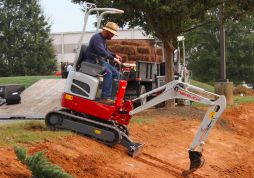
When you’re renting a mini excavator, the first thing to figure out is the size, and two numbers decide it: how deep you have to dig, and the narrowest opening the machine has to get through on the way in. We rent 22 compact excavators. The smallest, the Takeuchi TB210R, is 2 feet 6 inches wide and digs 5 feet 9 inches, and the biggest, the 8 to 10 ton machines, dig 14 feet 10 inches to 15 feet 4 inches. Once you have the size, ask us what’s on the machine you’re getting, and name any attachment you need so it goes out with it. Then get your account or prepayment and the proof of insurance moving the day you reserve, and call Diggers Hotline as soon as you have your start date.
Which size to rent
Start from the job. Drain lines, conduit, irrigation, and fence or deck footings are work for a 1 or 2 ton machine. Water and sewer lines, patios, and walls take a 3 or 4 ton machine. Deeper trenches and site preparation call for 5 to 7 tons, and larger site work and loading trucks put you in the 8 to 10 ton machines. Those are starting points, and two water line jobs can need different machines because one trench is deeper or one way in is narrower, so check the model itself. Its listed dig depth is the most it can reach, and a trench with straight walls comes in shallower, so pick a machine that digs deeper than your trench with room to spare. Its width has to clear the narrowest opening on the way in, with room on each side for the operator to steer. Our guide to mini excavator sizes lists all 22 by weight, dig depth, and width.
What's on the machine
Before the machine goes out, ask which bucket comes with it, whether it has a hydraulic thumb, and which coupler is on it. A thumb closes against the bucket so the machine can pick up a rock, a stump, or a section of pipe and set it down, and a coupler lets you change from the bucket to a breaker without knocking pins out. Name any attachment you need when you reserve, so it goes out with the machine. A breaker or a compactor is matched to the machine’s weight, and our guide to mini excavator attachments shows which one fits each mini excavator we rent.
Getting it to the job site
To tow a mini excavator yourself, add up the machine’s weight, which is in our guide to mini excavator sizes, any extra bucket or attachment going with it, and the trailer’s own weight. That total has to come in under the load rating on the trailer’s plate, and your truck has to be rated to tow it. If you tow for your business, check the license too. The driver needs a Class A CDL when the truck and trailer together have a rating or a weight over 26,000 pounds and the loaded trailer alone has a rating or a weight over 10,000 pounds (49 CFR 383.91). From 4 tons up, the machine alone weighs 7,639 pounds or more, so a trailer carrying one can pass 10,000 pounds once you add the trailer’s own weight. Our article on transporting equipment on trailers covers tie-down angles and weight placement.
If you’d rather not haul it, we deliver and pick up with our own trucks and trailers. Call with the job site address and the dates, and we’ll give you the delivery rate.
Before you dig
Wisconsin law requires a call to Diggers Hotline (811) at least three working days before you dig (Wis. Stat. 182.0175), and working days don’t count Saturdays, Sundays, or legal holidays. Make the call once you know your start date, so the marks are down when the machine arrives. If the digging doesn’t start within 10 days of the date you gave, or stops for more than 10 days, the law requires a second call.
On a lawn
If the machine has to cross a finished lawn or a soft surface, we rent 4 by 8 foot poly mats, a half inch thick and 86 pounds each, that go down under the tracks. They’re listed at a 60 ton capacity.
The terms
Every machine rental covers a set number of hours: 8 in a day, 40 in a week, and 160 in four weeks. The machine goes out with full tanks, and it has to come back the same way, or the fuel and DEF are charged. Before it leaves, we need your account or prepayment and proof of insurance naming us as additional insured and loss payee, so call your insurer the day you reserve. You supply a trained operator. Our guide to how renting works covers the rest of the terms, and our guide to getting ready for a rental covers the walkaround with the driver.
What to tell us when you reserve
Tell us how deep you have to dig, the narrowest opening on the way in, and what you’ll be picking up, so we can set you up with the right size and a thumb if you need one. Name the attachments, give us the dates and the hours you expect to run each day, and tell us whether we’re delivering or you’re towing. With that, we can have the machine ready to go out.
Talk to a location near you
Call or text, or send us the question through our contact page.