





Used Equipment Inspection Checklist
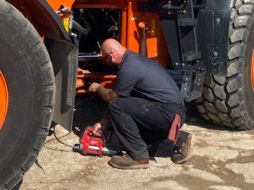
Ask what our technicians found when the machine came through the shop, and get its service record. Walk the machine yourself and look hardest at what costs the most to fix: the undercarriage or the tires, the hydraulics, the engine, the frame, and the play at the pins. Run it. A machine that passes, with its record, is a sound buy. One that fails on something big is a conversation about the price or a different machine.
Before you walk around it
Get the service record first. A machine is worth more when the oil and filter changes were done on schedule and written down, and if it was in our preventive maintenance program, we have the record. Ask what our technicians found when the machine came through the shop. Read the hour meter and compare it with the machine’s age. If the machine has telematics, the history shows its hours, its idle time, and its maintenance alerts, so ask to see it.
The frame
Look for cracks at the boom foot, along the stick welds, on the track frames or the loader arms, and at the bucket’s mounting hinges, because a small crack grows fast. Check the cab posts and the ROPS, the frame that protects you if the machine rolls over. A cracked, bent, or welded-on ROPS is not a price conversation: it comes out of service, and the manufacturer, not a welder, decides whether it can be repaired or has to be replaced.
Undercarriage, tracks, and tires
On a steel track machine, the undercarriage is a significant part of what the machine is worth. The bushing and roller measurements say how much life is left, so ask for them. If there are none, we can take them before you decide. Compare the wear from one side to the other, and look at the sprocket teeth. Rubber tracks show their age in cracks and cord poking through, and tires in cuts and chunking on the tread and the sidewalls. Our guide to undercarriage wear and track tension covers the measurements and what they tell you.
Hydraulics
Look at every cylinder rod for pitting and scoring, because a rough one cuts the seal on every stroke, and a wet film where the rod enters the barrel means oil is already getting past. Check the hoses for cracking, blisters, and leaks, and the fittings for weeping.
Engine and cooling
Start it and watch the exhaust. Heavy black smoke is a sign of a mechanical problem, a bad injector for one. Check the oil. The coolant should be clear, and if it’s cloudy or has particles floating in it, there may be corrosion inside. Look at the radiator and the oil cooler for debris and bent fins, and at the belts. On a Tier 4 machine, ask when the particulate filter was last cleaned, because that’s a service due about every 3,000 hours.
Pins, bushings, and the bucket
Grab the bucket and rock it. Play there means worn pins and bushings, which put more stress on the machine and take control away from the operator. Look at the teeth and the cutting edge: teeth are a quick replacement, and a bucket with holes in the corners is not. On a machine with a coupler, check that the locking mechanism isn’t stiff or bent and that the safety pin is there.
Cab and controls
Try every light, gauge, and switch, the horn, the backup alarm, and the seat belt, and check the monitor for maintenance alerts. Test the glass, the wipers, the heat, and the air conditioning, because you’ll spend the winter in there.
Run it
Drive it forward and in reverse, turn both ways, and listen for anything that doesn’t sound right. On tracks, make sure it runs straight with a full bucket. Then raise the bucket, hold it there with the controls centered, and give it a minute. If the boom or the arms settle, oil is getting past a seal or a valve, and that’s a repair to price before you buy. On an excavator, swing both ways with the bucket loaded and watch for a slow side.
A fluid sample
Engine oil, hydraulic oil, and coolant sent to a lab show the wear metals and contaminants a walkaround can’t. Ask whether the machine has a recent report, and if it doesn’t, pull a sample before you sign. Our guide to preventive maintenance and fluid analysis covers the kit.
The checklist
- Paperwork. What the shop found, the service record, the hour meter against the machine’s age and the telematics history.
- Frame. Boom foot, stick welds, track frames or loader arms, bucket hinges, ROPS and cab posts.
- Undercarriage or tires. The measurements, side-to-side wear, sprocket teeth, cracks and cord, tread and sidewalls.
- Hydraulics. Rods, hoses, fittings.
- Engine. Exhaust at startup, oil and coolant, radiator and cooler fins, belts, when the particulate filter was last cleaned.
- Wear points. Bucket pin play, teeth and edge, coupler lock and safety pin.
- Cab. Lights, gauges, switches, horn, backup alarm, seat belt, maintenance alerts, glass, wipers, heat, air.
- Run it. Both directions, both turns, straight with a full bucket, the bucket held up a minute with the controls centered, swing both ways.
- Fluid sample. A recent report, or pull one.
Talk to a location near you
Call or text, or send us the question through our contact page.