





The 2-Ton Mini Excavator: What It Digs and Where It Fits
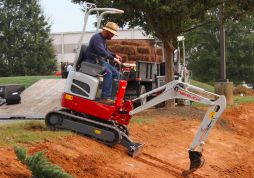
Our two 2-ton machines, the Takeuchi TB216 and the Hitachi/Landcros ZX17U-5N, weigh 3,902 and 3,800 pounds, dig 7 feet 10 inches and 7 feet 2 inches at most, and pull their undercarriage in to just over 3 feet wide. Start with one for drain lines, conduit, irrigation, and footings for a fence or a deck, where the way in is tight and the trench is shallow. For water and sewer lines, our starting point is the 3 and 4 ton machines, with listed dig depths of 8 feet 6 inches to 11 feet 4 inches. We rent both and sell both new.
What it digs
Our rate guide lists the TB216 at 7 feet 10 inches of dig depth and the ZX17U-5N at 7 feet 2 inches. That is the deepest the bucket teeth reach, and a trench with straight walls comes in shallower. For a trench close to 7 feet, the ZX17U-5N leaves almost nothing to spare, and Takeuchi’s spec sheet puts the TB216’s straight wall at 6 feet 9 inches, so a 3 or 4 ton machine is the safer start.
A 2-ton machine sets small pipe, and with a thumb it picks up and places rock, stumps, and brush. Before you lift anything heavy, check the lift chart in the operator’s manual. It gives the weight the machine can lift at each distance from the machine.
Where it fits
Both of our 2-ton machines pull their undercarriage in to get through a narrow opening: the TB216 to 3 feet 3 inches and the ZX17U-5N to 3 feet 2 inches. Measure the narrowest opening on the way in, and leave room on each side for the operator to steer. A 4-foot gate leaves about 4 to 5 inches on each side. A 3-foot gate is too narrow for either one, and the 1-ton Takeuchi TB210R, at 2 feet 6 inches, is the machine in our fleet for that.
Once the machine is through, spread the tracks back out before you dig. With the tracks spread, the machine sits on a wider stance and has better balance while it works.
If the way in passes under a porch roof or a garage door, check the height too. The TB216 is 7 feet 5 inches tall and the ZX17U-5N is 7 feet 9 inches.
TB216 or ZX17U-5N
The two do the same work, and the differences are small. The TB216 digs 8 inches deeper and is 4 inches lower, and their widths with the undercarriage pulled in are within an inch of each other. Ask for the TB216 when you need the extra depth or the way in is low. When the opening is the only tight spot, either one will do.
Getting it to the job site
At 3,800 to 3,902 pounds, a 2-ton machine goes on a trailer behind a pickup rated to tow it. Add up the machine’s weight, any extra bucket going with it, and the trailer’s own weight. That total has to come in under the load rating on the trailer’s plate, and your truck has to be rated to tow it. If you tow for your business, our guide to mini excavator sizes explains when the driver needs a CDL.
If you’d rather not haul it, we’ll deliver it and pick it up: call the location nearest you with the job site address, and we’ll give you the delivery rate.
Attachments for a 2-ton machine
Buckets come in different widths: a narrow one for a trench and a wider one for cleanup. A hydraulic thumb lets the machine pick up and place rock, pipe, and debris. For breaking concrete or compacting a trench, our rate guide lists the Kent FX35 breaker for 3,800 to 7,000 pound excavators and the Kent HP35 plate compactor for 2,500 to 4,000 pound excavators, and both of our 2-ton machines fall in those ranges. Ask for the breaker or the compactor when you reserve, and ask us whether a thumb or a second bucket is available for the machine. Our guide to mini excavator attachments covers the rest.
Rent it or buy it
Renting is the easy way to find out whether a 2-ton machine is big enough for your work, and every rental machine has a rent-to-purchase option. Rentals do not include an operator. Our guide to how renting works covers hours, fuel, insurance, and returns. If you are weighing owning one, our guide to renting, leasing, or buying walks through that choice.
What to tell us when you reserve
Tell us what you are digging and how deep, the narrowest opening and anything overhead on the way in, and the job site address if we are delivering. That lets us say whether a 2-ton machine is right, and which one.
Before you dig
Wisconsin law requires a call to Diggers Hotline (811) at least three working days before you dig (Wis. Stat. 182.0175). Check the machine every day before you start. Our daily checklist covers the walkaround: the hydraulic oil level and any leaks, grease on the joints, wear on the bucket teeth, and damage to the tracks.
Talk to a location near you
Call or text, or send us the question through our contact page.