





Excavator Sizes and How Deep Each One Digs
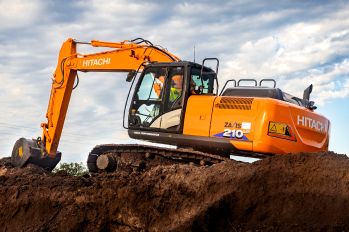
For water and sewer services and laterals, start with a compact excavator when one digs deep enough; ours dig up to 15 feet 4 inches. For basements, and for services and laterals deeper than that, start with our 30,000 to 41,000 pound excavators. Water and sewer mains start on full-size machines at 50,000 to 60,000 pounds, and for mass excavation, deep utility work, and loading trucks all day, go bigger. Then check the individual model, because dig depth comes from the boom and arm, not the weight, and the machine has to dig deeper than your deepest cut. Width and weight decide how it travels: in Wisconsin, a load wider than 8 feet 6 inches or heavier than 80,000 pounds gross typically needs a permit. Our full-size rental excavators, from Hitachi/Landcros and Link-Belt, run from 30,203 to 152,780 pounds.
Which size to start with
Our rental excavators under 30,000 pounds are the compact machines, 1 to 10 tons. For services and laterals, start with one of them if it digs deep enough, and our guide to mini excavator sizes matches them to the job. For basements, mains, and bigger jobs, use this table to pick a weight group, then compare your deepest cut and your job site with the models in that group. The depths in the table are the most our machines in each group dig, not how deep those jobs have to go.
| Work you are planning | Sizes to start with | Listed dig depths in that group |
|---|---|---|
| Basements, and services and laterals deeper than a compact machine digs | 30,000 to 41,000 pounds | 19′ 7″ to 21′ 4″ |
| Water and sewer mains | 50,000 to 60,000 pounds | 21′ 9″ to 25′ 0″ |
| Mass excavation, deep utility work, and loading trucks all day | 67,000 to 84,000 pounds | 23′ 4″ to 26′ 10″ |
| Large earthmoving and quarry work | 109,000 to 153,000 pounds | 27′ 2″ to 30′ 1″ |
| Dredging and slope work | The 250X4 Long Front, 63,600 pounds | 47′ 9″ |
These are starting points. Two sewer jobs can need different machines, because one cut is deeper, one job site is tighter, or one job loads trucks all day.
The boom and arm set the depth
How deep an excavator digs comes from the length of its boom and arm, not from its weight. Our fleet shows it. The 59,525-pound Hitachi/Landcros ZX250LC-6/7H digs 25 feet, deeper than the 67,700-pound Link-Belt 300X4S at 23 feet 4 inches. The Link-Belt 250X4 Long Front digs 47 feet 9 inches, more than twice the 250X4’s 22 feet 8 inches, because its boom and arm are far longer.
The arm changes the depth on the same machine, too. Link-Belt’s spec sheet for the 355X4S lists 21 feet 1 inch of maximum dig depth with its 8-foot 8-inch arm and 24 feet 5 inches with its 12-foot arm. Our rate guide lists the 355X4S at 24 feet 5 inches, the long-arm figure. When the depth is tight, ask which arm is on the machine you would get.
Leave depth to spare. The listed dig depth is the most the machine can reach, and a trench with straight walls comes in shallower. With the 12-foot arm, Link-Belt lists the 355X4S at 24 feet 5 inches of maximum dig depth, but 21 feet 8 inches for a straight vertical wall. So avoid a machine whose listed depth barely reaches the depth you need. For a 20-foot cut, a machine listed at 21 feet 4 inches may come up short.
Minimum tail swing for tight job sites
When an excavator’s upper part turns, the counterweight on the back swings out past the side of the tracks. On a minimum tail swing model it stays much closer to the tracks, which matters beside a building, a wall, or a lane of traffic.
Six of our full-size rental excavators are minimum tail swing models: the Link-Belt 145X4S, 245X4, and 355X4S, and the Hitachi/Landcros ZX135US-7H, ZX245USLC-7H, and ZX345USLC-7H.
Minimum does not mean zero. Link-Belt lists the 355X4S’s tail swing radius as 6 feet 6 inches, and the machine is 11 feet 2 inches wide, so its counterweight still swings about 11 inches past the side of the tracks. Check the tail swing radius on the machine’s spec sheet before you set the cones.
Every full-size excavator in our rental fleet
These are the 21 full-size excavators in our 2026 rental rate guide, lightest first. Track shoe width changes a machine’s overall width, so check the width of the machine you get.
| Model | Weight (pounds) | Dig depth | Reach | Width |
|---|---|---|---|---|
| Hitachi/Landcros ZX130-7H | 30,203 | 19′ 9″ | 28′ 9″ | 8′ 6″ |
| Link-Belt 145X4S (minimum tail swing) | 33,900 | 19′ 9″ | 28′ 8″ | 8′ 6″ |
| Hitachi/Landcros ZX135US-7H (minimum tail swing) | 34,390 | 19′ 7″ | 29′ 1″ | 8′ 6″ |
| Hitachi/Landcros ZX160LC-7H | 39,578 | 21′ 4″ | 30′ 7″ | 8′ 6″ |
| Link-Belt 170X4S | 40,380 | 21′ 4″ | 30′ 9″ | 8′ 6″ |
| Link-Belt 220X4S | 50,300 | 21′ 10″ | 32′ 6″ | 10′ 6″ |
| Hitachi/Landcros ZX210LC-7H | 50,927 | 21′ 10″ | 32′ 6″ | 10′ 6″ |
| Link-Belt 245X4 (minimum tail swing) | 56,900 | 21′ 10″ | 32′ 4″ | 10′ 6″ |
| Link-Belt 250X4 | 56,900 | 22′ 8″ | 33′ 9″ | 11′ 1″ |
| Hitachi/Landcros ZX245USLC-7H (minimum tail swing) | 58,200 | 21′ 9″ | 33′ 2″ | 10′ 6″ |
| Hitachi/Landcros ZX250LC-6/7H | 59,525 | 25′ 0″ | 35′ 9″ | 11′ 1″ |
| Link-Belt 250X4 Long Front | 63,600 | 47′ 9″ | 60′ 1″ | 11′ 1″ |
| Link-Belt 300X4S | 67,700 | 23′ 4″ | 35′ 0″ | 11′ 2″ |
| Hitachi/Landcros ZX300LC-7H | 69,005 | 25′ 10″ | 37′ 0″ | 11′ 1″ |
| Link-Belt 355X4S (minimum tail swing) | 78,700 | 24′ 5″ | 36′ 11″ | 11′ 2″ |
| Hitachi/Landcros ZX345USLC-7H (minimum tail swing) | 79,366 | 24′ 10″ | 37′ 7″ | 11′ 1″ |
| Hitachi/Landcros ZX350LC-7H | 80,248 | 26′ 10″ | 38′ 11″ | 11′ 1″ |
| Link-Belt 370X4S | 83,776 | 26′ 9″ | 39′ 1″ | 11′ 2″ |
| Link-Belt 490X4 | 109,800 | 27′ 4″ | 41′ 1″ | 12′ 0″ |
| Hitachi/Landcros ZX490LC-7H | 110,672 | 27′ 2″ | 41′ 0″ | 12′ 5″ |
| Hitachi/Landcros ZX690LC-7H | 152,780 | 30′ 1″ | 45′ 6″ | 13′ 9″ |
Getting it to the job site
Width and weight decide how a full-size machine travels. Under Wisconsin law, a load typically needs a permit when it is wider than 8 feet 6 inches, taller than 13 feet 6 inches, or heavier than 80,000 pounds gross. The Wisconsin Department of Transportation (WisDOT) issues those permits for state highways, and local highway authorities issue them for their own roads.
Our machines up to about 40,000 pounds are listed at 8 feet 6 inches wide, exactly the legal limit. Wider track shoes make a machine wider, so one of these with wider shoes would need a permit too. From the 50,000-pound machines up, they are 10 feet 6 inches to 13 feet 9 inches wide, so every one of them travels on an oversize permit.
Weight counts the truck, the trailer, and the machine together, and each axle has its own limit as well. Some county, town, and city roads are designated class B highways, where the weight limits are 60 percent of the standard limits. On the biggest machines, check the loaded height on the trailer against 13 feet 6 inches too.
If you are hauling it yourself, those are the limits to plan around. If you’d rather not haul it, we’ll deliver it and pick it up: call the location nearest you with the job site address and the dates, and we’ll give you the delivery rate.
What to tell us when you reserve
When you reserve, let us know the depth of the deepest cut, how far the bucket has to reach, whether the machine will work beside a building, a wall, or traffic, whether it will load trucks, and whether you are hauling it yourself. Those details say far more than a weight class, and they let us match the model to the job.
We rent breakers, plate compactors, and grapple buckets for most of these machines, and our guide to excavator attachments matches each one to the machine. Rentals do not include an operator, and every rental machine has a rent-to-purchase option. We also sell Hitachi/Landcros full-size excavators up to 189,157 pounds and Link-Belt X4 excavators up to 158,300 pounds, larger than anything in the rental fleet.
Talk to a location near you
Call or text, or send us the question through our contact page.