




Job Site Rentals: Trench Boxes, Compactors, Stone Boxes, Road Plates, Poly Mats, and Lasers
We rent more than machines. Trench boxes with their spreaders, vibratory compactors in four sizes, stone boxes, road plates, poly mats, and Spectra lasers all rent by the day, the week, or four weeks. The trench box is the one to size with care, and which box is rated for your trench comes down to how deep the trench goes and what the soil is. Every box we rent is listed with the depth it’s rated for in type C soil, the weakest soil class in OSHA’s excavation standard, and the ratings run from 11 to 29 feet. The compactors come with a smooth drum for sand and gravel or a pad drum for clay, and the lasers set grade across a site or down a pipe.
Trench boxes
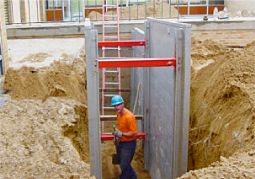
A trench box is a shield. It’s built to take the force of a cave-in and protect the crew working inside it. OSHA’s excavation standard allows three ways to protect a crew in a trench: slope or bench the walls back, shore them so they can’t move, or put the crew inside a shield. The standard requires one of the three in any trench 5 feet or deeper, unless it’s dug entirely in stable rock, and in a shallower one unless a competent person has looked at the ground and found no sign of a cave-in (29 CFR 1926.652).
The depth a box is rated for depends on the soil. Type C is the weakest soil class in the standard: gravel, sand, and loamy sand, soil with water seeping into the trench, and soft clay. A competent person on your crew classifies the soil, and if it’s type C, the rating in the table is the number to plan on. The box’s tabulated data, the manufacturer’s rating sheet, gives the depth for each soil type, and OSHA requires that sheet, in writing, on the job site while the box goes in, so ask for it when you reserve. Two more rules from the standard: nobody is in the box while it’s being set, lifted, or pulled, and the trench can go at most 2 feet below the bottom of the box, and even that only if the box is rated for the full depth of the trench and no soil is coming in from behind or under it.
| Box | Rated depth in type C soil | Weight (pounds) |
|---|---|---|
| 6′ x 6′ x 3″ single wall | 16′ | 1,520 |
| 6′ x 6′ aluminum double wall | 21′ | 710 |
| 8′ x 8′ x 3″ single wall | 14′ | 2,220 |
| 8′ x 8′ x 3″ double wall | 29′ | 2,820 |
| 8′ x 8′ aluminum double wall | 16′ | 1,160 |
| 8′ x 10′ x 3″ single wall | 11′ | 3,000 |
| 8′ x 10′ x 3″ double wall | 22′ | 3,450 |
| 8′ x 10′ aluminum double wall | 13′ | 1,360 |
| 8′ x 12′ x 3″ double wall | 18′ | 4,030 |
| 8′ x 12′ aluminum double wall | 11′ | 1,610 |
| 4′ x 16′ x 4″ double wall | 24′ | 4,510 |
| 8′ x 16′ x 4″ double wall | 19′ | 6,030 |
| 4′ x 20′ x 4″ double wall | 19′ | 5,290 |
| 8′ x 20′ x 4″ double wall | 19′ | 8,570 |
| 8′ x 24′ x 6″ double wall | 18′ | 11,500 |
In the box names, the first number is the panel height, the second is its length, and the inches are the wall thickness. The weights don’t include the spreaders, which come in widths from 24 inches to over 120 so the box can be set to the trench width. The weight matters because your excavator has to lift the box with its spreaders on. The four aluminum boxes weigh 710 to 1,610 pounds and the other eleven run from 1,520 to 11,500, so check the one you pick against what the excavator on the job can lift. If you give us advance notice, we’ll assemble the box before it goes out, and there’s a charge for that.
Vibratory compactors
For packing a road base, a building pad, or a lift of fill, we rent vibratory compactors in four sizes, and each size comes with a smooth drum or a pad drum. The smooth drum is for sand and gravel, the soils under a road bed or a foundation. The pad drum is for clay and silt, which need the pads to knead the soil as the drum rolls over it. The bigger the machine, the thicker the lift it can pack.
| Model | Drum width | Weight, smooth drum (pounds) | Weight, pad drum (pounds) |
|---|---|---|---|
| Volvo SD25 | 4′ 1″ | 6,000 | 6,500 |
| Volvo SD45 | 5′ 3″ | 10,600 | 11,350 |
| Volvo SD75 | 6′ 2″ | 15,750 | 17,780 |
| Volvo SD115 | 7′ 6″ | 23,600 | 25,280 |
Breakers and compactors for an excavator
Kent breakers and excavator-mounted compactors rent too, each listed by the weight of the excavator that carries it. Our guide to hydraulic breaker sizing has every model and range, with the rental excavators that fit each one.
Stone boxes, road plates, and poly mats
- Stone boxes. A stone box holds the bedding stone beside the trench, so the excavator can scoop it out as the pipe goes in. We rent them in 7, 9, and 12 cubic yards.
- Road plates. A road plate covers an open trench so traffic can cross it. We rent 1 inch plates in six sizes, from 4 by 8 feet to 8 by 20 feet, weighing 1,310 to 6,535 pounds. Set the plate so it bears on solid ground on both sides of the trench, secure it so it can’t slide, and ramp the edges so tires don’t catch them. The road’s owner sets the rules for how it’s secured and how long it can stay, so check before traffic crosses it.
- Poly mats. A poly mat goes down under a machine to protect a lawn or a soft surface. Each one is 4 by 8 feet, a half inch thick, and 86 pounds, and the mats are listed at a 60 ton capacity.
Lasers
Spectra makes every laser we rent. A laser level spins a level beam around the whole site, so you can check grade anywhere a receiver can pick it up, and the three we rent, the LL300N-8, LL500, and LL300S, have ranges of 1,000, 1,600, and 2,600 feet. A grade laser tilts that beam to the slope you set, in one direction on the GL412N single grade laser and two on the GL1425C dual grade laser, both with a 2,600 foot range, so a crew can run a ditch or a parking lot to grade. The DG613G pipe laser sits in the pipe and holds line and grade for 500 feet. A machine mounted receiver rents too, so the operator reads the grade from the seat.
Renting
Payment, insurance, and returns work the same as for a machine, and we deliver and pick up with our own trucks and trailers. Our guide to how renting works has the details.
What to tell us when you reserve
For a trench box, tell us the trench depth, the trench width, and the soil type. A compactor goes out matched to the material and the lift thickness, so tell us those. For a road plate we need the trench width and the road it’s on, and for a laser, what you’re setting to grade. With that, we can have the right one ready to go out.
Talk to a location near you
Call or text, or send us the question through our contact page.