





Wheel Loaders for Snow Removal: How to Choose the Right Machine
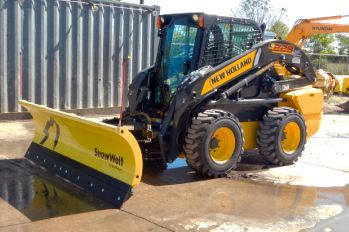
When you’re choosing a machine for snow removal, the first thing to figure out is how much pavement you have to clear and how far the snow has to travel before you can pile it. A wider pusher clears more with every pass, and the bigger the machine, the wider the pusher it can carry. SnowWolf builds 8 and 10 foot pushers for skid steers and 12 to 16 foot pushers for wheel loaders. So a wheel loader is the machine for a big parking lot or a long run, and a skid steer is the machine for a small one, where it’s easier to work around dumpsters, islands, and parked cars, because it turns in a much tighter space than a loader does. A track loader is best on gravel or soft ground, where its tracks get their grip. Whichever machine you run, get it ready before the first storm, not after.
Which machine for the job
A wheel loader is the machine for a big commercial parking lot or anywhere with long runs. It carries the widest pushers, and it covers a long run quickly: the spec sheets put even the compact ZW30-5B at 9.3 mph and the ZW50-5B at 10.6.
A skid steer is the machine for a small parking lot, a drive lane, and the corners around dumpsters and islands. It skids its tires to turn, so it gets around in a space a loader can’t, and SnowWolf builds its 8 and 10 foot pushers for it. Our three, the New Holland L320, L328, and L334, weigh 6,470 to 9,100 pounds.
A track loader is the machine for gravel or anywhere the ground under the snow is soft, because that’s where its tracks get their grip. On plowed pavement, rubber tracks tend to slip on snow and ice, and spinning them on concrete wears the rubber, so that’s the work for the other two.
The loader
Our compact Hitachi/Landcros loaders, the ZW30-5B at 7,310 pounds through the ZW120-7 at 18,590, are the ones for drive lanes and parking lots with tight corners. The ZW30-5B is 5 feet 2 inches wide, and the ZW120-7 is 8 feet 1 inch. Our medium loaders, the ZW150PL-6 through the ZW220-7, weigh 27,029 to 41,035 pounds, and that’s the size we’d start with for a big parking lot and a wide pusher. Our guide to wheel loader sizes lists all fourteen rental loaders with their widths and weights.
If you’ll be using a bucket instead of a pusher, a light material bucket holds more snow per pass than a general purpose bucket on the same loader.
The plow, pusher, or blower
We carry SnowWolf’s line: wing plows, angle plows, pushers, and blowers. For an open parking lot, use a pusher. It moves snow in a straight line and piles it at the end of the run. For a drive lane or a road, use an angle plow. It turns the snow off to one side as you drive, so you clear the lane without carrying the snow in front of you. A wing plow does both jobs: its wings swing out to push and contain the snow, and fold in to angle it. A blower throws the snow instead of pushing it, for a pile that has nowhere left to go.
The attachment has to match the machine’s weight, hydraulics, and mount, and SnowWolf builds each plow and pusher for a machine size, from skid steers up to the big loaders. Tell us the loader and what you’re clearing, and we’ll match the SnowWolf to it.
Ready for winter
The cold start is the same for any machine that works in January. Our Best Practices article on winterizing a machine and our article on cold weather operation cover the fuel, the coolant, the block heater, and the batteries, and our guide to DEF and Tier 4 engines in a Wisconsin winter covers the exhaust system. For a loader that plows at night, add these.
- Tire pressure. Check it weekly through the winter, before you start the machine or three hours after you shut it down, and check it where the machine works, not in a warm shop. A 10 degree drop in air temperature takes about 1 psi out of a tire.
- Cab heat. Check or replace the cab air filter so the heater works, and make sure snow and ice aren’t blocking the vents. A fogged windshield at 3 a.m. stops the job.
- Batteries. In the cold, a battery has to put out nearly twice the cranking amps to turn the engine over, so keep it charged and the connections clean.
- Warm-up. Let the engine come up to operating temperature before you load the hydraulics, because hoses and wires go brittle in extreme cold.
- Getting in and out. Use three points of contact every time you climb on or off. Slips and falls on snow and ice are a common winter injury on a job site, and the seatbelt stays on in the cab.
Talk to a location near you
Call or text, or send us the question through our contact page.