





DEF and Tier 4 Engines in a Wisconsin Winter: How to Keep the Machine Running
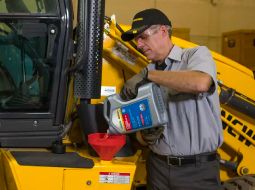
Three things stop a Tier 4 engine in a Wisconsin winter: diesel that has gelled, DEF that won’t pour, and a particulate filter that missed its regen cycles. Switch to a winter blend when overnight lows get near 30 degrees, before the fuel clouds. If the machine has a DEF tank, keep this week’s DEF where it will pour, keep diesel out of the tank, and plan the DEF fill with the fuel, because an empty tank stops the machine. When the machine asks for a regen, let it run.
Fuel: switch before it clouds
Diesel holds wax, and in the cold the wax turns to crystals. No. 2 diesel clouds at about 14 degrees, and the crystals plug the fuel filter, so the engine starts hard, hesitates, or quits. Switch 15 degrees above the cloud point: when overnight lows dip near 30, blend in No. 1 diesel with a winter additive, or use an anti-gel. Every 10 percent of No. 1 drops the cloud point 3 degrees. Blend before the cold arrives, because once crystals form, they stay in the filter after the fuel warms up. A machine that ran on a cold Friday can leave you stranded on a warm Monday. Keep a spare set of fuel filters in the cab. Our article on winter diesel has the blending steps.
DEF: keep it where it will pour
Not every Tier 4 machine uses DEF. Manufacturers put DEF systems on engines over 75 horsepower, so many compact machines have no DEF tank at all. If yours has the blue cap, this is for you.
DEF freezes at around 10 degrees. Freezing doesn’t hurt it, and the machine’s DEF tank is heated to thaw it, so the problem is the jug in the shed that won’t pour on a January morning. Keep what you’ll use this week where it stays liquid, and store the rest between 32 and 86 degrees, out of the sun, in plastic or stainless steel, because DEF can corrode other metals. Most machines have a DEF gauge. Under 10 percent the warnings start, and under 5 percent the engine cuts back its power, leaving enough to move the machine to where you can fill it. An empty tank stops it. Plan on a DEF fill about once for every three or four diesel fills. The DEF filler won’t take a diesel nozzle, so diesel gets into a DEF tank one way: somebody pours it from a jug through a funnel. Keep a DEF funnel that never touches diesel, and if diesel does go in, don’t start the engine. Call us. Low quality DEF damages the injection system too, so buy it sealed from a source you trust. Our article on diesel exhaust fluid covers storage and filling.
The particulate filter: let it regen
The diesel particulate filter traps soot until it’s full, then burns it off in a regeneration cycle at over 1,000 degrees. Some machines regen on their own while they work, and others ask for a stationary regen. When yours asks, park somewhere safe, idle down, lift the safety bar, let the coolant reach 65 degrees Celsius (about 150 degrees Fahrenheit), and hold the regen switch until the engine idles up. The steps differ by machine, so check your operator’s manual. Ignoring the alert plugs the filter. A machine that idles or runs light most of the day can run too cool to regen, so it asks more often and clogs sooner. Give it a stretch of real work, or run the stationary regen when it asks. Regen leaves ash behind that only a professional cleaning takes out, about every 3,000 hours, and blowing the filter out with an air hose is illegal. The DEF filter changes on about the same interval, and your manual has the number for your machine. Our article on exhaust aftertreatment has the regen steps.
Oil, coolant, and the cold start
Use the engine oil your manual lists for an engine with aftertreatment, and use it across the whole fleet so nobody grabs the wrong jug. Have the cooling system serviced before the cold, with the coolant mixed for Wisconsin temperatures, since frozen coolant cracks the block. Check the block heater and the glow plugs, and keep the batteries charged and warm: a cold engine takes nearly twice the cranking amps to turn over. Let the engine reach operating temperature before the machine goes to work, because cold hoses and wires are brittle. Our article on cold weather operation and our winterization tips have the full list.
When to call
Call when a regen alert won’t clear, when the engine cuts back its power, or when a DEF warning stays on after a fill. If diesel went into the DEF tank, call before anything else. Our technicians service aftertreatment systems at your job site or in our shops, on any make and model.
Talk to a location near you
Call or text, or send us the question through our contact page.