




Compact Wheel Loader or Track Loader: How to Choose
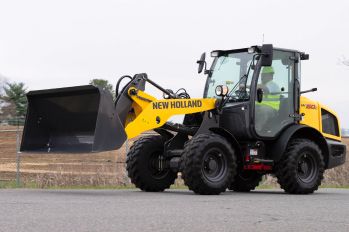
When you’re choosing between a compact wheel loader and a track loader, the first thing to figure out is what the machine will be driving on. On soft ground, go with the track loader. Its tracks spread its weight, so it stays on top of mud and keeps its grip on a slope. On pavement and packed gravel, both machines work, so the next thing to figure out is what the machine will be doing all day. If it’s loading trucks from a pile, go with the wheel loader. It’s built for that work and moves faster between the pile and the truck, so it loads more trucks in a shift. If the work changes through the day, from grading to post holes to clearing brush, go with the track loader, because it runs the attachments for those jobs. We rent five Hitachi/Landcros compact wheel loaders and nine track loaders, and if you’re buying, we also carry New Holland compact wheel loaders.
What the wheel loader does better
A compact wheel loader is a loader first. Our five, the Hitachi/Landcros ZW30-5B to the ZW120-7, carry buckets from half a cubic yard to 2 cubic yards, and the biggest of them, the ZW120-7, weighs 18,590 pounds. It steers by bending in the middle, so the tires roll through a turn instead of skidding, and it’s quicker on the run between the pile and the truck: the spec sheets put the ZW30-5B at 9.3 mph and the ZW50-5B at 10.6, while our largest Takeuchi track loader, the TL12V2, tops out at 7.3. Over a shift of loading, that adds up.
What the track loader does better
A track loader rides on two long rubber tracks that spread its weight over a big footprint, so it puts less pressure on the ground than tires do and stays on top of mud, wet sites, and fresh topsoil. It also carries the attachments. Our rental list for skid steers and track loaders has augers, breakers, brooms, brush cutters, grapples, rakes, and trenchers. Our wheel loaders rent with a bucket, and forks for the ones with 2 to 4 cubic yard buckets.
Our nine track loaders, from Takeuchi and New Holland, have capacities from 1,841 to 4,107 pounds. Our guide to skid steer and track loader sizes lists them all.
Which one for the job
Start with the wheel loader for loading trucks on pavement or a gravel pad and for moving sand, stone, and gravel all day. Start with the track loader on soft ground and on a site that’s still being built. The track loader is also the one for a day that changes from grading to post holes to clearing brush, because it runs the attachments.
A lot of jobs use both. The wheel loader works the pad and the track loader works the dirt. For snow removal, our guide to wheel loaders for snow removal compares the wheel loader, the skid steer, and the track loader.
Size and weight
The ZW30-5B is 5 feet 2 inches wide and weighs 7,310 pounds, close to our smallest track loaders. The ZW120-7 is 8 feet 1 inch wide and 18,590 pounds, which is more than any track loader we rent. New Holland’s compact wheel loaders, which we sell new, weigh 10,913 to 13,668 pounds. Our guide to wheel loader sizes lists every rental loader’s bucket, width, and weight. The trailer and license checks in our guide to skid steer and track loader sizes work the same for either machine.
Renting and buying
Every rental machine has a rent-to-purchase option, so you can run the one you’re leaning toward on your own ground before you buy. Rentals don’t include an operator. Our guide to how renting works covers hours, fuel, insurance, and returns.
If you’re buying, we carry compact wheel loaders from Hitachi/Landcros and New Holland, and track loaders from Takeuchi and New Holland, at all three of our locations.
What to tell us
Tell us what the machine will be driving on, whether it’s loading trucks all day or switching between jobs, what you’ll be loading and into what, and the attachments you need. With that, we can tell you which machine to start with and which size.
Talk to a location near you
Call or text, or send us the question through our contact page.