




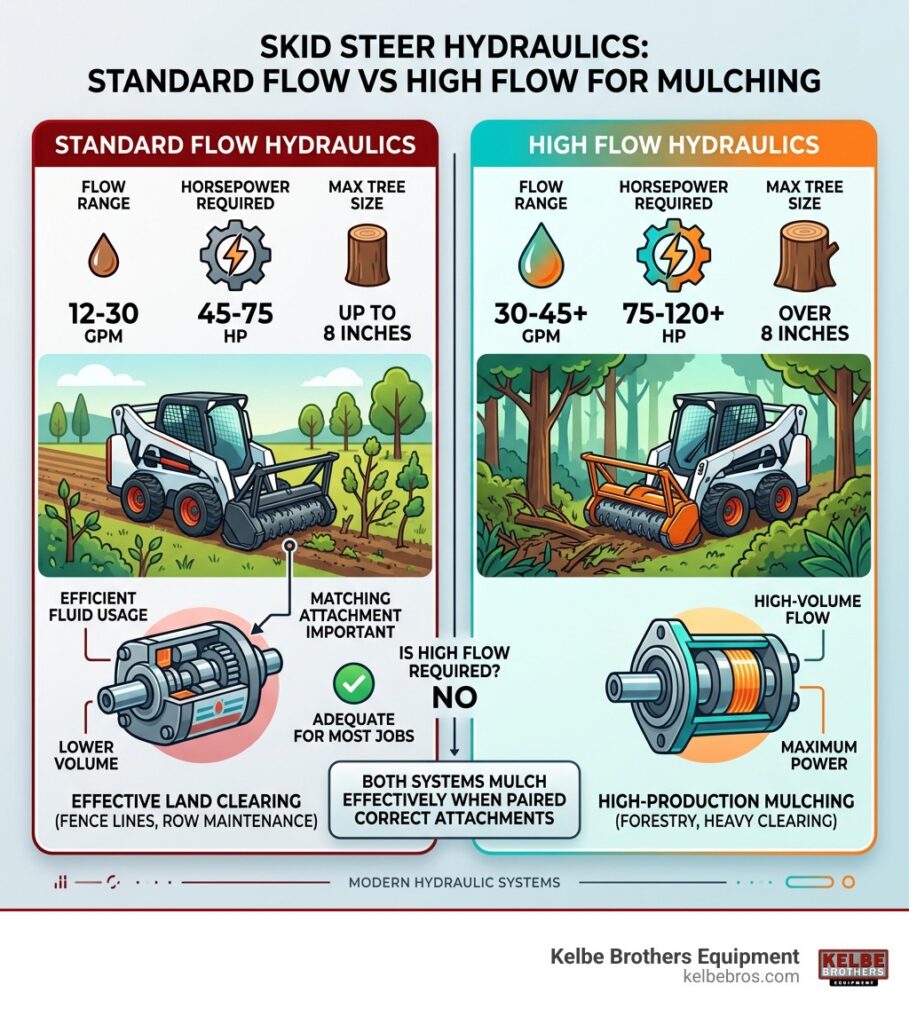
A low flow mulcher for skid steer lets you tackle serious land clearing — brush, saplings, and trees up to 8 inches thick — using a standard hydraulic machine. No high flow upgrade required.
Here are typical performance specs for low flow mulcher options compatible with standard machines:
| Mulcher Configuration | Flow Range | HP Required | Cut Width | Max Tree Size |
| High-Torque Model | 16-30 GPM | 55-75 HP | 50″ | 6-8 in |
| Standard-Duty Model | 14-27 GPM | ~66 HP | 50″ | 8 in |
| Compact-Width Model | 12-25 GPM | 45+ HP | 48″ | 6-8 in |
| Wide-Path Model | 17-25 GPM | 40-60 HP | 51″ | 6 in+ |
The short answer: If your machine produces 12-30 GPM and 45+ HP, a low flow mulcher can handle most land clearing jobs — fence lines, fire mitigation, ROW maintenance, and invasive species control — without upgrading your machine.
Most operators assume forestry mulching requires a high flow machine. That assumption costs them time and money.
The reality is different. Standard flow machines — putting out as little as 16 GPM — can run purpose-built drum mulchers that process thick brush and small trees into fine mulch. This is possible because of the hydraulic efficiency built into modern attachments. One operator cleared a dense five-acre lot packed with 2-3 inch saplings and 8-inch pines using nothing more than a 66 HP New Holland Skid Steer Loaders machine running 16.9 GPM. The key was matching the right low flow mulcher to the machine.
This guide covers exactly how to do that — including which mulchers work, which machines pair well, and what to expect in the field.
Understanding the Low Flow Mulcher for Skid Steer
When we talk about a low flow mulcher for skid steer use, we are referring to an attachment specifically engineered to thrive within the standard hydraulic constraints of most mid-sized construction machines. While high-flow systems are the “muscle cars” of the mulching world, low-flow units are the “high-efficiency diesels” — they get the job done by maximizing every drop of hydraulic fluid.
Typically, these attachments operate within a 16-30 GPM (gallons per minute) range. To run them effectively, you generally need a machine in the 50-75 HP class. Because these units don’t have the raw volume of oil that high-flow models enjoy, they rely on advanced engineering — like high-torque piston motors and specifically designed rotors — to maintain the momentum needed to shred through wood.
Understanding your machine’s equipment attachments is the first step toward successful land management. By choosing a low-flow head, you can transform a standard utility machine into a land-clearing powerhouse. For many of our customers in Wisconsin, why a forestry mulcher for your skid steer is a game changer for land clearing comes down to the ability to bid on brush management jobs without the massive overhead of a dedicated high-flow carrier.
Defining Low Flow vs. High Flow Requirements
The technical line between “low flow” (often called standard flow) and “high flow” is usually drawn at the 25-30 GPM mark.
- Low Flow (Standard): Typically ranges from 12 to 25 GPM. These systems are standard on machines like the New Holland Skid Steer Loaders or Takeuchi Compact Track Loaders.
- High Flow: Ranges from 26 to 45+ GPM. These require specialized hydraulic pumps and cooling packages to handle the heat and volume.
Standard flow mulchers use auxiliary hydraulics to power the motor. The key statistic to watch isn’t just GPM, but also the hydraulic pressure (PSI). A well-tuned low-flow system running at 3,000 to 3,500 PSI can produce surprising torque.
| Feature | Standard (Low) Flow | High Flow |
| GPM Range | 12 – 25 GPM | 26 – 45+ GPM |
| Typical HP | 45 – 75 HP | 75 – 120+ HP |
| Max Tree Diameter | 4 – 8 Inches | 10 – 15+ Inches |
| Weight | 1,300 – 1,800 lbs | 2,500 – 3,500 lbs |
Why Choose a Low Flow Mulcher for Skid Steer Projects?
Versatility is the primary reason we see local contractors opting for low-flow setups. If you already own a New Holland Skid Steer Loader or a Takeuchi Compact Track Loader, adding a low flow mulcher for skid steer allows you to expand your services without buying a new machine.
Furthermore, low-flow units offer:
- Fuel Economy: Running a 60 HP machine costs significantly less in fuel than a 110 HP high-flow machine.
- Reduced Weight: These attachments are lighter, which means less ground disturbance and easier transport on standard trailers.
- Lower Carrier Stress: High-flow mulching is notoriously hard on a machine’s cooling system and drive pumps. Low-flow mulching, when done correctly, keeps temperatures manageable.
When finding the right skid loader dealers for your equipment needs, it’s important to look for a partner who understands these hydraulic nuances so you don’t over-tax your equipment.
Key Features of Standard Flow Mulching Heads
To make up for the lower oil volume, manufacturers have to get creative with the mechanics. The heart of a low flow mulcher for skid steer is the motor. Many high-quality units use two-speed or variable displacement piston motors. These motors automatically adjust to the load; when the rotor hits a tough log, the motor shifts to provide more torque at a lower speed to keep the drum spinning.
Other critical features include:
- Drive Belt Systems: These act as a shock absorber between the motor and the rotor, protecting your hydraulic system from sudden stops.
- Adjustable Push Bars: These help “tuck” the tree into the rotor, allowing the teeth to get a better bite while keeping the center of gravity close to the machine.
Rotor Design and Tooth Options for a Low Flow Mulcher for Skid Steer
The rotor is where the work happens. In low-flow applications, “bite limiter” or “depth control” rotors are essential. These designs feature rings or gauges on the drum that prevent the teeth from grabbing too much wood at once. This prevents the rotor from stalling, which is a common frustration when using standard flow hydraulics.
Tooth choice is equally important:
- Carbide Hammers: These are the “tank” of teeth. They are incredibly durable and can handle hitting rocks or dirt without breaking. They grind the wood down through blunt force.
- Chisel Teeth: These act more like a chainsaw or an axe. They are sharper and cut through wood faster, but they require more maintenance and are easily damaged by rocks.
- Planer Knives: Found on some advanced rotors, these slice through material for a very fine mulch finish.
Performance Capabilities in Dense Vegetation
Don’t let the “low flow” label fool you. A properly configured unit can handle trees between 4 and 8 inches in diameter. In Wisconsin, this is perfect for clearing invasive buckthorn, honeysuckle, and small cedar or pine saplings.
While you won’t be taking down 20-inch oaks, these machines excel at undergrowth management and land reclamation. Keeping up with attachment maintenance best practices ensures that your teeth stay sharp and your belts stay tight, which is critical when you’re pushing a standard flow machine to its limits.
Matching Your Machine: New Holland and Takeuchi Compatibility
We specialize in New Holland and Takeuchi equipment because they offer some of the most robust hydraulic systems in the industry.
The New Holland Skid Steer Loaders features a long wheelbase and great stability, making them excellent platforms for front-heavy mulching attachments. Their cooling packages are designed to handle the continuous work cycles of brush cutting.
Takeuchi Compact Track Loaders are the gold standard for traction and pushing power. When you’re mulching in the soft, muddy terrain often found in Wisconsin, the high-flotation tracks of a Takeuchi keep you moving where a wheeled machine might bog down.
If you aren’t ready to commit to a purchase, finding the right skid steer rental in Eau Claire allows you to test these pairings on your specific job site.
Optimizing a Low Flow Mulcher for Skid Steer Performance
To get the most out of your setup, you must ensure your machine is properly configured.
- Case Drain Requirements: Most forestry mulchers, even low-flow ones, require a “case drain” line. This is a third hydraulic line that relieves back pressure from the motor. Without it, you will blow the seals on your mulcher motor almost instantly.
- Hydraulic Pressure: Ensure your machine is hitting its rated PSI. Even a small drop in pressure can lead to a significant loss in mulching torque.
- Operating Weight: Mulchers are heavy. Ensure your New Holland Skid Steer Loaders has the rated operating capacity (ROC) to safely lift and maneuver the head, especially when the arms are extended.
Don’t forget that your carrier needs love too. Following skid steer tire and track maintenance tips will keep your machine stable and productive throughout the clearing season.
Safety and Operator Protection
Mulching is inherently dangerous. You are essentially standing behind a giant, spinning drum of knives that is throwing debris at high speeds.
Standard glass windshields are not sufficient. We strongly recommend a 1/2″ polycarbonate windshield for any machine running a mulcher. Polycarbonate is impact-resistant and won’t shatter like glass when a chunk of wood flies back at the cab.
Additional safety features to look for include:
- Rear Chain Guards: These hang behind the mulcher to catch flying debris.
- Hydraulic Front Hoods: These can be closed to trap material inside the chamber for finer mulching or opened to attack standing trees.
- Serrated Steps: For safe entry and exit from the cab in muddy conditions.
Real-World Applications and Productivity
In the field, a low flow mulcher for skid steer is a surgical tool. While a high-flow machine is a sledgehammer, the low-flow unit allows for precision clearing.
Common applications in Wisconsin include:
- Fire Mitigation: Creating “defensible space” around homes by thinning out ladder fuels and brush.
- Fence Line Clearing: Farmers use these to clear overhanging branches and thickets that snag tractors and combines.
- ROW Maintenance: Keeping utility paths and roadsides clear of encroaching vegetation.
You can typically expect to clear between 1 and 4 acres per day depending on the density of the brush. Unlike bulldozing, mulching leaves the root systems intact (preventing erosion) and returns organic matter to the earth. This soil enrichment is a major selling point for environmentally conscious landowners. Understanding why skid steer services matter for your construction project often starts with efficient site prep that doesn’t require hauling away piles of debris.
Frequently Asked Questions about Low Flow Mulching
Can a standard flow skid steer handle 8-inch trees?
Yes, but it requires patience. While a high-flow machine might power through an 8-inch pine in seconds, a low-flow machine will need to “nibble” at it. You attack the tree from the top down or the side, allowing the rotor speed to recover between passes. It is more about technique than raw power.
What is the minimum GPM for a forestry mulcher?
Most manufacturers set the floor at 12 to 16 GPM. However, for productive work, we usually recommend at least 17-20 GPM. If your flow is on the lower end (12-15 GPM), you should look for a smaller 36-inch or 48-inch head to keep the rotor speed high.
Do low flow mulchers require a case drain line?
Almost always. If the mulcher uses a piston motor (which most high-quality low-flow units do), it must have a case drain to prevent internal pressure build-up. Always check your New Holland Skid Steer Loaders or Takeuchi Compact Track Loaders manual to ensure your machine is equipped with a case drain coupler.
Conclusion
You don’t need the biggest, most expensive machine on the lot to get into the forestry business. A low flow mulcher for skid steer provides a cost-effective, efficient, and versatile way to handle land clearing across Wisconsin. Whether you are maintaining a family farm in Madison or prepping a commercial site in Green Bay, these attachments offer professional results with the equipment you already own.
Ready to see what your machine can really do? Explore equipment attachments or discuss how a New Holland Skid Steer Loader or a Takeuchi Compact Track Loader can be paired with the perfect mulching head for your next project. We offer flexible financing and a team dedicated to keeping your fleet running.