




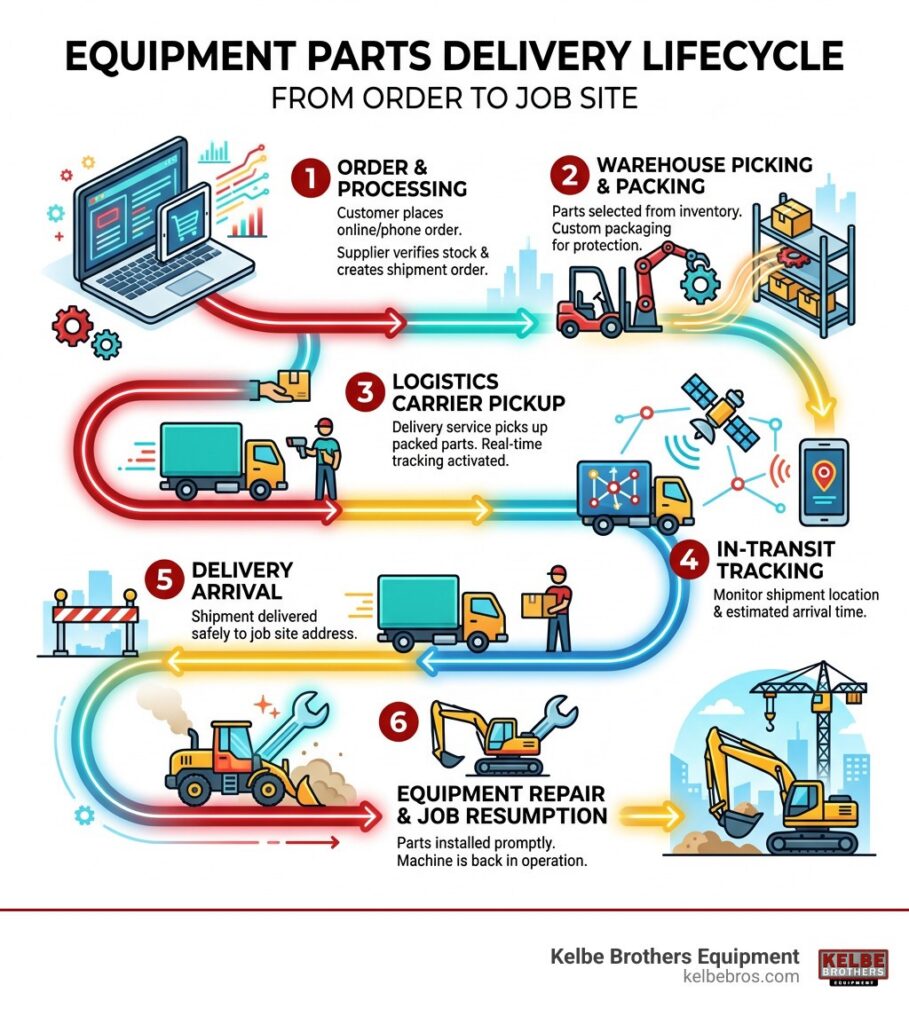
Equipment parts delivery is one of the most critical — and most overlooked — factors in keeping a construction operation running on schedule.
Here’s a quick overview of how it works and what to expect:
| Delivery Type | Typical Speed | Best For |
| Same-day / Hotshot | Within hours | Emergency repairs |
| Expedited (overnight) | Next business day | Urgent but not critical |
| Ground (UPS/USPS) | 1–5 business days | Standard restocking |
| LTL Freight | 3–7 business days | Heavy or oversized parts |
| Full Truckload | Varies | Large bulk orders |
Most in-stock parts can ship the same day if you order before noon. Parts over 150 lbs typically require LTL freight carriers with special handling. Real-time tracking is now standard with most reputable suppliers.
Every hour a machine sits idle, it costs you money. Whether it’s a Hitachi excavator waiting on a hydraulic component or a Takeuchi compact track loader sidelined by a worn drive sprocket, the speed and reliability of your parts supply chain directly determines how fast your crew gets back to work.
Wisconsin construction managers know this all too well. Suppliers that are slow to respond, hard to reach, or out of stock can turn a minor repair into a multi-day delay — and a blown project deadline.
I’m Jeffrey J. Miller, President of Kelbe Brothers Equipment, and with over 70 years of combined company experience in the construction equipment industry, we’ve built our parts and equipment parts delivery processes around one goal: minimizing your downtime. In the sections below, I’ll walk you through the full logistics picture — from choosing the right shipping method to navigating returns — so you can make faster, smarter decisions when it matters most.
Understanding Equipment Parts Delivery Methods
When a New Holland Skid Steer Loader goes down on a job site in Butler or De Pere, the first question isn’t just “Do you have the part?” but “How fast can you get it here?” Navigating equipment parts delivery requires understanding that not all shipping methods are created equal. The size, weight, and urgency of the component dictate the logistical path it takes.
For smaller items like filters, sensors, or small hardware for a Takeuchi Compact Excavator, ground transport via UPS or USPS is the standard. These typically offer a 1-to-5-day transit window. However, when we move into larger territory — think a replacement bucket for a Hitachi Wheel Loader or a track assembly — we enter the realm of LTL (Less Than Truckload) freight.
LTL is used for shipments over 150 lbs. These require specialized handling, often involving pallets and lift-gates. For massive orders or major structural components for a Link-Belt Material Handler, Full Truckload (FTL) services might be necessary to move the inventory directly from a central warehouse to your shop.
Expedited Equipment Parts Delivery for Critical Repairs
In the construction world, “tomorrow” is often too late. That’s why expedited equipment parts delivery is the backbone of emergency support. We’ve seen that most parts can be made available within 24 hours, with overnight availability being the standard for in-stock inventory.
The “Golden Rule” of fast shipping is the cutoff time. Generally, orders placed Monday through Friday before noon local time are shipped the same day. For those truly “machine down” scenarios, “hotshot” deliveries provide a dedicated driver to take a part from our warehouse directly to your site in Milwaukee or Green Bay. This rush service bypasses standard sorting hubs, ensuring that a New Holland Compact Track Loader is back moving dirt by the afternoon.
Real-Time Tracking and Delivery Confirmation
The days of “calling and hoping” are over. Reliable equipment parts delivery now relies on advanced tracking technology. Customers should expect live support and real-time ETA updates. Whether it’s a simple tracking number for a ground shipment or GPS-based tracking for a dedicated courier, knowing exactly where your Link-Belt Excavator parts are located reduces project management stress.
Confirmation methods have also evolved. Digital signatures and photo-text confirmations — where the driver texts a photo of the part sitting at your shop door — provide a transparent paper trail. This ensures that even if you aren’t on-site when the delivery arrives, you have visual proof that your order has landed safely.
Maximizing Uptime with Strategic Inventory and OEM Sourcing
Speedy delivery is useless if the part isn’t on the shelf. At Kelbe Brothers, we maintain a large inventory because we know that off-the-shelf availability is the best way to fight downtime. Our sourcing networks are designed to stock parts based on the specific equipment our Wisconsin customers use most, such as New Holland Tractor Loader Backhoes and Takeuchi Compact Excavators.
One of the biggest decisions a fleet manager faces is choosing between Original Equipment Manufacturer (OEM) parts and aftermarket alternatives. While aftermarket parts can sometimes offer a lower initial price point, OEM parts are manufactured to the exact specifications of your machine. This “perfect fit” often leads to faster installation and better long-term performance.
| Feature | OEM Parts | Aftermarket Parts |
| Fit & Finish | Exact match to machine specs | Variable; may require “tweaking” |
| Delivery Speed | High (stocked by dealers) | Varies by third-party stock |
| Warranty | Manufacturer-backed | Limited or third-party only |
| Reliability | Tested for specific models | General-purpose quality |
For more insights on keeping your fleet running, you can read more info about finding reliable skid steer parts.
Tailored Equipment Parts Delivery for Construction and Earthmoving
Different machines have different logistical needs. A Hitachi Wheel Loader requires different support than a New Holland Compact Track Loader. Our parts specialists work with you to identify the exact component needed — whether that’s through a detailed parts diagram, a serial number lookup, or a call with one of our experienced technicians.
By identifying the exact part upfront, you eliminate the “order-return-reorder” cycle that plagues many construction projects. Whether you need components for Link-Belt Excavators or Takeuchi Compact Track Loaders, precision in the ordering phase is the first step in a successful equipment parts delivery.
Specialized Logistics for Heavy and Oversized Components
Shipping a box of bolts is easy; shipping a 200-lb hydraulic cylinder for a Link-Belt Material Handler is a different story. Oversized and heavy components require specialized logistics that go beyond standard parcel services.
When a part exceeds 150 lbs, it must ship via LTL carrier. This introduces new variables:
- Lift-Gate Requirements: If your shop doesn’t have a loading dock, you’ll need a truck equipped with a lift-gate to lower the part to the ground.
- Residential vs. Commercial: Delivering a heavy part to a job site in a residential area of Madison may incur additional fees compared to a commercial warehouse delivery.
- Shuttle Networks and Drop Boxes: Some advanced logistics setups use a “shuttle network.” This involves trucks moving parts between branch locations overnight. Customers can then pick up their parts from locked “drop boxes” at their convenience, often avoiding expensive site-delivery fees.
Understanding these regional nuances is vital for Wisconsin contractors. You can learn more about why regional parts access in Wisconsin matters to see how local distribution speeds up the entire process.
Navigating Returns, Warranties, and Expert Support
Even with the best logistics, sometimes a part needs to go back. Perhaps the wrong model number was provided, or a part arrived with shipping damage. Understanding the return and warranty policy is a key part of the equipment parts delivery lifecycle.
Standard industry practice often includes a 30-day window for returns, provided the part is unopened and in saleable condition. Be aware that many suppliers charge a handling or restocking fee for returned items to cover the logistical costs of processing and re-shelving the inventory. Special order parts — those not normally kept in stock — are frequently non-returnable.
Warranties provide peace of mind. OEM parts typically come with a manufacturer’s warranty that covers defects in materials or workmanship. For those looking to save money without sacrificing quality, remanufactured parts are an excellent option. These often cost up to 45% less than new parts but come with similar warranties. For tips on this, check out our best practices for remanufactured parts.
If you’re ever unsure about what you need, don’t guess. Use a parts request form or call a specialist. At Kelbe Brothers, our experienced staff can help you identify exactly what’s needed for your New Holland Skid Steer Loaders or Takeuchi Compact Track Loaders, ensuring the equipment parts delivery is right the first time.
Frequently Asked Questions about Parts Logistics
What is the typical cutoff time for same-day shipping?
For most standard orders, the cutoff is noon local time. Orders placed before this time on business days are typically processed and handed to the carrier that same afternoon.
How are parts over 150 pounds delivered?
Items over 150 lbs are shipped via LTL (Less Than Truckload) freight. These parts are usually palletized and require a forklift or a lift-gate truck for unloading. It is important to confirm your unloading capabilities when placing the order to avoid redelivery fees.
Can I track my parts order in real-time?
Yes! Most modern equipment parts delivery services provide a tracking number or a digital link. For local “hotshot” deliveries, you may even receive real-time GPS updates or a text photo once the part has been dropped off at your designated location.
Conclusion
In the world of Wisconsin construction, you can’t afford to wait on a slow supply chain. Effective equipment parts delivery is about more than just a truck on the road; it’s about maintaining a large parts inventory, a network of expert specialists, and the logistical flexibility to get parts to Milwaukee, Madison, or Green Bay at a moment’s notice.
As a fourth-generation, family-owned business, Kelbe Brothers Equipment understands that our success is tied to yours. We pride ourselves on rapid response times and a “hassle-free” service model that keeps your Hitachi, Link-Belt, New Holland, and Takeuchi machines moving.
Don’t let a broken part stall your project. Order your heavy equipment parts today and experience the difference that local expertise and dedicated logistics can make.