




Wheel loader pallet forks are one of the most practical attachments you can add to your loader — and if you’re trying to figure out which type is right for your yard or job site, here’s a quick breakdown:
What you need to know at a glance:
- What they do: Lift, move, and stack palletized materials, bulk goods, and irregularly shaped loads
- Common capacity range: From around 2,200 lbs for compact loaders up to 16,000 kg for large wheel loaders
- Key types: Standard pallet forks, adjustable forks, block forks, and rail-style forks
- Mounting options: Quick coupler (most common) or direct pin-on
- Compatible machines: Hitachi Wheel Loaders, New Holland Compact Wheel Loaders, and more
- Top industries: Construction, agriculture, and general material handling
Whether you’re moving bagged materials on a Wisconsin job site or stacking pallets in a yard, the right pallet fork attachment can dramatically cut down on manual labor and keep your crew moving.
Pallet forks work by attaching to the front of your wheel loader and using the machine’s existing hydraulic lift system — no extra power source needed. You simply slide the tines under the load, lift, and transport. It’s a simple concept, but the details — capacity ratings, tine length, mounting style — matter a lot when you’re matching forks to a specific machine and job.
I’m Jeffrey J. Miller, President of Kelbe Brothers Equipment, and with over 70 years of combined company experience helping Wisconsin contractors select the right wheel loader pallet forks and attachments for demanding job sites, I’ve seen how the wrong spec can cost you time and the right one can transform your operation. Let’s walk through everything you need to make a confident choice.
At Kelbe Bros., we know that “one size fits all” rarely applies to Wisconsin construction sites. When you step away from the bucket and look at equipment attachments, you’ll find that wheel loader pallet forks come in several distinct flavors designed for specific material handling tasks.
The primary function of any fork attachment is to provide a stable platform for lifting, stacking, and moving goods that aren’t easily scooped. This includes everything from palletized bricks and drainage pipes to bulky hay bales in agricultural settings.
- Fixed Pallet Forks: These are the workhorses of the industry. The tines are set in a permanent position, offering maximum stability for standard-sized pallets.
- Adjustable Tines: These are far more common on modern job sites. They allow the operator to manually or hydraulically slide the tines closer together or further apart. This versatility is essential if you are switching between standard pallets and wider loads like storage bins or timber.
- Rail-Style Forks: These feature a heavy-duty rail system (often rated for 10,000 lbs or more) that allows for easy sliding of the tines. High-quality rail-style forks often use a “top swing lock” design, which eliminates stress on the heel of the fork — a common failure point in cheaper attachments.
- Block Forks: Specifically designed for the masonry and quarry industries, these forks feature multiple tines (often more than two) to support heavy stacks of concrete blocks or natural stone without the need for a pallet.
Specialized Fork Designs
Beyond the standard categories, specialized designs can solve unique site challenges. For instance, some manufacturers offer foldable forks. These are fantastic for tight yards in Milwaukee or Green Bay where maneuverability is a premium; when not in use, the tines fold up, shortening the machine’s footprint.
We also see shaft-mounted forks. Unlike hook-mounted versions, these tines slide along a heavy-duty shaft, which spreads load across a larger mounting area and makes them well suited to high-breakout-force applications.
| Feature | Standard Pallet Forks | Block Forks |
| Primary Use | Pallets, Crates, Bales | Concrete Blocks, Bricks, Stone |
| Tine Count | Typically 2 | 3 to 6+ |
| Adjustment | Manual or Hydraulic | Often fixed or semi-permanent |
| Load Stability | High for flat surfaces | Optimized for tiered materials |
Key Specifications for Selecting Wheel Loader Pallet Forks
Selecting the right wheel loader pallet forks isn’t just about picking a brand; it’s about the math. If you’ve read our guide on why 3-yard buckets are essential, you know that matching the attachment to the machine’s operating weight is critical for safety and performance.
When browsing for forks, keep these specs at the top of your list:
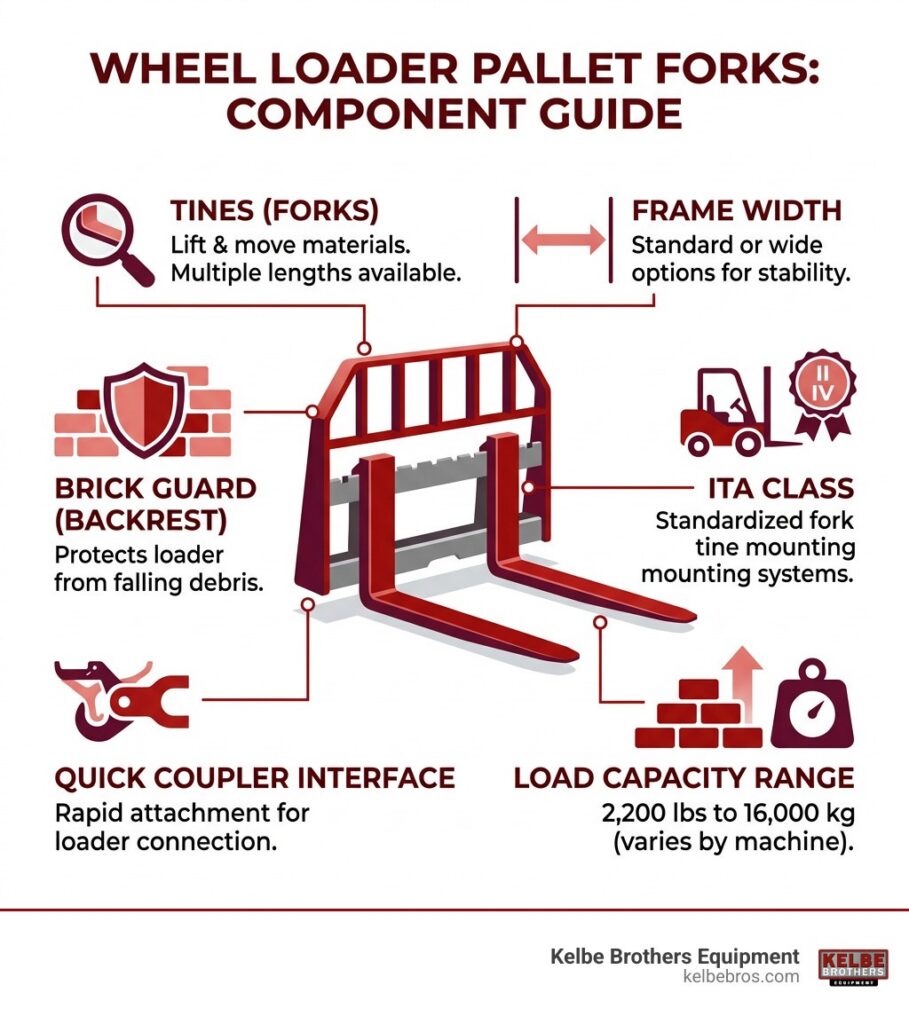
- Load Capacity: This is the maximum weight the forks can safely handle. You’ll find ratings ranging from 2,200 lbs for compact loaders up to massive 16,000 kg (over 35,000 lbs) ratings for heavy-duty Hitachi Wheel Loaders.
- Tine Length: Standard lengths are 42, 48, and 60 inches. A 48-inch tine is the industry standard for most pallets, but if you’re moving large hay bales or deep crates, you might need 72-inch tines.
- Frame Width: The carriage width (often 48″, 60″, or 72″) determines how much lateral support the load has. A wider frame provides more stability for long materials like pipe or lumber.
- Tine Thickness and Width: For example, a heavy-duty fork might feature tines that are 1.5 inches thick and 4 inches wide. Thicker tines resist bending under extreme loads.
- ITA Class: Pallet forks are categorized by “Class” (Class II, III, or IV) based on the carriage height and weight capacity. Ensuring your forks match the ITA class of your loader’s carriage is vital for a secure fit.
Understanding Lift Capacity Ratings
It is important to distinguish between the capacity of the forks and the capacity of the loader. Just because your forks are rated for 10,000 lbs doesn’t mean your loader can lift that much at full extension.
Always check your loader’s load chart — which accounts for the “center of gravity” of the load — to ensure you aren’t exceeding the machine’s tipping load.
Maximizing Versatility with Quick Coupler Mounting Systems
In the Wisconsin construction market, time is money. This is why the quick coupler (or quick attach) system has become the gold standard for Hitachi Wheel Loaders and New Holland Compact Wheel Loaders.
A quick coupler allows the operator to switch from a bucket to wheel loader pallet forks in seconds, often without leaving the cab. This is particularly useful on multi-use sites where you might be loading gravel one minute and unloading a flatbed of pipe the next.
- Quick Attach vs. Direct Pin-On: While direct pin-on mounting offers the highest possible breakout force (because the attachment is closer to the loader arms), it takes much longer to swap. Most modern contractors prefer the quick coupler for the sheer versatility it provides.
- Hydraulic Switching: Some high-end systems allow for hydraulic locking pins. With the push of a button, you’re locked in and ready to work.
- Compatibility: Whether you are running a New Holland Compact Wheel Loader or a full-sized Hitachi Wheel Loader, ensure the mounting plate matches your machine’s specific coupler style (e.g., JRB, ACS, or ISO styles).
Essential Safety Features and Maintenance for Longevity
Safety isn’t just a buzzword at Kelbe Bros.; it’s how we ensure our customers make it home every night. When using wheel loader pallet forks, several safety features are non-negotiable.
- Brick Guards: Also known as backrests, these are the vertical “fences” on the back of the fork frame. They prevent materials from sliding backward onto the loader arms or, worse, toward the cab when the mast is tilted back.
- Lock Mechanisms: Always ensure your tines have functional lock-in-position clips. This prevents the tines from sliding unexpectedly while you are traversing uneven terrain.
- Visibility Aids: Many modern forks feature a “walk-thru” or open-frame design. This significantly improves the operator’s visibility to the fork tips, making it much easier to line up with pallet pockets without damaging the goods.
Proper maintenance is also key. If you are utilizing wheel loader rentals, you’ll notice that well-maintained equipment always performs better.
Routine Inspection and Care
To get the most out of your investment, follow these maintenance tips:
- Inspect the “Heel”: The 90-degree bend (the heel) of the fork takes the most stress. Check this area daily for cracks or thinning. If a fork has lost more than 10% of its original thickness due to wear, it must be replaced.
- Lubrication: If you have adjustable forks, keep the rails or shafts lubricated. This prevents the tines from seizing up due to rust or debris.
- Check the Mounting Plate: Look for stress fractures or bent pins on the quick coupler interface. If the fit is “sloppy,” it can lead to accelerated wear on your loader’s pins and bushings.
- Balance the Load: As we discuss in our guide on choosing the right bucket, balance is everything. Always center your load on the forks and keep it as low to the ground as possible during transport.
Frequently Asked Questions about Wheel Loader Pallet Forks
What is the typical lift capacity of wheel loader pallet forks?
The capacity varies widely based on the size of the machine. For compact equipment like a New Holland Compact Wheel Loader, you might see ratings around 2,200 lbs to 4,000 lbs. For mid-sized and large Hitachi Wheel Loaders, heavy-duty rail-style forks are commonly rated at 10,000 lbs, with some specialized industrial versions reaching over 35,000 lbs (16,000 kg).
Can I use pallet forks on a compact wheel loader?
Absolutely. In fact, New Holland Compact Wheel Loaders are some of the most popular machines for fork attachments because they offer a tighter turning radius than full-sized loaders. Many of these machines use quick-attach mounts to make swapping attachments easy.
How do I ensure my wheel loader pallet forks are compatible?
Compatibility comes down to the mounting system and the hydraulic capacity. You must match the mounting plate of the forks to the coupler on your loader. Additionally, check the Hitachi wheel loader specifications to ensure the operating weight of the machine can handle the weight of the attachment plus the intended load.
Conclusion
At Kelbe Brothers Equipment, we’ve spent four generations serving the Wisconsin construction community. From our locations in Milwaukee, Madison, and Green Bay, we understand that the right tool makes the difference between a profitable job and a headache.
Wheel loader pallet forks are more than just an accessory; they are a versatility multiplier. Whether you are looking for new or used construction equipment for sale, or you need a reliable construction equipment rental, our team is here to help you find the perfect match for your Hitachi, Link-Belt, New Holland, or Takeuchi machines. With fast parts delivery, on‑site service, and a deep inventory of parts and attachments, we make sure your yard stays productive, no matter what you’re lifting.
For more information on how to optimize your fleet, check out our full range of equipment attachments or stop by one of our Wisconsin locations today!