




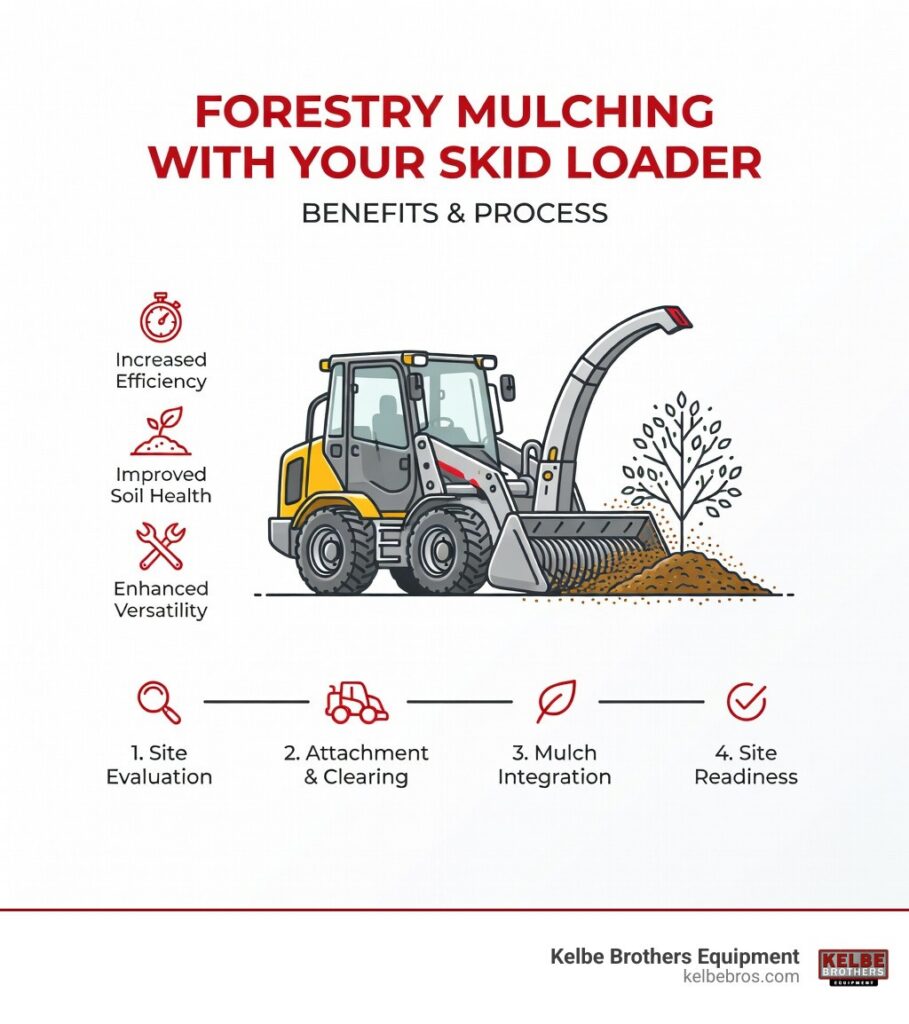
A skid loader forestry mulcher is a powerful attachment that turns your equipment into a land-clearing machine. It’s designed to grind unwanted trees, brush, and stumps into fine mulch, right where they stand.
- What it is: A specialized attachment for skid steers and compact track loaders.
- How it works: Uses a rotating drum or disc with sharp teeth to shred vegetation.
- Main tasks: Land clearing, site preparation, maintaining rights-of-way, and managing overgrown areas.
- Ideal for: Enhancing the capability of New Holland Skid Steer Loaders and Takeuchi Compact Track Loaders for heavy-duty jobs.
A skid loader forestry mulcher transforms challenging landscapes into clear, manageable spaces. This versatile tool is essential for anyone needing to efficiently remove vegetation, prepare land for new projects, or maintain property lines. It handles everything from dense brush to standing trees, breaking them down into nutrient-rich mulch that can benefit the soil.
As President of Kelbe Brothers Equipment, I, Jeffrey J. Miller, have guided our company through industry changes, expanding our equipment offerings and modernizing operations to meet customer needs, especially in skid loader forestry mulcher solutions. Understanding this powerful attachment is key to boosting your productivity.
Understanding the Skid Loader Forestry Mulcher
When we talk about land clearing in Wisconsin, we aren’t just talking about basic maintenance. We’re talking about taming the wild “Northwoods” vibe that creeps into every fencerow and job site from Milwaukee to Green Bay. A skid loader forestry mulcher is the heavy hitter you bring in when a standard attachment just won’t cut it.
At its core, this attachment uses the immense hydraulic power of your carrier, like the New Holland Skid Steer Loaders or our rugged Takeuchi Compact Track Loaders, to spin a specialized rotor at high speeds. This rotor is outfitted with teeth made of forged alloy or carbide that can pulverize wood into a fine consistency.
One of the best things about these units is their versatility. You don’t need a massive, dedicated forestry machine. Instead, you can take the Takeuchi Compact Track Loaders you already use for grading and excavation, swap the bucket for a mulching head, and you’re suddenly in the vegetation management business. You can contact our team at Kelbe Brothers Equipment to see how these attachments integrate with modern compact construction equipment.
Engineering and Mechanics
The “magic” happens through a mix of hydraulic flow and mechanical torque. Most high-quality mulchers utilize a hydraulic axial piston motor. This isn’t your average motor; it’s designed to handle the variable loads that come with hitting a 10-inch tree.
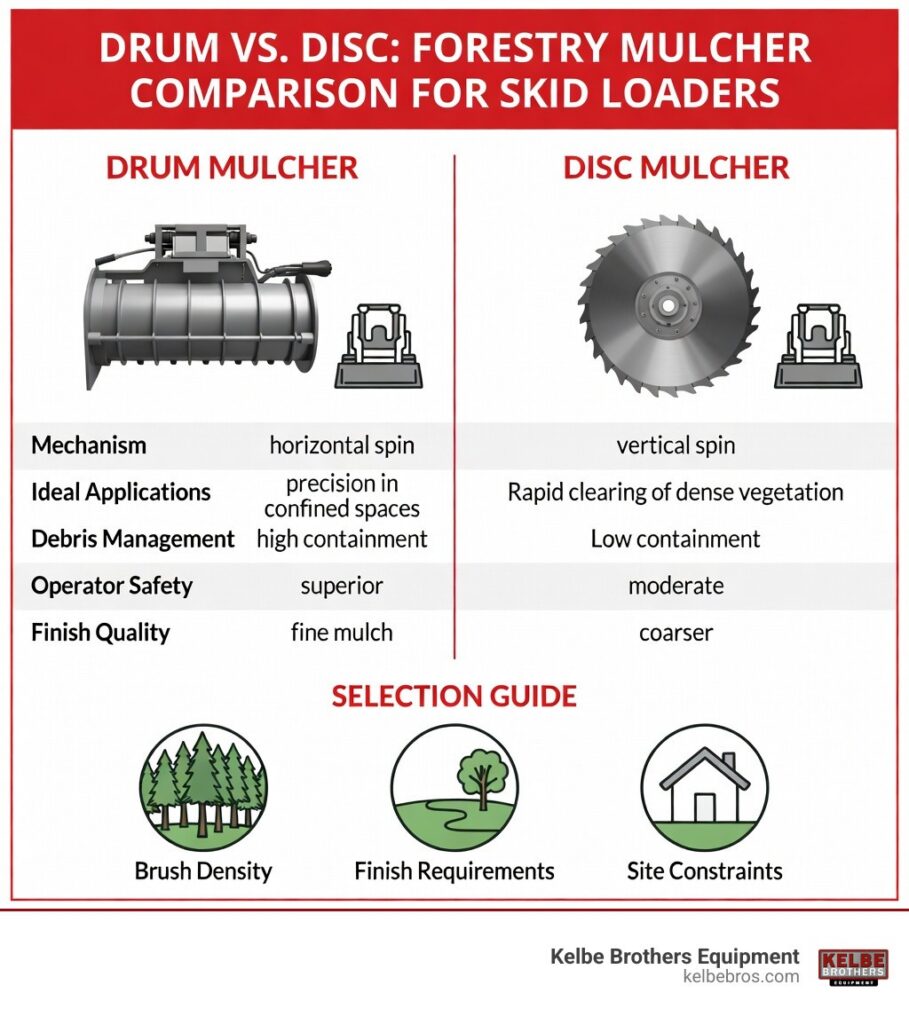
There are two primary designs: horizontal rotors (drum mulchers) and vertical discs (disc mulchers). The drum style features a cylindrical rotor that spins horizontally, while the disc style uses a large, flat flywheel that spins vertically. Both connect to your machine via a universal quick-attach system, meaning you can jump from a New Holland Skid Steer Loader to a Takeuchi machine without a headache, provided the hydraulic specs match.
Benefits of On-Site Mulching
Mulching offers a compelling on-site alternative to traditional clearing methods. In many areas, open burning may be restricted or regulated, and a forestry mulcher eliminates the need to haul debris off-site entirely.
- Soil enrichment: The mulch left behind can help return organic material to the soil as it decomposes.
- Erosion control: A mulcher can leave more ground cover in place compared to heavy clearing equipment, helping reduce erosion risk.
- No hauling: You can reduce the need to load and haul debris off-site.
- Single-machine efficiency: You clear, grind, and finish the site with one operator and one machine.
If you’re planning a broader site package, forestry mulching often pairs well with the rest of your fleet, including construction equipment rentals for follow-on work, such as a New Holland Mini Excavator for trenching or Takeuchi Compact Excavators for grading and cleanup.
Drum vs. Disc: Choosing Your Mulching Style
Choosing between a drum and a disc mulcher is like choosing between a scalpel and a sledgehammer. Both are great, but you need to know which one fits the job. In our experience helping contractors in Madison and Butler, the choice usually comes down to the density of the brush and the desired finish.
The Precision of a Drum Skid Loader Forestry Mulcher
The drum mulcher is the king of precision. If you’re working in a tight spot or need a “park-like” finish, this is your tool. The horizontal rotor allows the operator to work the head from the top down or the front back. Because the drum is enclosed, it contains debris much better than a disc, making it safer for work near roads or buildings.
Many drum models, especially those paired with New Holland Compact Track Loaders, feature depth control rings. These rings limit how deep the teeth can bite into the wood, preventing the rotor from stalling and ensuring a consistent, fine mulch. Drum mulchers are also capable of “sub-surface” mulching, meaning they can dip an inch or two below the soil line to grind down stumps and roots.
The Power of a Disc Skid Loader Forestry Mulcher
If you have 40 acres of thick brush and you need it gone yesterday, the disc mulcher is your best friend. These units use a massive, heavy flywheel that stores kinetic energy. When that spinning disc hits a tree, it doesn’t just cut it; it explodes it.
Disc mulchers are famous for their “grab and throw” capability. They can fell a 14-inch tree in seconds. However, they are a bit messier. They tend to throw large chunks of wood further than a drum would. For wide-open land clearing in rural Wisconsin, a disc mulcher on a high-flow Takeuchi Compact Track Loader is an absolute beast. It’s less about the fine finish and more about raw production speed.
Technical Requirements for Optimal Performance
You can’t just slap a heavy-duty mulcher on a small machine and expect it to work. To get the most out of your skid loader forestry mulcher, you need to understand the “Big Three”: GPM (Gallons Per Minute), PSI (Pounds per Square Inch), and ROC (Rated Operating Capacity).
Hydraulic flow is the lifeblood of the mulcher. Most forestry heads require high-flow hydraulics to maintain the rotor speed necessary to pulverize wood. If you’re looking to upgrade your fleet, you can contact Kelbe Brothers Equipment to find the right specs for your specific machine.
Standard Flow vs. High Flow Configurations
- Standard Flow (17-25 GPM): Best for light duty such as tall grass, thick brush, and small saplings (often up to around 4 inches in diameter, depending on species and conditions). We often see these used on smaller New Holland Skid Steer Loaders for property maintenance.
- High Flow (26-45 GPM): This is where the real forestry work happens. High-flow systems provide the torque needed to mulch larger material (commonly 8-inch to 12-inch class trees, depending on the head and operator technique).
If you try to run a high-flow mulcher on a standard-flow machine, you’ll likely overheat the hydraulic oil and accomplish very little. Conversely, running a standard-flow head on a high-flow machine requires careful adjustment of the flow settings to avoid damaging seals.
Matching Attachment to Carrier
Stability is just as important as power. A forestry mulcher can weigh anywhere from 1,500 to nearly 3,000 lbs. When you hang that much weight off the front of a loader, your center of gravity shifts.
This is why we often recommend large-frame Takeuchi Compact Track Loaders for tough conditions. The tracks provide a larger footprint and better stability on the uneven, often muddy terrain we find around De Pere and Green Bay. You also need to ensure your machine has the cooling capacity to handle the constant hydraulic load. Many New Holland and Takeuchi models can be equipped with cooling packages designed for high-duty-cycle attachments like mulchers.
If you’re comparing options for your broader fleet, our team can also help with construction equipment for sale, including excavators for sale, mini excavators for sale, and wheel loaders for sale, as well as used construction equipment for sale for Wisconsin contractors who want dependable machines with local parts and service support.
Key Applications and Safety Standards
The beauty of the skid loader forestry mulcher is that it isn’t a one-trick pony. While land clearing is the primary use, we see our customers using them for a variety of tasks across Wisconsin.
- Right-of-way maintenance: Keeping corridors clear of encroaching trees.
- Fire mitigation: Creating firebreaks by removing ladder fuels (brush that allows fire to climb into the canopy).
- Invasive species removal: Taking out buckthorn or honeysuckle that can choke out native Wisconsin plants.
- Orchard maintenance: Cleaning up old rows or removing diseased trees.
Essential Safety Features
Let’s be real: you are essentially operating a giant, high-speed blender. Safety isn’t just a suggestion; it’s a requirement.
The number one safety feature is a polycarbonate windshield. Standard glass can shatter if struck by debris. We recommend at least a 1/2-inch thick polycarbonate door for forestry work.
Other key features include:
- Reinforced push bars: These help guide the tree away from the cab as it falls.
- Hydraulic drum brakes: These help stop the rotor quickly (often in under 20 seconds) once the hydraulics are disengaged.
- Rear debris chains: These help reduce material thrown back toward the loader.
Maintenance for Peak Efficiency
If you take care of your mulcher, it will take care of you. The most frequent maintenance task is checking the teeth. Depending on whether you are hitting rocks or just soft wood, carbide-tipped teeth can last anywhere from 500 to 1,000 hours.
Greasing is also critical. High-speed bearings generate a lot of heat. A quick shot of grease every few hours of operation can help prevent major bearing wear. Also, keep an eye on your hydraulic hoses. We suggest using protective sleeves or hose slings to reduce the chance of snagging on branches.
For contractors building out a complete vegetation-management and earthmoving package, Kelbe Brothers Equipment can support you with construction equipment rentals and the rest of your fleet needs, including Takeuchi Compact Excavators, New Holland Mini Excavators, and Link-Belt Material Handlers when the job calls for heavier lifting and ground work.
Frequently Asked Questions about Forestry Mulchers
How thick of a tree can a skid loader forestry mulcher handle?
A standard drum mulcher is usually rated for trees up to 8 inches in diameter for continuous clearing, though it can handle larger one-off trees if you take your time. Disc mulchers are more aggressive and can often fell trees up to 14 inches in diameter. The hardness of the wood matters, too — mulching a soft popple is much faster than chewing through mature hardwood.
What is the difference between standard clearing and mulching?
Standard clearing methods often leave behind long, jagged pieces and larger chunks of debris. A forestry mulcher grinds the material into a more uniform mulch. If you need a site that people can walk on more comfortably afterward, you want a mulcher.
How many acres can a skid loader mulch per day?
On average, you can expect to clear between 1 and 4 acres per day. This depends heavily on the density of the vegetation and the terrain. Operator skill and having a high-flow machine also play a huge role in daily production rate.
Conclusion
At Kelbe Brothers Equipment, we’ve been a part of the Wisconsin construction landscape for four generations. We know that when you’re out in the field in Milwaukee, Madison, or Green Bay, you need equipment that works as hard as you do. Whether you are looking for New Holland Skid Steer Loaders to handle property maintenance or a heavy-duty Takeuchi Compact Track Loader for a major land-clearing contract, we have the expertise to match you with the right skid loader forestry mulcher.
We pride ourselves on our rapid response and on‑site field service because we know that downtime in our short Wisconsin construction season is not an option. From flexible financing to our hassle-free rental fleet, we are here to help your business grow.
Ready to see what a mulcher can do for your operation? For more info about equipment attachments, visit our website or stop by one of our locations in Butler or De Pere. Let’s get to work!