




The best compact backhoe combines digging power, loading capability, and maneuverability in one machine. For Wisconsin contractors juggling tight schedules and tighter budgets, choosing the right compact backhoe loader means less downtime, fewer equipment swaps, and more jobs completed on time.
Top Compact Backhoe Considerations:
- Dig Depth: Look for models under 14 feet for true compact classification
- Power Range: 24-95 HP covers most residential and light commercial work
- Drive System: 4WD offers better traction on Wisconsin’s varied terrain
- Key Models: New Holland Tractor Loader Backhoes like the B75D deliver 32.5 gpm hydraulic flow and optional extendahoe for deeper trenching
These machines excel at trenching, utility work, landscaping, and light excavation—all while fitting through residential gates and navigating urban job sites. Unlike larger equipment, compact backhoes travel at road speeds (up to 25 mph) and don’t require special permits for transport.
The market has shifted dramatically. Ten years ago, some manufacturers offered many compact models. Today, fewer manufacturers serve this niche, but the remaining options pack more technology and efficiency than ever. Brands like New Holland focus on operator comfort, hydraulic efficiency, and attachment versatility to keep you productive hour after hour.
Why This Matters Now
With mini excavators and skid steers dominating equipment yards, compact backhoes offer something different: true versatility. One machine handles front-end loading, rear excavation, and everything between. For contractors who can’t afford multiple specialized machines—or the downtime to swap them—that’s a game-changer.
As Jeffrey J. Miller, President of Kelbe Brothers Equipment, I’ve spent decades helping Wisconsin contractors match machines to their toughest jobs, including finding the best compact backhoe for diverse project needs. Our experience with New Holland and other leading brands gives us insight into which features actually matter on Wisconsin job sites.
WHAT DEFINES A COMPACT BACKHOE LOADER?
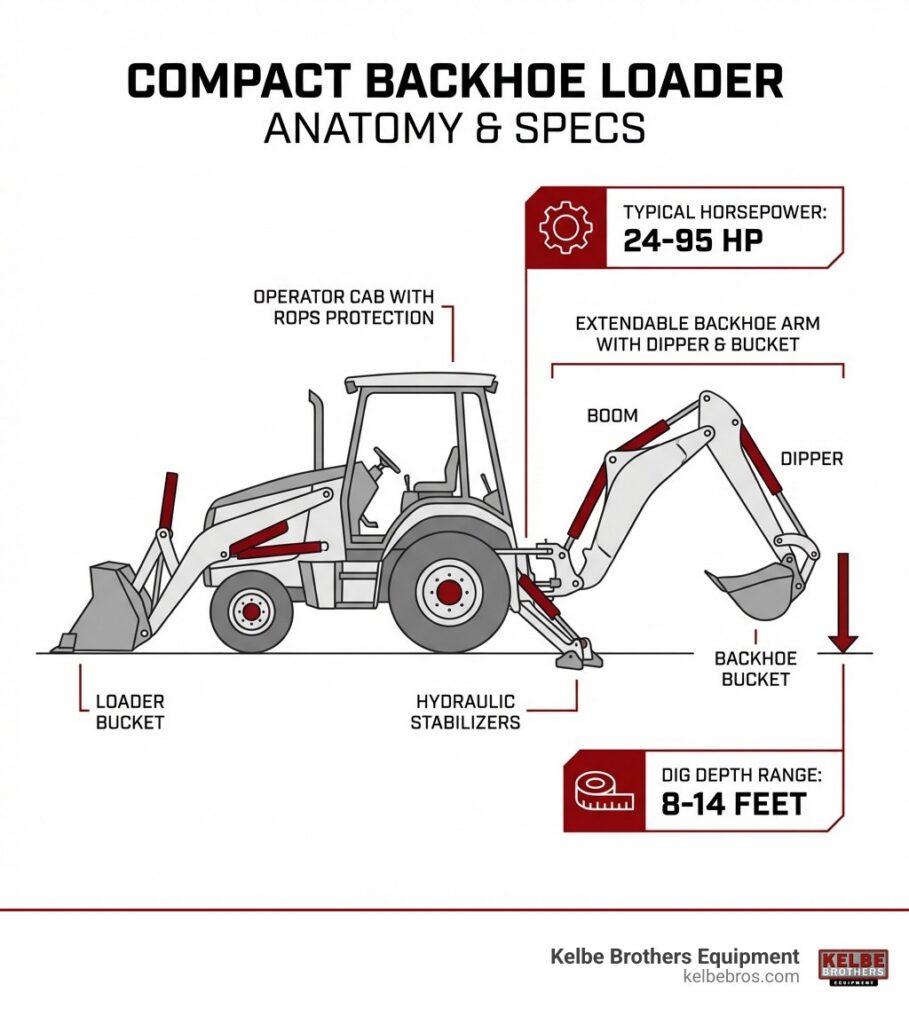
When we talk about the best compact backhoe, we’re referring to a specific class of equipment designed to offer the power of a traditional backhoe loader in a more agile, smaller footprint. At its core, a compact backhoe loader is defined by its digging depth, typically falling under 14 feet. This classification sets it apart from its larger counterparts, allowing it to access confined spaces and steer urban or residential job sites where larger machinery simply can’t go.
The essence of a compact backhoe lies in its maneuverability and lighter operating weight. Imagine needing to dig a trench in a backyard with limited access, or performing utility work in a tight city street in Milwaukee or Madison. A full-sized backhoe would be too cumbersome, but a compact model can weave through obstacles with ease. These machines are engineered with an integrated tractor chassis, ensuring a balanced and robust platform for both loading and excavating tasks.
Our New Holland Tractor Loader Backhoes exemplify this design philosophy. They combine a powerful loader at the front with a versatile backhoe arm at the rear, making them true all-in-one machines. This integrated approach means the machine is purpose-built for the combined stresses of digging and loading, offering superior performance and stability compared to a standard tractor with bolt-on attachments. For us, helping you choose the right equipment is about ensuring your projects run smoothly and efficiently. We understand that Why Choosing the Right Construction Equipment is Essential for Modern Projects isn’t just a suggestion—it’s the key to your success.
FINDING THE BEST COMPACT BACKHOE: KEY SPECIFICATIONS TO COMPARE
Choosing the best compact backhoe for your Wisconsin projects requires a close look at the numbers. Performance metrics, custom to your specific job site requirements, are crucial for determining which machine truly has the capabilities you need. We’re here to help you decipher these specifications to make an informed decision.
POWER AND PERFORMANCE METRICS
The heart of any backhoe loader is its engine and hydraulic system. We look at several key metrics to gauge a machine’s true potential:
- Net Horsepower (HP): This indicates the engine’s power output available for work. For compact backhoes, we often see models ranging from around 24 HP up to 95 HP, which is ample for most residential and light commercial work across Wisconsin. For example, our New Holland B95C offers a robust 95 net HP, providing plenty of muscle for demanding tasks.
- Engine Technology: Modern compact backhoes feature advanced engine technologies designed for fuel efficiency and reduced emissions, vital for operating in environmentally sensitive areas or for meeting local regulations in Green Bay or De Pere.
- Hydraulic System Efficiency: Measured in gallons per minute (GPM), hydraulic flow is critical for fast, powerful, and responsive loader and backhoe operations. A higher GPM means quicker cycle times and stronger breakout forces. Our New Holland B75D, a popular choice for its versatility, boasts a strong 32.5 gpm hydraulic flow, ensuring smooth and efficient work.
- Breakout Force: This metric tells you how much power the loader bucket and backhoe arm can exert. Higher breakout force means you can dig through tougher soil or lift heavier loads with less effort.
While some backhoes, like our New Holland B75D, might technically exceed the 14-foot dig depth compact classification (it offers 14 ft, 6 in. standard, and 18 ft, 4 in. with an extendahoe), its overall compact design and operational benefits often place it in the conversation for the best compact backhoe for those needing a little extra reach without the footprint of a full-sized machine.
DIGGING AND LOADING CAPABILITIES
The primary roles of a backhoe loader are digging and loading, and its specifications in these areas are paramount.
- Maximum Dig Depth: This is perhaps the most critical specification for the backhoe arm. Our New Holland B75D offers a maximum dig depth of 14 ft, 6 in., which can be extended to an impressive 18 ft, 4 in. with the extendable option. This extendable feature is a game-changer for reaching deeper into trenches or over obstacles, providing significant operational flexibility.
- Reach from Swing Pivot: This measures how far the backhoe arm can extend horizontally from its pivot point, influencing its ability to dig and dump without constantly repositioning the machine.
- Loader Lift Capacity: For the front-end loader, this indicates the maximum weight it can lift, crucial for moving piles of dirt, gravel, or other materials.
- Hinge Pin Height: This refers to the maximum height the loader bucket can reach, essential for loading high-sided trucks or hoppers.
Understanding these capabilities helps us match your project’s specific demands with the right machine.
DRIVETRAIN AND MOBILITY
The ability to move efficiently around a job site and between locations is another key factor in determining the best compact backhoe.
| Drive System | Advantages | Disadvantages |
| 2WD | More fuel-efficient, lower purchase cost, suitable for hard, flat surfaces. | Limited traction on soft, uneven, or slippery terrain (common in Wisconsin!). |
| 4WD | Superior traction and stability, better for rough terrain, mud, snow, and slopes. | Higher purchase and maintenance costs, slightly less fuel-efficient. |
Choosing between 2WD and 4WD depends heavily on your typical working conditions. Given Wisconsin’s diverse landscapes and often challenging weather, we frequently recommend 4WD for its superior traction and stability, ensuring your compact backhoe can handle anything from muddy construction sites in Butler to snowy landscapes in Green Bay.
Transmission types also play a significant role in mobility and ease of operation:
- Powershift Transmissions: These offer smooth, on-the-go gear changes without clutching, ideal for tasks requiring frequent forward and reverse movements like loading cycles.
- Hydrostatic (HST) Transmissions: Providing infinite speed control and seamless direction changes, HSTs are often favored for their simplicity and precision, particularly in applications requiring fine control.
Compact backhoes can achieve impressive travel speeds, with some models capable of traveling up to 25 mph. This roadability is a huge advantage for contractors who need to move their equipment between multiple job sites without the hassle and expense of a separate transport vehicle. This mobility significantly improves overall job site efficiency, allowing you to maximize your uptime.
THE VERSATILITY ADVANTAGE: USE CASES AND ALTERNATIVES
The true beauty of the best compact backhoe lies in its unparalleled versatility. For contractors across Wisconsin, this machine isn’t just a digger or a loader; it’s a multi-tool that can tackle a wide array of tasks, making it an indispensable asset on countless job sites.
Compact backhoes excel at:
- Trenching: Perfect for laying utility lines, irrigation systems, or drainage, their precise digging capabilities ensure clean and efficient trenches.
- Landscaping: From shaping terrain and digging ponds to moving decorative rocks and preparing planting beds, these machines handle delicate tasks with power.
- Utility Work: Essential for accessing and repairing underground infrastructure, their compact size allows them to operate in tight urban environments without disrupting traffic or damaging surrounding property.
- Roadability: One of their standout features is the ability to travel at road speeds. This means less time spent loading and unloading onto trailers, and more time working, especially when moving between jobs in Milwaukee, Madison, or any of our other service areas.
This “all-in-one” solution offers significant advantages. Instead of needing a separate excavator for digging and a wheel loader for material handling, a single compact backhoe can perform both functions. This reduces initial investment, lowers maintenance costs, and simplifies logistics for your crew.
While compact backhoes are incredibly versatile, we recognize that sometimes a specialized tool is the right tool. For purely excavation-focused tasks, particularly in extremely tight spaces or where continuous digging is the primary need, Compact Excavators might be a more efficient choice. Similarly, if your work primarily involves moving large volumes of material, then New Holland Compact Wheel Loaders could offer greater efficiency. However, for a balanced approach to digging, loading, and general site work, the compact backhoe remains king. It’s about matching the machine to the task, and we’re here to help you make that perfect match.
MODERN FEATURES AND THE OPERATOR ENVIRONMENT
In the pursuit of the best compact backhoe, we can’t overlook the importance of the operator’s environment. Modern compact backhoes are not just about raw power; they’re about smart design that boosts productivity, minimizes operator fatigue, and integrates cutting-edge technology to make every workday more efficient and comfortable.
CHOOSING THE BEST COMPACT BACKHOE FOR OPERATOR COMFORT
An uncomfortable operator is an unproductive one. That’s why we emphasize features that improve comfort and reduce fatigue, especially during long hours on a Wisconsin job site:
- ROPS/FOPS Certified Cab: Rollover Protective Structures (ROPS) and Falling Object Protective Structures (FOPS) are non-negotiable safety features. Beyond safety, a well-designed cab protects the operator from the elements, ensuring comfort whether it’s scorching summer or freezing winter in Green Bay.
- Ergonomic Controls: The placement and feel of controls can significantly impact ease of use. Modern compact backhoes feature intuitively placed joysticks and levers that reduce strain and allow for more precise movements.
- Adjustable Seating: A deluxe high-back seat with adjustable armrests, cushioning, and the ability to swivel for backhoe operation is crucial. The ability to customize the seating position to the operator’s preference means less back strain and greater comfort throughout the day.
- All-Around Visibility: Clear sightlines to the loader bucket, backhoe arm, and surrounding work area are vital for both safety and precision. Large windows and strategically placed mirrors contribute to excellent visibility.
- HVAC Systems: Heating, ventilation, and air conditioning (HVAC) are essential for maintaining a comfortable working temperature year-round in Wisconsin’s variable climate. A climate-controlled cab keeps operators focused and productive, regardless of the weather outside.
TECHNOLOGICAL ADVANCEMENTS TO LOOK FOR
Beyond comfort, technological advancements are continually reshaping what the best compact backhoe can do:
- Center-Pivot vs. Side-Shift Boom: Traditionally, backhoes in North America feature a center-pivot boom. However, side-shift booms are gaining popularity, especially for urban projects and precision digging. A side-shift boom allows the backhoe kingpost to slide side-to-side, enabling the operator to dig right up against walls or in extremely tight spaces without repositioning the entire machine. This flexibility is invaluable in congested areas like downtown Milwaukee or Madison.
- Pilot vs. Mechanical Controls: The industry is seeing a shift towards pilot controls (joystick-based) over traditional mechanical levers. Many younger operators, familiar with excavators, prefer the ease and precision of joysticks. These controls can significantly reduce operator effort and improve the smoothness of operations.
- Quick Couplers: These ingenious devices allow operators to rapidly switch between various attachments without leaving the cab. This dramatically increases the versatility and efficiency of the compact backhoe, changing it from a digging machine to a material handler, a breaker, or an auger in minutes. We often recommend exploring our range of Equipment Attachments to maximize your machine’s utility.
These innovations mean that today’s compact backhoes are more capable, comfortable, and efficient than ever before, truly offering a powerful solution in a compact package for any Wisconsin contractor.
MAKING THE RIGHT CHOICE: MAINTENANCE, SUPPORT, AND OWNERSHIP
Selecting the best compact backhoe isn’t just about initial specifications; it’s a long-term investment that hinges on serviceability, long-term value, and the strength of your dealer relationship. A machine that’s hard to maintain or lacks reliable support can quickly turn into a liability, no matter how powerful it seems.
We believe that proactive care and accessible support are paramount. That’s why we encourage all our customers to dig into Heavy Equipment Maintenance Best Practices to ensure their machines stay in peak condition, day in and day out.
EVALUATING NEW VS. USED COMPACT BACKHOES
The decision to buy new or used is a significant one for any contractor in Wisconsin. Both options present unique advantages:
New Machine Benefits:
- Warranty: New machines come with comprehensive warranties, providing peace of mind and protecting your investment against unexpected repairs.
- Latest Technology: You get the most current advancements in engine efficiency, hydraulic performance, operator comfort, and digital controls.
- Reliability: A new machine offers maximum uptime, which is crucial for meeting tight project deadlines.
Used Machine Considerations:
For those considering a used compact backhoe, careful evaluation is key to finding value. We offer a wide selection of Used Construction Equipment for Sale and guide our customers through a thorough inspection process. Here’s a list of key inspection points:
- Engine Hours: Lower hours generally indicate less wear and a longer remaining lifespan.
- Visual Inspection: Look for signs of excessive wear, damage, or poor repairs on the frame, boom, and loader arms.
- Tire Condition: Check for excessive wear, cracks, or sidewall damage. Tires can be a significant replacement expense.
- Hydraulic Leaks: Inspect all hoses, cylinders, and connections for any signs of leaks. Hydraulic system integrity is vital for performance.
- Engine Performance: Listen for unusual noises, check for excessive smoke, and ensure smooth operation.
- Loader and Backhoe Functionality: Test all movements for smoothness, power, and responsiveness.
- Cab Condition: Evaluate the condition of the interior, controls, and seating for comfort and functionality.
- Maintenance Records: Request detailed service history to understand how well the machine has been cared for.
THE IMPORTANCE OF SERVICEABILITY AND DEALER SUPPORT
Once you own a compact backhoe, its long-term performance and your operational efficiency depend heavily on how easily it can be serviced and the quality of support you receive.
- Daily Maintenance Checks: Machines designed with ground-level service points make routine checks (like fluid levels, filters, and greasing) quicker and safer, encouraging consistent maintenance that prevents larger issues.
- Parts Availability: Having ready access to genuine parts is critical. Delays in receiving a necessary component can lead to costly downtime. We pride ourselves on maintaining a robust inventory of parts for our New Holland equipment, ensuring that your machine is back up and running as quickly as possible.
- Factory Trained Technicians: The complexity of modern heavy equipment demands specialized expertise. Our Factory Trained Technicians have the knowledge and tools specific to New Holland equipment, ensuring accurate diagnostics and efficient repairs. This specialized training means your machine gets the right care the first time, minimizing repeat issues.
- Local Dealer Support: For Wisconsin contractors, having a reliable local partner like Kelbe Brothers is invaluable. As a dedicated New Holland Dealer in Wisconsin, we understand the unique challenges of our local environment and are committed to providing rapid response and personalized support, whether you’re in Milwaukee, Green Bay, or anywhere in between. Our team is always ready to assist with everything from routine maintenance to emergency repairs, ensuring your projects stay on track.
CONCLUSION: YOUR PARTNER FOR POWERFUL AND COMPACT SOLUTIONS
Finding the best compact backhoe is a strategic decision that impacts your productivity, profitability, and peace of mind on every project. We’ve explored what defines these versatile machines, the critical specifications to compare, their wide range of use cases, the modern features that improve operator comfort and efficiency, and the vital role of maintenance and dealer support.
The ideal compact backhoe is one that perfectly matches your specific tasks, job site conditions, and operational preferences. Its versatility—the ability to dig, load, and handle a multitude of attachments—makes it an indispensable tool for Wisconsin contractors who demand efficiency and flexibility from a single machine.
At Kelbe Brothers Equipment, we’re not just selling machines; we’re building partnerships. With decades of experience serving Wisconsin contractors, we offer local expertise, reliable New Holland equipment, and a commitment to rapid response and hassle-free service. We understand the demands of your work, from the busy streets of Milwaukee to the challenging terrains near Madison. Let us help you find the powerful, compact solution that will drive your success.
Ready to improve your fleet with the right equipment? Explore our options and find the right compact equipment for your next project.