




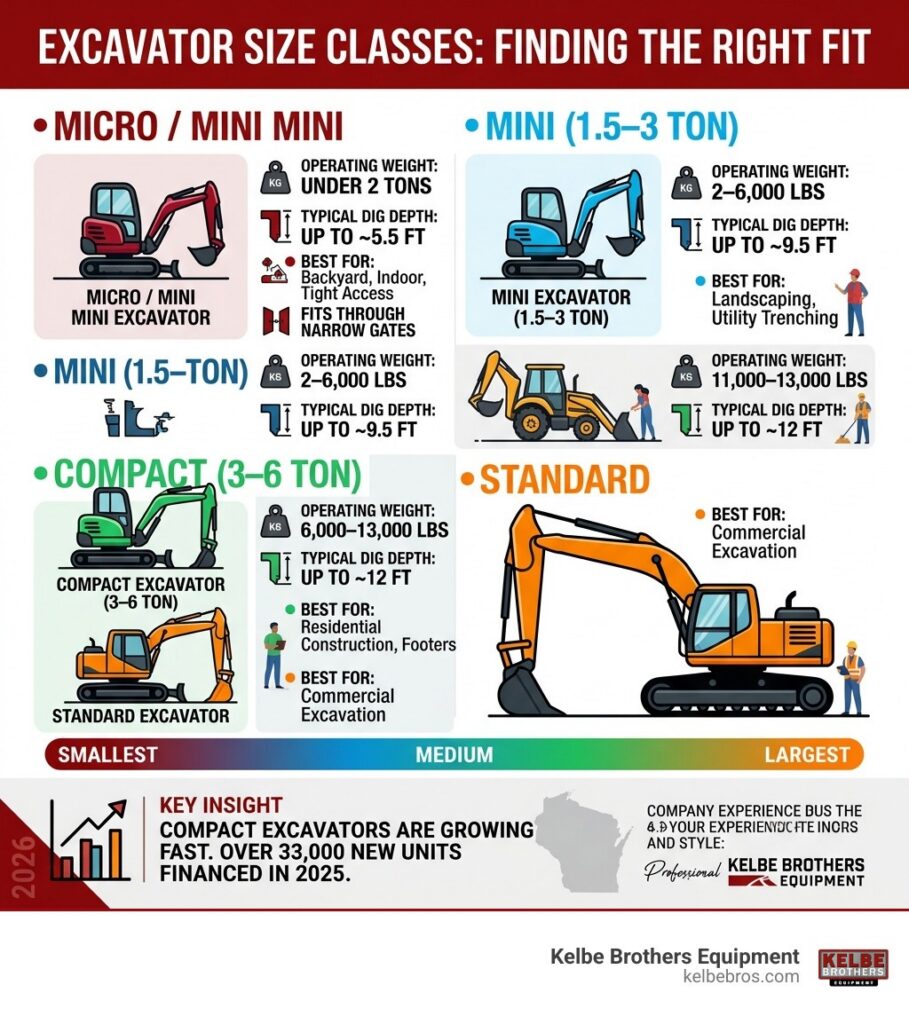
A mini mini excavator — often called a micro excavator or 1-ton class compact excavator — is the smallest category of tracked digging equipment, typically weighing under 2 tons and narrow enough to fit through a standard gate or doorway.
Here’s a quick breakdown of excavator size classes to help you find the right fit:
| Size Class | Operating Weight | Typical Dig Depth | Best For |
| Micro / Mini Mini | Under 2 tons | Up to ~5.5 ft | Backyard, indoor, tight access |
| Mini (1.5–3 ton) | 2–6,000 lbs | Up to ~9.5 ft | Landscaping, utility trenching |
| Compact (3–6 ton) | 6,000–13,000 lbs | Up to ~12 ft | Residential construction, footers |
| Standard | 10+ tons | 12 ft+ | Commercial excavation |
If your jobsite has a narrow gate, a tight urban lot, or ground you can’t afford to tear up, a mini mini excavator is almost certainly the right tool.
Compact excavators are now one of the fastest-growing equipment categories in construction. Over 33,000 new units were financed in 2025 alone — more than double the number sold a decade earlier. That growth isn’t a coincidence. Job sites are getting more complex, and crews need machines that can go where bigger iron simply cannot.
With over 60 years of combined experience helping Wisconsin contractors find the right compact equipment — including the mini mini excavator class — it is clear how the right machine size can make or break a project timeline. In the sections below, we’ll walk through everything you need to know to choose, operate, and maintain these ultra-compact machines.
Understanding the Mini Mini Excavator and Its Role on the Jobsite
When we talk about a mini mini excavator, we are looking at the heavyweights of the “small” world. These machines are engineered to bridge the gap between manual labor and full-scale excavation. While a standard excavator might weigh 15 to 20 tons, a micro or “mini mini” model often tips the scales at just 2,000 to 4,000 pounds.
The most defining characteristic of these machines isn’t just their weight; it’s their width. Many models in this class feature retractable tracks. This allows the operator to shrink the machine’s footprint to less than 30 inches wide—narrow enough to roll through a standard backyard garden gate or even a front door for indoor demolition projects. Once through the opening, the tracks can be hydraulically expanded to provide a stable footprint for digging.
In Wisconsin, we see these machines used heavily for utility installation and indoor renovations. Whether you are trenching for electrical lines in a cramped Milwaukee alleyway or breaking up a concrete floor inside a Madison warehouse, the precision of a small machine is unmatched. Understanding why mini excavator sizes matter for Wisconsin construction projects is the first step in ensuring you don’t bring too much—or too little—iron to the site.
Why a Compact Machine Outperforms Manual Labor
We’ve all been there: staring at a trench that needs to be dug in a spot where you can’t fit a backhoe. In the past, that meant pickaxes, shovels, and a lot of ibuprofen the next morning. A mini mini excavator changes that equation entirely.
Precision digging is the primary advantage. With pilot controls and smooth hydraulics, an operator can dig within inches of a foundation wall or a live utility line without the physical fatigue of manual swinging. For residential projects like planting large trees or installing irrigation, these machines allow a single operator to do the work of a five-person crew in a fraction of the time.
Key Benefits of Using Ultra-Compact Excavation Equipment
The “mini mini” class offers several strategic advantages that larger machines simply cannot replicate.
- Tight Access Mastery: If you can walk through it, a micro excavator can probably drive through it. This opens up revenue streams for contractors in landscaping and interior remodeling that were previously inaccessible to mechanized equipment.
- Zero-Tail-Swing Design: Many Takeuchi Zero Swing Excavators are designed so the rear of the machine stays within the width of the tracks. This means you can rotate 360 degrees without worrying about the back of the cab hitting a fence, a tree, or a building.
- Low Ground Pressure: Because they are lightweight and use rubber tracks, these machines exert very little pressure on the turf. This is essential for why mini excavators are essential for Wisconsin construction and landscaping, as it prevents deep ruts in soft soil or damage to expensive pavers.
- Easy Transport: You don’t need a CDL or a massive semi-truck to move these. Most 1-ton to 2-ton models can be towed behind a standard pickup truck on a utility trailer, making equipment rentals much more accessible for small businesses.
The Power of a Mini Mini Excavator in the 1-2 Ton Class
Don’t let the small stature fool you. Brands like Takeuchi, Hitachi, and New Holland have packed incredible hydraulic performance into these frames. When you look at Takeuchi Zero Swing Excavators or Hitachi Compact Excavators, you’ll find breakout forces that can handle tough Wisconsin clay and frozen winter ground.
The New Holland Mini Excavators are particularly known for their balance of power and comfort. Even in the smallest models, the hydraulic flow is optimized to run attachments like augers or breakers without losing cycle speed. This ensures that even though the machine is small, it still works with the “big machine” urgency required on professional jobsites.
Essential Specifications: Weight, Dig Depth, and Tail Swing
When browsing mini excavators for sale, it is easy to get lost in the numbers. However, for the “mini mini” class, three specs reign supreme: operating weight, dig depth, and tail swing type.
| Feature | 1-Ton Model (e.g., Micro) | 2-Ton Model (e.g., Mini) |
| Operating Weight | ~2,200 lbs | ~4,500 lbs |
| Dig Depth | 5.5 ft – 6 ft | 7.5 ft – 8.5 ft |
| Max Reach | 10 ft | 13 ft |
| Horsepower | 10 – 15 HP | 18 – 25 HP |
Choosing between a canopy and a cab is another big decision. For indoor work or tight residential spots, a canopy is often preferred because it offers better visibility and can sometimes be folded down to clear low overhead obstacles. However, if you are working through a Wisconsin winter in Green Bay or Milwaukee, a heated cab on a slightly larger 2-ton model might be worth the extra weight.
Choosing the Right Mini Mini Excavator for Wisconsin Soil
Our local geography presents unique challenges. From the heavy clay of the Fox Valley to the rocky terrain further north, your machine needs to stay grounded. A mini mini excavator with a wide blade and a retractable undercarriage allows you to expand the tracks for maximum stability when digging in tough conditions.
The power in a compact package: the 2-ton mini excavator is often the “sweet spot” for Wisconsin soil. It provides enough downward pressure on the blade to keep the machine from hopping during a difficult dig, while still being small enough to fit into a backyard in Butler or De Pere.
Maximizing Versatility with Attachments and Maintenance
A mini mini excavator is only as good as the tool on the end of its arm. By using quick couplers, operators can switch between a standard bucket and a specialized attachment in minutes.
- Hydraulic Thumbs: Essential for picking up rocks, brush, or demolition debris.
- Augers: Perfect for fence posts or sonotube footings in residential landscaping.
- Grading Blades: Used for finishing work and spreading topsoil after a project.
- Hammers/Breakers: Turn your micro excavator into a demolition powerhouse for concrete removal.
Versatility also depends on upkeep. Maintaining your compact excavator is critical for these smaller machines because their hydraulic systems operate at high pressures with smaller fluid reservoirs. Keeping filters clean and greasing the pivot points daily ensures your Takeuchi, Hitachi, or New Holland machine stays in the field and out of the shop.
Top Models from Takeuchi, Hitachi, and New Holland
We focus on brands that offer the best reliability and operator comfort.
- Takeuchi Compact Excavators: Known for their rugged, all-steel construction. They are built like tanks and are a favorite for heavy-duty rental fleets.
- Hitachi Compact Excavators: These offer some of the smoothest hydraulics in the industry. If you need surgical precision around existing utilities, Hitachi is a top contender.
- New Holland Mini Excavators: These machines excel in operator ergonomics. They often feature spacious cabs (for their size) and intuitive controls that reduce operator fatigue during long shifts.
Whether you are looking for construction equipment for sale or exploring excavator rental options, these brands represent the gold standard of compact performance.
Frequently Asked Questions about Mini Mini Excavators
What is the difference between a micro and a mini excavator?
While the terms are often used interchangeably, a “micro” excavator (or mini mini excavator) typically refers to machines under 2,000 to 3,000 lbs that can fit through a 30-inch opening. A “mini” excavator generally covers the 3,000 to 12,000 lb range and is used for more traditional outdoor construction.
Can a mini excavator fit through a standard doorway?
Yes, many micro models feature retractable tracks and folding ROPS (Roll-Over Protective Structures) specifically designed to clear a standard 30-inch to 32-inch interior doorway. This makes them ideal for interior basement excavations or commercial interior demolition.
What are the maintenance requirements for compact track equipment?
Daily maintenance includes checking engine oil, hydraulic fluid levels, and greasing all pins and bushings. Because these machines often work in dusty or muddy conditions, cleaning the undercarriage and checking track tension is vital to prevent premature wear on the rubber tracks.
Conclusion
The rise of the mini mini excavator has changed the way we think about small-scale construction in Wisconsin. From the tight urban corridors of Milwaukee to residential backyards in Madison and Green Bay, these machines provide the power of a crew in a package that fits through a garden gate.
As a fourth-generation, family-owned company, we are dedicated to helping local contractors succeed. Whether you are looking for Takeuchi excavators, Hitachi excavators, or New Holland mini excavators, we provide the expertise, flexible financing, and 24/7 emergency support you need to keep your jobsite moving.
Ready to see what a compact machine can do for your next project? Explore our new equipment inventory today or visit one of our locations in Milwaukee, Madison, or Green Bay to speak with our experienced staff. We offer everything from used construction equipment for sale to the latest construction equipment rentals, ensuring you always have the right tool for the job.