




The Complete Guide to Excavator Parts
Excavator parts are the essential components that keep your heavy machinery running efficiently on the job site. When you understand what these parts are, how they work together, and how to maintain them, you reduce costly downtime and keep your projects on schedule.
Main Excavator Parts at a Glance:
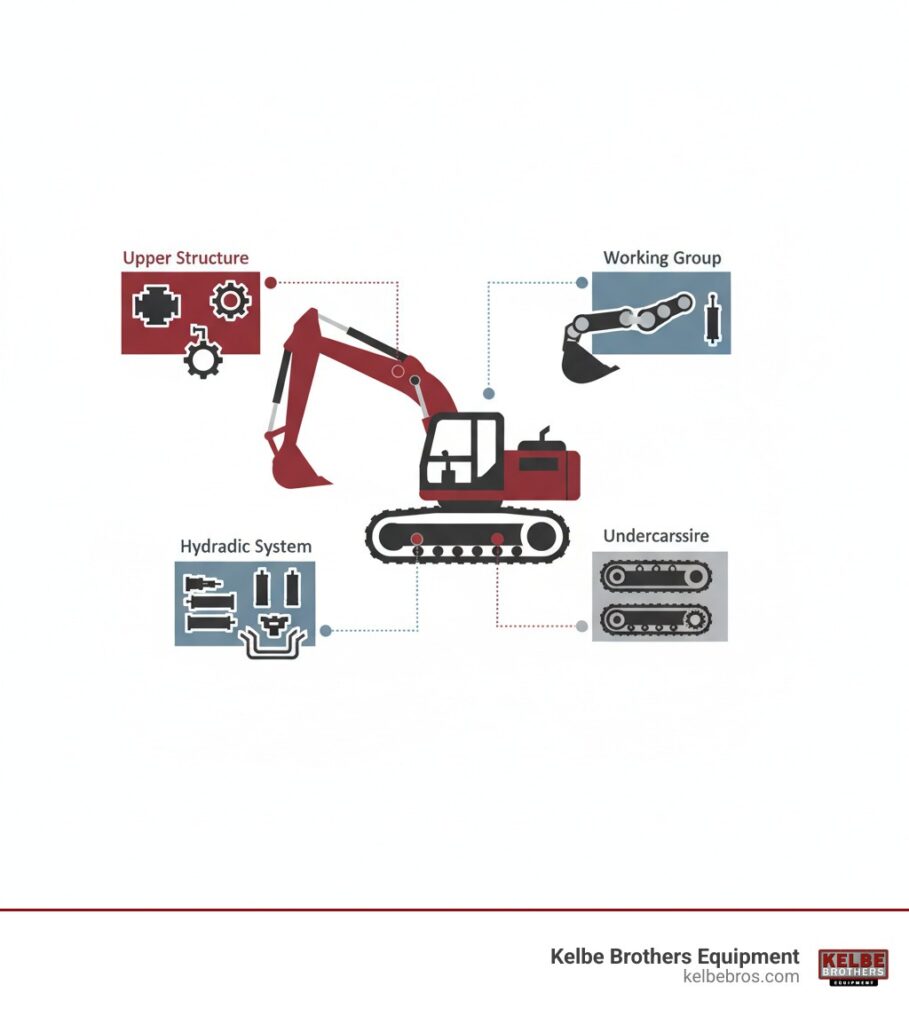
- Upper Structure – Engine, cab, control systems, and swing mechanism
- Working Group – Boom, arm (stick), and bucket attachments
- Hydraulic System – Pumps, cylinders, control valves, and hoses that power movement
- Undercarriage – Tracks, rollers, sprockets, idlers, and adjusters for stability and mobility
- Operator Controls – Joysticks, levers, displays, and safety features
For Wisconsin construction managers facing tight deadlines, knowing which excavator parts need regular attention can mean the difference between meeting your schedule and watching your crew sit idle. Every hour of downtime costs money and delays the entire project.
I’m Jeffrey J. Miller, President of Kelbe Brothers Equipment, and over my years in the construction equipment industry, I’ve seen how proper knowledge of excavator parts helps managers like you prevent breakdowns and keep machines productive. Whether you’re running Hitachi Excavators, Link-Belt Excavators, or Takeuchi Compact Excavators, understanding your equipment’s anatomy is your first step toward maximizing uptime.
Anatomy of an Excavator: Core Components and Functions
Every excavator is built from several interconnected systems working together to deliver the power and precision you need on the job site. When you understand how these excavator parts fit together, you’re better equipped to spot problems early and keep your machine running smoothly.
The upper structure – sometimes called the “house” – sits on top and rotates a full 360 degrees. This is where you’ll find the engine, the operator’s cab, and the swing mechanism. That rotation happens on a component called the slew ring, which lets the operator work in any direction without moving the tracks. It’s what makes an excavator so versatile compared to other equipment.
Inside that upper structure, the engine generates all the power needed to run the hydraulic systems and other components. Modern engines deliver impressive power while using less fuel than older models – something that matters when you’re running long days on the job site.
The swing mechanism itself combines a swing motor with a gearbox to create smooth, controlled rotation. This precision movement lets operators reposition the boom and bucket quickly, whether they’re digging a trench or loading a truck. It’s one of those features that seems simple until you’ve operated equipment without it.
The control systems tie everything together, giving the operator command over each movement. We’ll explore those controls in more detail in just a moment.
Getting familiar with these core excavator parts helps you make smarter decisions about operation and maintenance. It’s not just about memorizing component names – it’s about understanding how each piece contributes to the machine’s ability to dig, lift, and move materials with remarkable force and accuracy.
The Working Group: Boom, Arm, and Bucket
The “working group” is where the real action happens. This is the visible part of the excavator that everyone recognizes – the arm that reaches out, digs deep, and lifts heavy loads. It’s made up of three main excavator parts that work in concert: the boom, the arm (sometimes called the dipper or stick), and the bucket.
The boom extends directly from the upper structure and provides the primary reach. Think of it as the machine’s shoulder and upper arm – it gives you the vertical lift and horizontal extension needed to get to your work area. Without a strong, well-maintained boom, your excavator can’t deliver the reach that makes these machines so valuable.
Connected to the boom’s end, the arm (or dipper/stick) adds another joint of articulation. This is like the excavator’s forearm, providing additional reach and flexibility. The arm lets you dig deeper, reach farther, and work at different angles. When an operator needs to grade a slope or dig a precise trench, the arm’s movement is what makes that accuracy possible.
At the business end, you’ll find the bucket. This is what actually touches the ground, scoops the material, and gets the work done. Buckets come in many shapes and sizes depending on the job. A general-purpose bucket works well for loose soil and loading operations. Heavy-duty buckets handle tougher conditions with reinforced edges and thicker steel. Specialized buckets like trenching buckets create narrow, deep cuts, while grading buckets help create smooth, level surfaces.
But the versatility doesn’t stop with buckets. Modern excavators accept a wide range of attachments that transform them into multi-purpose machines. Hydraulic breakers demolish concrete and break up rock. Grapples handle demolition debris or move logs and scrap. Augers drill holes for posts or foundations. These attachments expand the capabilities of Link-Belt Excavators, Hitachi Excavators, and Takeuchi Compact Excavators, letting you tackle multiple types of work with one machine. Takeuchi Zero Swing Excavators particularly shine in tight urban spaces, and when you add specialized attachments, they become even more valuable on confined job sites.
The boom, arm, and bucket endure tremendous stress during normal operation. Regular inspections catch wear before it becomes a problem. Keeping pivot points properly lubricated reduces friction and extends component life. A little preventive care on these excavator parts saves you from expensive repairs and unexpected downtime.
The Operator’s Hub: Cab and Control Systems
The operator’s cab is where human skill meets machine capability. It’s far more than just a seat with a view – it’s a carefully designed workspace where operators spend entire shifts controlling tons of steel and hydraulic power. When we set up Takeuchi Compact Excavators, Hitachi Compact Excavators, or Link-Belt Excavators for our customers, we know that cab comfort directly affects productivity.
Inside, you’ll find the joysticks and levers that translate the operator’s intentions into machine movement. Push forward, and the boom extends. Move the joystick left, and the bucket curls. These controls have become remarkably intuitive over the years, but they still require skill to operate efficiently. Modern cabs feature ergonomic designs with adjustable seating, climate control systems, and digital displays that show machine status at a glance. Some newer models include touchscreen displays with radio and Bluetooth connectivity – small comforts that make long workdays more bearable.
Safety features in the cab protect the operator when things go wrong. ROPS (Roll Over Protective Structure) and FOPS (Falling Object Protective Structure) are built into the cab frame to shield the operator if the machine tips or if debris falls from above. These aren’t optional extras – they’re essential protection that can save lives on active construction sites.
Beyond the basic controls, many excavators now integrate advanced guidance systems that use GPS and 3D modeling. These systems give operators real-time information about digging depth, grade, and position. Instead of constantly checking grade stakes or calling for measurements, operators can see exactly where they are and where they need to be. This technology dramatically improves precision and speeds up work, especially on grading and excavation projects with tight tolerances. Several of our Takeuchi Compact Excavators come equipped with these digital technologies, giving operators exceptional precision even on demanding jobs.
The cab is where operator experience combines with machine capability. A comfortable, well-equipped operator station with responsive controls helps your crew work faster, safer, and with better results.
The Powerhouse: Understanding the Hydraulic System
Think of the hydraulic system as the excavator’s bloodstream. Just as blood carries energy throughout your body, hydraulic fluid carries power throughout the machine. Without a healthy hydraulic system, even the most expensive excavator becomes an oversized paperweight.
Here’s how it works: hydraulic fluid, usually a specialized oil, gets pressurized by a pump and flows through a network of hoses, valves, and cylinders. The engine provides the initial mechanical energy, which the hydraulic system converts into fluid power. That pressurized fluid then creates the massive force needed to lift tons of material or the delicate touch required to grade a precise slope.
What makes hydraulics so remarkable is this combination of raw power and fine control. An operator can smoothly transition from forcefully breaking through compacted soil to gently placing a load, all through subtle movements of the joysticks. Whether you’re running one of our Hitachi Excavators on a large-scale project or maneuvering a Takeuchi Compact Excavator in tight quarters, that hydraulic responsiveness makes all the difference.
The hydraulic system enables the boom to reach skyward, the arm to extend and curl, the bucket to dig deep, and the entire upper structure to swing in a full circle. It’s what transforms an excavator from a static machine into a dynamic workhorse capable of tackling diverse tasks with precision and efficiency.
Key Hydraulic Excavator Parts
Every hydraulic system depends on several critical excavator parts working together seamlessly. The hydraulic pump serves as the beating heart, driven directly by the engine. It pulls fluid from the reservoir and pressurizes it, creating the force that powers everything downstream. When a pump starts failing, you’ll notice it immediately in reduced performance across the entire machine.
The hydraulic cylinders are where that pressurized fluid gets converted into actual movement. Each major component of the working group has its own dedicated cylinder. The boom cylinder provides lifting force, the arm cylinder controls reach and curl, and the bucket cylinder operates the digging action. Inside each cylinder, seals keep the fluid contained while allowing a piston to move back and forth, creating that push-and-pull motion we see in the excavator’s movements.
Directing all this power is the control valve, sometimes called the main control valve. This sophisticated component acts like a traffic controller, routing hydraulic fluid to exactly where it needs to go based on what the operator does with the joysticks. It allows multiple functions to work simultaneously and independently, so you can swing while lifting while curling the bucket, all at the same time.
Connecting everything together is an extensive network of hydraulic hoses and lines. These carry high-pressure fluid throughout the machine, from the pump to the cylinders and back to the reservoir. They need to be tough enough to handle extreme pressure while flexible enough to move with the machine. We’ve seen too many job sites go quiet because of a burst hose that could have been prevented with regular inspection. That’s why we emphasize following Best Practice: Hydraulic Hose guidelines for all our Link-Belt Excavators, New Holland Mini Excavators, and Takeuchi Compact Excavators.
Hydraulic System Maintenance
Taking care of your hydraulic system isn’t optional if you want to avoid expensive surprises. The good news is that most hydraulic problems announce themselves before they become catastrophic, if you’re paying attention.
Checking your hydraulic fluid should be part of your daily routine. The fluid level needs to stay within the proper range, and the fluid itself should look clean. Dark, milky, or contaminated fluid means trouble is brewing. This fluid is doing double duty as both a power transmitter and a lubricant for the entire system.
Preventing leaks requires vigilance. Walk around your machine and look at all the hoses, cylinders, and connections. A small drip today becomes a puddle tomorrow and a failed component next week. Most leaks start at seals or hose connections, and catching them early means a quick fix instead of a major repair bill.
Changing filters on schedule keeps contaminants from damaging sensitive components. Hydraulic filters trap the tiny particles of metal and dirt that naturally accumulate in the system. Skip this maintenance, and those particles act like sandpaper on your pump, valves, and cylinders.
When you notice performance issues like sluggish operation, weak digging force, or strange noises, don’t ignore them. These symptoms often point to hydraulic problems that need immediate attention. Our Factory Trained Technicians can diagnose issues quickly, and regular Fluid Analysis can spot contamination or abnormal wear before it sidelines your machine. We’ve helped countless Wisconsin contractors avoid costly downtime by catching hydraulic problems early, keeping their projects moving forward without interruption.
The Foundation: Undercarriage Components and Stability
When people think about excavators, they picture the boom swinging and the bucket digging. But here’s the truth: without a solid undercarriage, that impressive upper structure isn’t going anywhere. The undercarriage is the foundation that makes everything else possible.
These critical excavator parts are what give your machine its mobility and stability. They’re the reason you can steer rough terrain, maintain balance on slopes, and distribute the machine’s weight evenly across soft or uneven ground. Think of the undercarriage as the machine’s feet – they need to be strong, stable, and well-maintained to keep the entire operation running smoothly.
For our Takeuchi Compact Track Loaders, New Holland Compact Track Loaders: 200 Series, Link-Belt Excavators, and Hitachi Excavators, the undercarriage takes a beating day in and day out. It’s constantly dealing with rocks, mud, debris, and the sheer weight of the machine above it. That’s why we put such emphasis on proper Undercarriage Maintenance – because when the foundation fails, everything stops.
Critical Undercarriage Excavator Parts
Let’s talk about what’s actually down there under your machine. The tracks are what most people notice first. You’ll find two main types: steel tracks built for punishment on rocky, abrasive terrain where traction and durability are everything, and rubber tracks that you’ll see on machines like Takeuchi Compact Excavators and New Holland Mini Excavators. Rubber tracks are the gentler option – they’re kinder to finished surfaces like asphalt or concrete, they reduce vibration for the operator, and they’re perfect for urban job sites where you can’t afford to tear up the ground.
The bottom rollers, sometimes called track rollers, are the workhorses of the undercarriage. They’re constantly supporting the machine’s weight while guiding the track chain along the ground. Because they’re always in contact with both the track and whatever surface you’re working on, they take tremendous wear. Meanwhile, top rollers (or carrier rollers) keep the upper section of track from sagging as it travels from the sprocket back to the idler.
At the rear of the undercarriage, you’ll find the sprockets – those large, toothed wheels that grab onto the track chain and actually move the machine forward or backward. They’re receiving power from the final drive and converting it into motion. Up front, the idlers guide the track and help absorb shocks from rough terrain. They’re essential for smooth operation and protecting the rest of the undercarriage from excessive impact.
Finally, there are the track adjusters, typically hydraulic components that let you fine-tune the tension of your track chain. Getting this tension right is absolutely critical. Too loose, and your track might come off completely – which is not a fun repair to make in the middle of a job site. Too tight, and you’ll wear out your rollers and sprockets prematurely, costing you money and downtime. Our guide on Best Practice: Undercarriage Maintenance and Adjusting Track Tension walks you through exactly how to get it right.
Understanding these excavator parts isn’t just about knowing their names. It’s about recognizing that the undercarriage represents a significant portion of your machine’s value and directly impacts how efficiently you can work. Regular inspections, proper cleaning to remove packed debris, and staying on top of wear patterns will extend the life of these components and keep your Hitachi Excavators, Link-Belt Excavators, and Takeuchi machines productive for years to come.
Sourcing and Maintaining Quality Excavator Parts
Here’s the truth: the quality of your excavator parts directly impacts how long your machines last and how much money you keep in your pocket. Whether you’re running Hitachi Excavators or Link-Belt Excavators, making smart choices about replacement parts and staying on top of maintenance can mean the difference between a machine that serves you for decades and one that becomes a money pit.
We’ve seen it time and again – contractors who invest in quality parts and follow a solid maintenance routine experience far less downtime and avoid those budget-busting emergency repairs. Every hour your excavator sits idle is money lost, which is why we’re passionate about helping you make informed decisions. For a comprehensive look at keeping your fleet healthy, check out our Heavy Equipment Maintenance Best Practices.
Types of Replacement Parts
When it’s time to replace an excavator part, you’re faced with several options. Each type has its place, and understanding the trade-offs helps you choose what’s right for your situation and budget.
| Part Type | Pros | Cons |
| New OEM Parts | Perfect fit guaranteed; manufacturer warranty; highest quality and reliability; optimal performance for Hitachi Wheel Loaders, Link-Belt Excavators, and other premium machines | Higher upfront cost; may have longer lead times for specialty items |
| Aftermarket Parts | Lower cost; wider availability; competitive quality from reputable suppliers; good for non-critical components | Variable quality between suppliers; may void warranties; compatibility questions on complex systems |
| Used Components | Significant cost savings; environmentally friendly; good option for older machines; available through Used Construction Equipment For Sale | Unknown wear history; limited or no warranty; may have hidden damage; shorter remaining lifespan |
| Rebuilt Parts | Professional restoration to like-new condition; more affordable than new; warranty often included; good balance of cost and reliability | Quality depends on rebuilder’s expertise; may not match new part longevity; core exchange sometimes required |
New OEM parts are the gold standard. When you’re maintaining premium machines like Hitachi Excavators or Link-Belt Excavators, these parts are engineered specifically for your equipment. They fit perfectly, come with manufacturer backing, and deliver the performance you expect. Yes, they cost more upfront, but they often save you money over time by lasting longer and preventing secondary damage.
Aftermarket parts have come a long way. Reputable suppliers now produce components that rival OEM quality at friendlier price points. They’re often a smart choice for filters, wear items, and less critical components. Just be careful – not all aftermarket suppliers are created equal, and cutting corners on quality can backfire.
Used components can be a lifesaver when you need to keep an older machine running or you’re facing budget constraints. We’ve helped many Wisconsin contractors find quality used parts that kept their projects moving. The key is buying from trusted sources who inspect and stand behind what they sell. Our Used Construction Equipment For Sale inventory often includes machines that can serve as parts sources.
Rebuilt parts offer an appealing middle ground. A professionally rebuilt hydraulic pump or final drive can give you near-new performance at a fraction of the cost. These parts have been disassembled, inspected, refurbished with new wear components, and tested. When done right by experienced technicians, rebuilds are an excellent value.
Factors for Choosing the Right Parts
Finding the right excavator parts involves more than just matching a part number. Several critical factors should guide your decision.
Machine compatibility is non-negotiable. A part that fits one model of Hitachi Wheel Loaders might not work on another, even if they look similar. This is especially true for sophisticated components like control valves or electronic modules. Always verify compatibility before ordering, whether you’re working on New Holland Mini Excavators, Takeuchi Compact Excavators, or Link-Belt Excavators.
Quality and material matter tremendously. A cheaper bucket tooth might save you a few dollars today, but if it wears out twice as fast or breaks under load, you’re losing money. For critical components – hydraulic cylinders, structural elements, engine parts – we always recommend prioritizing quality over initial cost. Your Hitachi Excavators and Link-Belt Excavators deserve parts that match their engineering standards.
Supplier reliability can make or break your project timeline. You need parts when you need them, not “sometime next week.” We pride ourselves on rapid response and keeping critical excavator parts in stock because we understand Wisconsin contractors can’t afford to wait. Look for suppliers with deep inventory, knowledgeable staff, and a track record of delivering on promises.
Using parts diagrams is your secret weapon for getting the right part the first time. These detailed illustrations show exactly how components fit together and their proper part numbers. They’re invaluable whether you’re ordering for Takeuchi Compact Excavators or New Holland Mini Excavators.
Essential Maintenance for Part Longevity
Even the highest-quality excavator parts won’t last if you neglect basic maintenance. Think of it this way: you wouldn’t skip oil changes on your truck and expect it to run forever. Your excavators deserve the same care.
Regular inspections catch small problems before they become expensive disasters. Walk around your Hitachi Excavators, Link-Belt Excavators, or Takeuchi Compact Excavators at the start of each day. Look for leaks, listen for unusual noises, check for loose bolts or damaged hoses. Five minutes of attention can save thousands in repairs. Our Preventive Maintenance program takes this systematic approach to keep your fleet healthy.
Proper lubrication is the lifeblood of moving parts. Grease those pins, fill those zerks, and don’t skip the hard-to-reach spots. Inadequate lubrication is one of the fastest ways to destroy expensive components like boom pins, bucket linkages, and undercarriage parts. The few minutes spent greasing pays back tenfold in extended part life.
Cleaning procedures might seem like just making things look pretty, but they serve a real purpose. Built-up dirt and debris trap moisture, leading to corrosion. They also hide developing problems and can interfere with moving parts. A clean machine is easier to inspect and tends to run better. After working in muddy conditions, take time to wash down your New Holland Mini Excavators or Takeuchi Zero Swing Excavators.
Following manufacturer guidelines isn’t just covering your backside for warranty purposes – though it does that too. Those service intervals and specifications exist because engineers determine what your equipment needs to perform reliably. Whether you’re maintaining Hitachi Wheel Loaders or New Holland Compact Track Loaders: 200 Series, the manufacturer’s maintenance schedule represents years of testing and real-world experience. Our Factory Trained Technicians follow these guidelines religiously because they work.
The bottom line? Quality parts combined with consistent maintenance create a powerful combination that maximizes your return on investment and keeps your projects moving forward.