




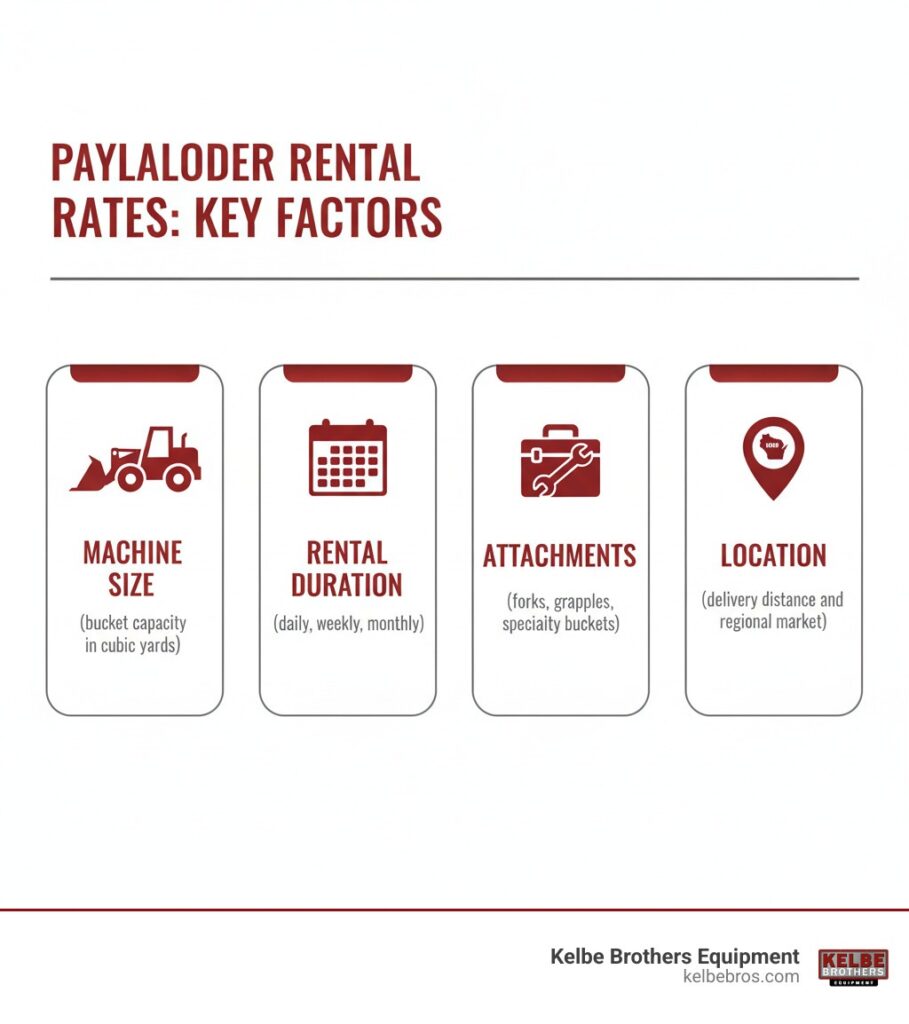
Understanding payloader rentals is essential for any construction manager before breaking ground. The structure of a rental agreement depends on several key factors, including machine size, rental duration, and location.
Key factors that shape your rental agreement:
- Machine size – Bucket capacity (measured in cubic yards) directly impacts performance.
- Rental duration – Longer rental periods are structured differently than short-term rentals.
- Attachments – Specialized buckets, forks, or grapples alter the machine’s function.
- Location – Delivery distance and regional logistics affect the overall arrangement.
When your project timeline tightens, knowing what drives rental agreements helps you make faster, smarter decisions. A wheel loader, also called a payloader or front-end loader, is one of the most versatile machines on any Wisconsin construction site. These articulated machines excel at moving dirt, loading trucks, clearing debris, and handling materials for projects of all scales.
The challenge? Rental terms vary widely based on factors that aren’t always obvious upfront. Understanding these variables helps you plan accurately and avoid surprises.
With years of experience helping Wisconsin contractors steer equipment decisions for projects of all sizes, my goal is to help you see exactly how to get the best value for your specific project needs.
Understanding the Basics: What is a Payloader?
Have you ever wondered what makes a construction site tick? Often, it’s the mighty payloader leading the charge! Also known as a wheel loader or front-end loader, this impressive machine is a true workhorse, easily identified by its large front-mounted bucket. It’s truly one of the powerhouses behind modern construction.
These machines are essential for earthmoving, material handling, and jobsite cleanup. They are heroes of snow removal in Wisconsin winters and excel at loading trucks with excavated material or aggregates. From aggregate movement to site preparation, a payloader significantly speeds up operations.
Types of Loaders and Their Applications
The world of loaders is diverse, with each type built for specific challenges. When we talk about payloaders, we’re usually thinking of larger, articulated machines. Our fleet includes top-notch choices like robust Hitachi Wheel Loaders, dependable New Holland Wheel Loaders, and agile Takeuchi Compact Wheel Loaders. These are designed for demanding tasks, boasting impressive capacities for moving large volumes of material.
For tighter spots or when you need an extra nimble machine, our New Holland Compact Track Loaders are a fantastic pick. They offer superb traction and float well on softer ground, making them incredibly versatile. Choosing the right machine provides the best jobsite versatility for your project’s unique needs.
Wheel Loader vs. Track Loader
One common question is about the difference between a wheel loader and a track loader. While both move materials, their designs mean they shine in different situations.
Wheel loaders, like our Hitachi and New Holland models, run on rubber tires, making them much quicker on the move. This great mobility is ideal for large sites with firm ground, hard dirt, or pavement.
On the other hand, track loaders, such as the New Holland Skid Steer Loaders: 200 Series and Takeuchi Compact Track Loaders, use continuous tracks. This design gives them incredible traction and allows them to “float” over soft, uneven, or muddy terrain. Their tracks spread the machine’s weight over a larger area, reducing ground pressure and preventing it from getting stuck. While they might be slower, their stability and grip in challenging ground conditions are best.
The ultimate choice between a wheel loader and a track loader comes down to your project’s specific demands and jobsite conditions.
Key Factors That Influence Payloader Rentals
When you’re planning a construction project in Wisconsin, understanding what drives payloader rentals helps you plan effectively. The arrangement isn’t just about picking a machine—several interconnected factors shape the final agreement, from how long you need the equipment to where it’s going and what it needs to do.
The Role of Rental Duration
The length of time you need a payloader makes a significant difference. Rental agreements are structured to accommodate different project timelines.
Daily rentals work perfectly for quick, single-day jobs. You get in, get the work done, and return the equipment without a long commitment.
Weekly rentals are suited for projects spanning several days. This option provides a straightforward solution for many mid-sized projects.
Monthly rentals—typically structured as 4-week periods—are designed for extended projects. For major site development or multi-phase construction, this option provides equipment for the long haul.
Project timelines shift, and we work with you to accommodate extensions or early returns, giving you flexibility. This approach aligns perfectly with what complete rentals for modern projects entail.
The Impact of Size and Capacity
The machine’s physical capabilities directly influence the rental. Larger, more powerful equipment is built for bigger tasks, and matching the machine to the job is key to efficiency.
Bucket capacity, measured in cubic yards, tells you how much material the loader moves in each scoop. A compact loader with a 1-yard bucket suits lighter work, while heavy construction demands a 3-yard bucket or larger. Understanding a 1-yard loader bucket helps explain smaller applications, while knowing why 3-yard buckets are essential for heavy-duty construction work covers when you need serious capacity.
Operating weight indicates the machine’s mass and correlates with stability. A heavier Hitachi Wheel Loader or New Holland Wheel Loader provides the stability needed for lifting heavy loads. The horsepower rating shows the engine’s muscle—more horsepower means faster cycle times and better performance.
Tipping load is a critical specification for safety and capability, indicating the maximum weight the loader can lift before becoming unstable. Matching the machine’s tipping load to your material weights is about keeping your crew safe.
The goal is to match the equipment’s capabilities to your actual project demands. Our experienced staff helps you find that balance.
The Role of Attachments and Location
Beyond the base machine and rental duration, two additional factors shape your rental: the attachments you need and your jobsite’s location.
Modern payloaders are incredibly adaptable thanks to attachments. Standard buckets handle most earthmoving, but forks turn your loader into a heavy-duty forklift. Grapple buckets handle irregular debris, and brooms convert your loader into a sweeping machine. These attachments rent separately but often eliminate the need for additional specialized equipment.
Location and delivery represent the other major variable. Getting a payloader from our yard to your jobsite in Milwaukee, Madison, or Green Bay involves transportation and logistics. The farther your site, the more complex the mobilization. We are transparent about these logistics to help you plan better, which is why finding the right equipment rental covers not just equipment selection but also these practical considerations.
Choosing the Right Machine: Key Specifications to Consider
When you’re ready to select a payloader, it’s about more than just picking the most available machine. Diving into the details of its specifications ensures you’re getting a workhorse that’s perfectly suited for the job, leading to greater efficiency and a more successful project.
We look beyond just bucket size and consider a few crucial specifications. The machine’s Operating Weight tells you about its stability. Horsepower (HP) is key for understanding its digging and travel power. Dump Clearance is important for loading high-sided dump trucks. You’ll also want to know the Breakout Force, which measures the power to break through tough material. Finally, Tipping Load is a critical safety spec, indicating the maximum weight the loader can safely lift before becoming unstable.
These specifications are your roadmap to choosing a machine that can handle your project’s demands. Whether you’re looking at New Holland Mini Excavators or mighty Hitachi Wheel Loaders, understanding these numbers helps you make a smart choice. These machines are truly the earth-moving giants of modern construction!
Matching the Machine to the Job
The “right” machine is the one that perfectly balances its capabilities with your project’s needs. This balance directly impacts your overall project efficiency.
For instance, for landscaping or moving smaller amounts of material, a compact wheel loader or a modest New Holland Wheel Loader might be ideal. But for large-scale road construction, a robust Hitachi Wheel Loader with a high bucket capacity will be your best friend. Tasks like material stockpiling and debris removal also benefit from machines with the appropriate size and power. For specialized digging, you might consider other heavy equipment from our fleet, such as Hitachi Excavators or Link-Belt Excavators. Just like with loaders, finding the right excavator rental involves similar considerations.
Understanding Operator Comfort and Efficiency
A comfortable operator is a productive operator. Modern payloaders are designed with this in mind, and these features contribute significantly to your project’s overall efficiency. When your operator is effective, your project stays on schedule.
Look for machines that offer excellent Cab Visibility for safety and precision. Ergonomic Joystick Controls reduce operator fatigue during long shifts. Features like Power Steering and an Automatic Transmission simplify operation and make maneuvering heavy machinery less strenuous. These design elements, found in dependable machines like Takeuchi Compact Excavators, work together to minimize operator fatigue and maximize productivity. For those working with smaller machinery, such comfort and efficiency considerations are equally vital when getting your hands on the right equipment, such as a mini excavator rental.
The Rental Process & Additional Considerations
Renting a payloader involves more than just picking a machine. The process involves paperwork, insurance, and logistics that are best understood upfront. We’ve walked hundreds of Wisconsin contractors through this process, and knowing the details makes everything smoother.
The rental agreement is your roadmap. It spells out responsibilities, the rental term, and the expected condition of the equipment upon return. We keep our agreements straightforward, but it’s always worth reading carefully.
Insurance requirements are non-negotiable. You’ll need contractor’s equipment insurance or an inland marine policy that covers the full replacement value of the machine. We must be named as an additional insured and loss payee. A quick call to your insurance agent before renting saves headaches later.
Regarding the fuel policy, we deliver every machine with a full tank of diesel and DEF (Diesel Exhaust Fluid). We expect it back the same way. If returned with less, refueling will be handled by us as outlined in the agreement.
Operator responsibility falls squarely on your shoulders. You are responsible for ensuring that whoever runs the machine is competent, trained, and certified. The operator should be familiar with the specific model and follow all of OSHA’s guidelines on heavy equipment operation. We’re happy to provide guidance on the machine’s features.
Maintenance during your rental is a shared responsibility. We handle major repairs, but daily checks like greasing points and monitoring fluid levels are on you. This keeps the machine running smoothly and helps you avoid downtime.
Delivery and pickup logistics are based on your job site’s distance from our yard and the machine’s size. We work hard to keep mobilization efficient. Understanding these logistics is as important as finding the right equipment rental.
Optional damage waivers can provide an extra layer of protection for certain types of damage, complementing your primary insurance. We’ll walk you through what’s available.
For comprehensive guidance, best practices for heavy equipment rental cover everything from planning to safe operation. The same attention to detail applies whether you’re renting a payloader or exploring why a skid steer rental is your project’s best solution.
Renting vs. Owning: Making the Smart Choice
The rent-versus-buy question is common, and the best choice depends on your operational needs and equipment utilization.
Renting makes sense when you use equipment occasionally or for specific projects. It gives you access to the latest technology and a wide range of machines without the responsibilities of ownership, such as storage and long-term maintenance. Renting is ideal when you need a machine for a specific job, require a temporary replacement, or need to fill a short-term gap in your fleet.
Owning might be your better bet if you use the same type of equipment constantly, on a near-daily basis. When a machine is a core part of your daily operations across most projects, ownership can provide immediate availability and control.
Many contractors find that a mix of owned and rented equipment offers the most flexibility. They own their core machines and rent specialized equipment or extra capacity as projects demand. This hybrid approach ensures they always have the right tool for the job. That’s often why renting is a good idea for growing businesses.
Frequently Asked Questions about Payloader Rentals
When you’re planning a project, you naturally have questions. We’ve been helping Wisconsin contractors steer equipment decisions for generations, and these are the conversations we have almost every day.
What are the typical rental durations available for payloaders?
Most payloaders—whether you’re looking at Hitachi Wheel Loaders, New Holland Wheel Loaders, or Takeuchi Compact Wheel Loaders—are available for daily, weekly, and monthly (4-week) rental periods. This flexibility allows you to align the equipment rental with your specific project timeline.
We understand that construction schedules can change. That’s why we work with you to provide flexible options that match your actual timeline, not just what you anticipated when you first called.
Do I need special insurance to rent a payloader?
Yes, and this is non-negotiable for your protection and ours. All heavy equipment rentals require proof of insurance, typically called contractor’s equipment insurance or an inland marine policy. Your policy must cover the full replacement value of the rented machine and name us as an additional insured and loss payee.
This isn’t just paperwork—it’s about ensuring you’re protected. We strongly recommend speaking with your insurance provider well before your rental period begins to get the certificate of insurance sorted out early and avoid delays.
What is the difference between a payloader (wheel loader) and a skid steer?
This is an important distinction that affects project efficiency. A payloader, or wheel loader, is a larger, articulated machine designed for moving large volumes of material over longer distances on a job site. It’s your workhorse for heavy lifting and bulk material handling.
A skid steer, like our New Holland 200 Series Skid Steer Loaders, is smaller, incredibly maneuverable in tight spaces, and accepts a wide variety of attachments. Takeuchi Compact Track Loaders offer similar versatility with the added benefit of tracks for superior traction on softer ground.
While both are loaders, their scale and primary applications differ. If you’re moving mountains of material, you want a wheel loader. If you’re working in confined areas or need to switch between multiple tasks, a skid steer is often the better choice. For more guidance, consider the process of finding the right skid steer rental.
Your Partner for Wisconsin Equipment Rentals
Navigating heavy equipment rental can feel like a puzzle, but it doesn’t have to be overwhelming. By understanding the key factors—machine size, rental duration, attachments, and location—you’re set up for informed decisions. This knowledge helps you plan effectively and achieve project success.
We’re more than a rental company; we’re your dedicated partner. As a fourth-generation, family-owned business serving Wisconsin since 1953, we believe in building lasting relationships. You can count on us for rapid response, 24/7 emergency support, and a hassle-free service experience.
Our experienced staff are your local experts. They’ll guide you through the important rental factors and help with equipment selection to ensure you get the perfect machine. Whether you need a powerful Hitachi Wheel Loader, a versatile New Holland Compact Track Loader, or an agile Takeuchi Compact Wheel Loader, we have you covered.
For your next project in Wisconsin, choosing a partner who understands your challenges makes all the difference. We’re here to help you succeed.
Ready to get started? Explore our extensive fleet of heavy equipment for rent in Wisconsin.