




Bulldozer rental offers Wisconsin contractors immediate access to powerful earthmoving equipment without the long-term commitment of ownership. Here’s what you need to know:
Key Bulldozer Rental Options:
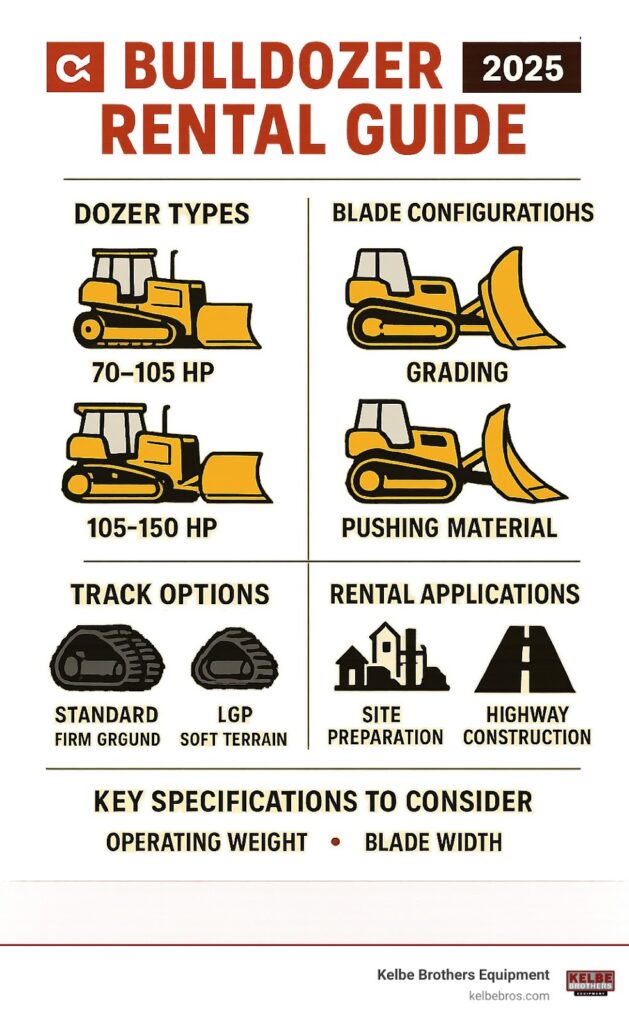
- Small dozers (70-105 HP): Residential clearing, light grading
- Medium dozers (105-150 HP): General construction, site preparation
- Large dozers (150+ HP): Highway construction, major earthmoving
- Track types: Standard for firm ground, Low Ground Pressure (LGP) for soft terrain
- Blade options: S-blade for grading, U-blade for pushing material, PAT blade for versatility
A bulldozer is a tracked machine that uses a front-mounted blade to push, level, and grade materials like soil, debris, and rock. These powerful machines are the backbone of earthmoving operations, offering the best versatility for everything from site clearing to road building.
The earthmoving power of modern dozers comes from their combination of high-horsepower engines, heavy operating weight, and superior traction from steel or rubber tracks. This makes them ideal for demanding Wisconsin terrain and weather conditions.
Why rent instead of buy? Renting gives you access to the latest technology, eliminates maintenance headaches, and provides flexibility to match the right machine to each specific project. It’s particularly smart for contractors who don’t need dozers year-round.
This guide will help you steer bulldozer specifications, match the right machine to your project, and understand the rental process from delivery to operation.
As Jeffrey J. Miller, President of Kelbe Brothers Equipment, I’ve helped Wisconsin contractors find the right earthmoving solutions for over 60 years of combined industry experience. Our bulldozer rental fleet includes New Holland Crawler Dozers that deliver the reliability and performance your projects demand.
Why Renting a Bulldozer Makes Sense for Your Project
Let’s be honest – owning a bulldozer is a major commitment. For many Wisconsin contractors, buying one outright isn’t always the most practical approach. That’s where bulldozer rental becomes your best friend.
Flexibility is probably the biggest advantage of renting. Maybe you’ve got a three-week site clearing job, or you need to grade a parking lot before winter hits. Why commit to owning equipment that might sit idle for parts of the year? Renting lets you grab exactly what you need, when you need it, then move on to your next project.
Here’s something that might surprise you: rental dozers often feature modern technology that’s newer than what many contractors have in their owned fleets. We’re talking about New Holland Crawler Dozers with improved fuel efficiency, better operator comfort, and monitoring systems that help prevent major breakdowns. When you rent from us, you get access to equipment that’s regularly updated and maintained to current standards.
Nobody wants to deal with maintenance headaches. Oil changes, track adjustments, hydraulic repairs – it all adds to your team’s workload and can cause project delays. When you choose bulldozer rental, all that becomes our problem, not yours. Our skilled technicians handle the servicing, and if something goes wrong, we fix it or swap out the machine. You just show up and start moving dirt.
As a rule of thumb, if you’re not using a dozer for the majority of your projects, renting is often the more strategic choice. This approach frees up your resources, allowing you to allocate them to payroll, materials, or other business needs that keep you growing.
Short-term needs are perfect for rental. Maybe your main dozer is down for repairs, or you landed a big job that needs two machines running simultaneously. We’ve got you covered without the long-term commitment.
And here’s a bonus – renting is like trying before buying. Thinking about adding a dozer to your fleet? Rent different sizes and models first. See how a medium dozer handles compared to a large one. Test out different blade types on your actual projects. It’s the smartest way to make sure you’re making the right long-term decision.
More info about our Best Practices
Understanding Key Dozer Specifications
Choosing the right bulldozer for your project starts with understanding its key specifications. Think of it like picking the perfect tool from a toolbox – you need to know what each one does best!
One of the primary differentiators among dozers is their horsepower range. This figure gives you a good indication of the machine’s pushing power and overall capability. Small dozers, often ranging from 70 to 105 horsepower, are nimble and efficient for lighter tasks. Medium dozers typically fall within the 105 to 150 horsepower range, offering a versatile balance of power and maneuverability. For the heaviest earthmoving applications, large dozers boast 150 horsepower and higher, ready to tackle the toughest jobs.
Closely related to horsepower is the operating weight. This specification is crucial for understanding a dozer’s stability and its ability to handle large volumes of material. Standard-sized dozers often weigh between 19,000 and 22,000 pounds, providing a solid footprint for general construction. Larger, heavy-duty machines can range significantly higher, with some models exceeding 51,000 pounds, built for maximum pushing force and stability on demanding sites.
The blade types are another critical consideration, as they dictate the dozer’s primary function and efficiency for specific tasks. Bulldozer blades are the metal plates mounted at the front, designed to push and spread material.
- The S-Blade (Straight Blade) is short and has no side wings. It’s excellent for fine grading, stumping, and working on uneven terrain due to its precise control and ability to penetrate hard ground.
- The U-Blade (Universal Blade) is taller and wider, featuring large side wings that curl forward. This design allows it to carry a much larger volume of material, making it ideal for pushing material over long distances, ditching, and handling light, loose earth.
- The S-U Blade (Semi-U Blade) combines features of both the S and U blades. It has a straighter profile than the U-blade but still incorporates small side wings. This versatility makes it a popular choice for a wide range of tasks, including backfilling, crowning, and handling a variety of materials.
- The Power-Angle-Tilt (PAT) Blade is the most versatile. It can be hydraulically angled, tilted, and lifted from the operator’s cabin, allowing for precise control and adaptability to various grading, spreading, and clearing tasks. This blade is a true multi-tasker, making it a favorite for many projects.
Beyond type, blade width is also a key specification. A wider blade can move more material in a single pass, increasing efficiency for large-scale operations, while a narrower blade offers more precision for confined spaces.
Finally, we consider track types, which are fundamental to a dozer’s performance on different terrains. Bulldozers run on steel or rubber tracks instead of wheels, providing superior traction and pushing force.
- Standard tracks are robust and long-lasting, typically made of steel. They excel on jobsites with inclines, sharp debris, and hard, rocky ground, offering maximum durability and grip in rugged environments.
- Low Ground Pressure (LGP) tracks are wider and distribute the dozer’s weight over a larger area, reducing the pressure exerted on the ground. This makes LGP dozers ideal for projects on softer ground, like agriculture or dirt construction, or when you need to limit potential damage to pavement or sensitive surfaces.
Understanding these specifications helps us guide you to the perfect New Holland Crawler Dozer for your project.
Matching the Right Dozer to Your Project
Finding the perfect bulldozer rental for your Wisconsin project is like choosing the right tool for any job – it all comes down to matching the machine’s strengths with what you need to accomplish. Over the years, we’ve helped contractors across countless industries find just how versatile these powerful machines can be.
In the construction world, dozers are the go-to machines for getting sites ready. They clear land, knock down old structures, and create those perfectly level foundations that everything else depends on. Landscaping professionals love them for reshaping terrain and spreading topsoil across large areas. Our agriculture customers use them for clearing fields and creating proper drainage, while forestry operations rely on them for clearing paths and managing logging debris.
The beauty of bulldozer rental lies in how these machines handle specific tasks. Whether you’re doing site clearing to remove trees and brush, grading and leveling to create smooth surfaces, or road building to prepare sub-grades, dozers get the job done efficiently. They excel at material spreading – distributing soil or aggregates evenly across large areas. You’ll also find them invaluable for backfilling trenches, breaking up hard ground, and managing debris on demolition sites.
Here’s what we’ve learned over the years: how dozer size correlates with project type makes all the difference in your success.
Choosing the right size for your bulldozer rental
Think of dozer sizing like choosing between a pickup truck and a semi – both haul things, but each has its sweet spot.
Small dozers in the 70-79 horsepower range are the nimble problem-solvers of the dozer world. They’re perfect for residential lots where space is tight, light grading tasks that need finesse, and projects where you need power but also need to fit through narrow gates or work around existing structures. These machines are also easier to transport, which can streamline your logistics.
Medium dozers – those workhorses in the 70-105 horsepower range – are what most people picture when they think “bulldozer.” They’re ideal for general construction because they strike that perfect balance between power and maneuverability. These machines can handle most earthmoving tasks on typical job sites without being overkill for the project.
When you’re tackling major earthmoving projects, that’s when large dozers with 150+ horsepower really shine. Think highway projects, massive land clearing operations, or any job where you’re moving serious volumes of material. These powerful machines provide the stability and pushing force needed for large-scale operations.
Essential dozer attachments and their uses
While the blade gets most of the attention, the right attachments can transform your dozer into an even more versatile machine.
Rippers are those tough, claw-like tools mounted on the back that break up hard-packed soil, rock, or other stubborn materials. Think of them as the dozer’s way of “tenderizing” tough ground before the blade does its work. Winches turn your dozer into a powerful pulling machine – essential for forestry work or when you need to move heavy objects across challenging terrain. Rakes replace the standard blade with wide, toothed attachments that are perfect for clearing brush and debris while leaving the underlying soil relatively undisturbed.
Our experienced team can help you determine which attachments will make your bulldozer rental most effective for your specific project needs.
More info about our Parts department
Navigating the Bulldozer Rental Process
Getting your bulldozer rental delivered and ready to work doesn’t have to be complicated. At Kelbe Brothers Equipment, we’ve streamlined the process to take the headaches out of heavy equipment rental, so you can focus on what matters most – your project.
Let’s talk about delivery and transportation first. Bulldozers aren’t exactly something you can toss in the back of a pickup truck! These machines require specialized flatbed trailers and experienced drivers who know how to handle oversized loads. We take care of all the logistical considerations from our yard to your job site, but we do need your help with a few details.
Site access requirements can make or break a smooth delivery. Before your dozer arrives, take a quick look around your site. Are there any low-hanging power lines that might cause trouble? Narrow gates or tight corners that could pose a challenge? Soft ground that might not support a heavy delivery truck? A quick phone call to let us know about these conditions helps our drivers plan the best route and approach. Trust me, it’s much easier to figure this out beforehand than to have a flatbed truck stuck at your gate!
Now, let’s address the not-so-fun but absolutely essential topic of insurance requirements. Before any New Holland Crawler Dozer leaves our lot, we need to make sure you have proper contractor’s equipment coverage in place. This isn’t just paperwork for the sake of paperwork – it protects both you and the equipment during your rental period. If you’re not sure about your current coverage, give your insurance agent a call. Most contractors already have this type of policy, but it’s always better to double-check than to be caught off guard.
Here’s something that might seem obvious but is worth mentioning: operator qualifications matter. A lot. While we provide well-maintained, reliable equipment, we’re counting on you to make sure whoever’s running that dozer knows what they’re doing. Operating a bulldozer requires skill, experience, and proper training. It’s not just about moving dirt – it’s about doing it safely and efficiently. Make sure your operator is comfortable with the machine size, has experience with the type of work you’re planning, and follows established best practices like those outlined by OSHA for heavy equipment operation.
Before you fire up the engine, take time for a thorough pre-rental inspection. Yes, our skilled technicians go over every machine before it leaves our facility, but an extra set of eyes never hurts. Walk around the dozer and check the basics: fluid levels should be where they need to be, tracks should look solid without obvious damage, and the blade and hydraulics should operate smoothly.
Don’t forget to familiarize yourself with the safety features and operator controls. Every machine has its own personality, and getting comfortable with the layout before you start working will make your day go much smoother. Our team is always happy to walk you through the controls and answer any questions. After all, a confident operator is a safe and productive operator.
More info about our Service department
Frequently Asked Questions About Bulldozer Rental
After helping Wisconsin contractors for decades, we’ve noticed the same questions come up time and again when it comes to bulldozer rental. Let me share some insights from our experience that might help clear things up for you.
What’s the difference between a standard track and a Low Ground Pressure (LGP) dozer?
This question really gets to the heart of choosing the right machine for your specific conditions. Think of it like choosing the right footwear for different terrain – you wouldn’t wear dress shoes to hike through mud!
Standard tracks are built tough and narrow, designed to bite into firm ground with maximum grip. They concentrate the dozer’s weight into a smaller footprint, which gives you incredible traction on hard surfaces. These are your go-to choice when you’re working on rocky terrain, steep slopes, or anywhere you need that aggressive grip to push through tough conditions. They’re also more durable when you’re dealing with sharp debris that might tear up wider tracks.
LGP tracks take a completely different approach. These wider tracks work like snowshoes, spreading the dozer’s weight over a much larger area. This ground pressure distribution is what makes all the difference when you’re working on soft, muddy, or sensitive ground.
The ideal soil conditions for LGP dozers include wet construction sites, agricultural fields where you don’t want to compact the soil too much, or finished areas where pavement protection is crucial. We’ve seen contractors prevent significant repair work by choosing an LGP dozer for projects near existing pavement or landscaping.
Can a bulldozer remove tree stumps?
Here’s where I need to give you the honest answer – yes and no! Dozers have impressive stump removal capabilities for smaller stumps and surface-level work. If you’re dealing with recently cut trees or smaller stumps, a dozer can often push them right out or break them off at ground level.
But here’s the thing about root systems – they can extend much deeper and wider than you’d expect. Larger, established stumps with extensive root networks can be incredibly stubborn. Trying to force these out with a dozer can lead to potential blade damage or put unnecessary strain on the machine. We’ve seen blades get bent or hydraulic systems stressed when contractors try to tackle stumps that are just too big for the job.
That’s where alternative equipment really shines. Our Takeuchi excavators and New Holland mini excavators are purpose-built for this kind of detailed work. With their digging capability and specialized attachments, they can get around the entire root ball and extract it cleanly. It’s often faster and safer than wrestling with a stubborn stump using a dozer.
More info about our Takeuchi excavators
What should I check before accepting a rental dozer?
Even though our skilled technicians go through every machine before it leaves our yard, doing your own pre-rental checklist is smart business. It helps you get familiar with the machine and catch anything that might have happened during transport.
Start with the basics – fluid levels should all be where they need to be. Check your engine oil, hydraulic fluid, and coolant. These are your machine’s lifeblood, and starting with proper levels sets you up for success.
Next, walk around and inspect the track condition. Look for any obvious damage, loose pins, or excessive wear. The tracks should look solid and properly tensioned – not too tight or too loose.
The blade and hydraulics deserve special attention since they’re doing the heavy work. Run the blade through its full range of motion – lift it up, bring it down, angle it left and right. Everything should move smoothly without jerky motions or unusual noises.
Don’t skip the safety features – lights, backup alarms, mirrors, and emergency stops. Make sure the operator’s cab is clean and the seatbelt works properly. These might seem minor, but they’re crucial for safe operation.
Finally, spend a few minutes with the operator controls. Sit in the cab and test everything – steering, throttle, blade controls. Get comfortable with where everything is located before you start your actual work.
Our team is always happy to walk through this inspection with you and answer any questions about operating the machine. We want your bulldozer rental experience to be productive and worry-free from day one.
Your Partner for Powerful Earthmoving Solutions
When you’re planning your next project, choosing the right bulldozer rental is about more than just horsepower and blade types – it’s about partnering with people who understand your needs and deadlines.
Throughout this guide, we’ve covered the essentials of matching specs to the job. Whether you need a nimble small dozer for residential grading or a powerful large machine for highway construction, the right choice makes all the difference. We’ve explored how blade configurations like the versatile PAT blade and material-carrying U-blade can transform your efficiency, and why understanding logistics – from track selection to delivery requirements – sets successful projects apart from frustrating ones.
The benefits of renting are clear: you get flexibility when you need it, access to modern New Holland technology without the long-term commitment of ownership, and freedom from maintenance headaches that disrupt your workflow. For Wisconsin contractors juggling multiple projects and seasonal demands, this approach just makes sense.
Here at Kelbe Brothers Equipment, we’ve been helping Wisconsin contractors tackle tough jobs for four generations. As a family-owned company, we understand that your success is our success. We’re not just handing you keys to a machine – we’re providing a complete partnership built on experienced staff, rapid response times, and genuinely hassle-free service.
Our New Holland Crawler Dozers arrive ready to work, backed by the kind of 24/7 emergency support that keeps your projects moving forward when unexpected challenges arise. Because let’s face it – in construction, something always comes up, and when it does, you need people you can count on.
We’re here to help you push boundaries, meet deadlines, and achieve your project goals with the reliability and support that only comes from working with locals who truly understand Wisconsin’s construction industry.