




Undercarriage maintenance is critical for protecting your tracked equipment investment and preventing costly downtime. Here’s what you need to know:
Essential Undercarriage Maintenance Practices:
- Daily Cleaning – Remove mud, debris, and packed material after each shift
- Regular Inspections – Check track tension, sprockets, rollers, and idlers daily
- Proper Operation – Make wide turns, limit high speeds, and minimize track spinning
- Correct Track Tension – Adjust based on terrain conditions (looser for mud/sand)
- Timely Replacement – Swap worn components before they damage other parts
Your tracked equipment—whether it’s Takeuchi excavators, Link-Belt excavators, or Hitachi excavators—takes a beating from Wisconsin’s demanding job sites. The undercarriage represents about 20% of your equipment’s purchase price but can account for up to 50% of your total maintenance budget. That’s a significant chunk of your operating costs.
The good news? Most undercarriage damage is preventable. With the right maintenance routine, you can extend component life, reduce unexpected repairs, and keep your equipment working when you need it most.
Whether you’re running construction equipment rentals or own your fleet outright, neglecting undercarriage care leads to expensive consequences. Premature wear on one component creates a chain reaction that damages others. A worn sprocket destroys track chains. Loose tracks damage rollers and idlers. Before you know it, you’re facing thousands in repairs and days of lost productivity.
As Jeffrey J. Miller, President of Kelbe Brothers Equipment, I’ve seen how proper undercarriage maintenance separates profitable projects from budget-busting disasters. Over 60 years of serving Wisconsin contractors has taught us that proactive care always beats reactive repairs.
THE DAILY WALK-AROUND: YOUR FIRST LINE OF DEFENSE
Before we even think about turning a key, the daily walk-around is your first and most crucial step in undercarriage maintenance. It’s a quick but thorough visual inspection that can catch small issues before they become big, expensive problems. This routine should be performed as a pre-operation check before starting work and a post-operation check at the end of each shift. This puts the responsibility squarely on the operator, who is often the first to notice changes in how the machine feels and sounds. Early problem detection isn’t just about saving money; it’s about ensuring safety and maximizing the uptime of your valuable Link-Belt excavators, New Holland Crawler Dozers, or Takeuchi Compact Track Loaders.
KEEP IT CLEAN: THE FOUNDATION OF GOOD MAINTENANCE
Imagine trying to run a marathon with mud caked to your shoes – it’s going to be harder, slower, and more tiring. The same principle applies to your heavy equipment’s undercarriage. Keeping it clean isn’t just about appearances; it’s an indispensable step towards extending the service life and enhancing the productivity of your equipment.
Mud, dirt, sand, and other debris can pack tightly into the undercarriage components of your Hitachi excavators or New Holland Mini Excavators. This soil build-up creates several problems:
- Increased Wear: Packed material acts like sandpaper, constantly grinding against critical components such as track chains, sprockets, and rollers. This accelerates abrasive wear significantly.
- Lower Fuel Efficiency: Extra weight from packed materials means your engine has to work harder, consuming more fuel. It’s like carrying an invisible passenger all day long.
- Premature Failures: The constant pressure and friction from packed debris can lead to premature failures of seals, bearings, and other vital parts.
- Freezing Damage: In Wisconsin’s cold winters, wet debris can freeze solid, potentially damaging bolts, causing track guiding issues, or even seizing rollers. This is a common culprit for unexpected downtime.
We advise cleaning the undercarriage at the end of each workday. A power washer is often your best friend here, capable of blasting away stubborn grime. For tougher, packed mud, a track spade, shovel, or scraper can help dislodge material before a final rinse. Some manufacturers are even designing newer equipment with easier-to-clean undercarriages, recognizing the importance of this simple yet effective practice. The two primary undercarriage management principles are to keep it clean and maintain the appropriate tension.
KEY COMPONENTS TO INSPECT
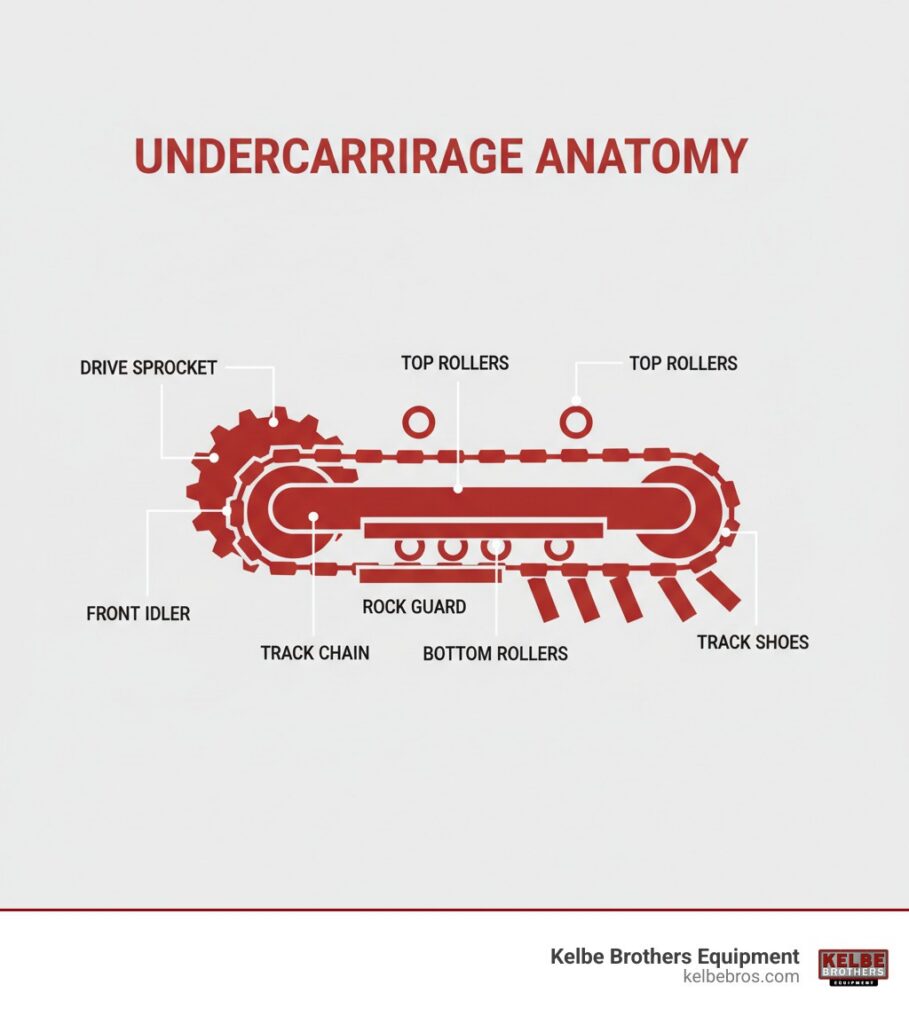
During your daily walk-around, you’ll want to cast a keen eye over several vital undercarriage components. Think of it as a health check-up for your machine’s locomotion system. Here’s what to focus on:
- Track Chains: Look for excessive stretching (pitch elongation), cracks, or bent links. These are the backbone of your track system, and any issues here can quickly lead to widespread damage.
- Track Shoes (Pads): Check for bent, cracked, or missing shoes. Also, observe the wear on the grousers (the raised bars on the shoes) – are they worn down or chipped?
- Sprockets: These are the “drive gears” that mesh with the track chain. Look for “pointy” or hooked teeth, which indicate severe wear.
- Idlers (Front and Rear): Idlers guide the track and absorb shock. Check for scalloped or uneven wear on the tread, as well as any signs of oil leakage, which could indicate a failed seal.
- Rollers (Top and Bottom): These support the weight of the machine and guide the track. Look for flattened or uneven wear, cracks, or chips. Like idlers, oil leaks from rollers are a red flag for failed seals.
- Track Bolts: Ensure all track bolts are present and tight. Loose or missing bolts can lead to track pads coming off or accelerated wear on other components.
- Rock Guards: These protect the rollers and track frame. Check for damage or bends that could impede track movement or expose components to impact.
- Signs of Leaks: Any oil or grease leaking from idlers, rollers, or the drive motor suggests a failed seal. This needs immediate attention to prevent major component failure.
- Abnormal Wear Patterns: Are there any unusual shiny spots, gouges, or areas wearing faster than others? This could indicate misalignment, improper operation, or a deeper mechanical issue.
For our New Holland Skid Steer Loaders: 200 Series or Takeuchi Compact Excavators, these components are designed for durability, but consistent inspection is key to catching issues early.
MASTERING YOUR MACHINE: BEST PRACTICES FOR MINIMAL WEAR
Here’s something I’ve learned after decades in this business: even the toughest equipment can’t withstand poor operating habits. You could have the most robust Link-Belt Material Handlers or Hitachi Wheel Loaders on your job site, but if your operators aren’t trained properly, you’re essentially throwing money away on premature undercarriage replacement.
Operator training isn’t just a nice-to-have—it’s the difference between replacing your undercarriage every 2,000 hours versus every 5,000 hours. That’s real money staying in your pocket instead of going toward repairs and downtime. When operators understand how their actions affect the machine, they naturally work smarter. They reduce stress on components, minimize wear and tear, and extend the life of everything from track chains to sprockets.
The best part? Most of these techniques don’t slow down productivity. They just require a shift in thinking about how to move the machine efficiently.
SMART OPERATING TECHNIQUES
Watch an experienced operator run a New Holland Crawler Dozer, and you’ll notice something: they make everything look effortless. That’s because they’ve learned techniques that protect the machine while getting the job done. Let’s talk about what separates the pros from the rest.
Wide turns versus sharp pivots might seem like a small detail, but it’s huge for undercarriage maintenance. When you make a tight pivot turn, you’re essentially scrubbing the tracks sideways across the ground. This aggressive action wears down track shoes and links at an alarming rate. Instead, encourage your operators to make wide, gradual turns whenever possible. Yes, it takes an extra few seconds, but it distributes stress evenly across the entire undercarriage instead of concentrating it in one spot.
High-speed travel is tempting when you’re trying to meet deadlines, but it’s murder on undercarriage components. Every bump and rock at high speed sends shock waves through the rollers, idlers, and track links. We’ve seen operators cut years off their Takeuchi Zero Swing Excavators by consistently running them at full speed over rough terrain. Slowing down just a bit reduces impact forces dramatically and keeps those components working longer.
Here’s one that surprises people: reverse operation wears sprockets and bushings faster than forward travel. The mechanics of how the sprocket engages the track chain in reverse create more stress on these components. While backing up is sometimes necessary, operators should prioritize forward navigation whenever practical. Plan your work paths to minimize backing up, and your sprockets will thank you.
Track spinning is one of those habits that operators fall into without realizing how damaging it is. When tracks slip or spin, they’re grinding against sprockets and wearing down track shoes at an accelerated rate. It’s also incredibly inefficient—all that motion without actually moving the machine. If an operator finds the tracks spinning, that’s a signal to reposition the machine or adjust the load, not to power through it.
One technique we don’t talk about enough is alternating turning directions. If an operator consistently turns left, the left side of the undercarriage wears faster than the right. It sounds simple, but consciously alternating which direction you turn helps balance wear across both sides of your New Holland Compact Track Loaders: 200 Series or Takeuchi Compact Track Loaders.
For excavators—whether you’re running our Hitachi Excavators, Link-Belt Excavators, or looking at mini excavators for sale—correct digging procedures make a significant difference. Operators should position the machine so excavation forces are distributed properly, not concentrated on the front idlers or rear drive sprockets. Proper positioning reduces strain on the entire drive system and prevents premature wear.
NAVIGATING DIFFERENT TERRAINS
The ground beneath your tracks isn’t just a surface—it’s an active participant in how quickly your undercarriage wears out. Understanding this relationship is essential for anyone operating construction equipment rentals or managing their own fleet.
Terrain impact goes beyond just “hard” or “soft” ground. When your Hitachi Compact Excavators or New Holland Mini Excavators work on slopes, the weight distribution shifts dramatically. The downhill side carries more load, which means those rollers, idlers, and track components wear faster. Working uphill puts more stress on rear rollers and drive sprockets, while downhill work concentrates wear on front rollers and idlers. Smart operators recognize these patterns and adjust their travel paths accordingly.
Abrasive conditions like sand, gravel, and rock are particularly brutal on undercarriages. Sand might look soft, but it acts like a grinding compound, working its way into every joint and bushing. Rock and gravel do the same, only with more impact. In these conditions, daily cleaning becomes absolutely critical—not just recommended, but essential. Those abrasive particles need to be flushed out before they can do serious damage to track links, pins, bushings, and rollers.
High-impact environments with large rocks or severely uneven surfaces subject your equipment to forces it wasn’t designed to handle repeatedly. Even our heavy-duty Link-Belt excavators and Hitachi excavators, built tough for Wisconsin job sites, benefit from operators who pick their paths carefully to minimize severe impacts. Bent track shoes, cracked links, and damaged rollers are expensive repairs that often result from avoidable impacts.
Working on crowned or depressed surfaces creates uneven wear patterns that can be puzzling until you understand what’s happening. A crown in the terrain pushes the machine’s weight toward the inner components, while a depression shifts it outward. This concentrated wear on one side of the undercarriage leads to components failing at different rates, complicating replacement schedules.
Track shoe width is one of those decisions that has long-term consequences. The general rule is simple: use the narrowest shoe that still provides adequate flotation for your conditions. Narrower shoes offer better soil penetration and grip on hard ground, and they reduce the leveraging effect that accelerates wear on pins, links, and bushings. Wider shoes provide more flotation and lower ground pressure, which is ideal for soft, muddy Wisconsin sites, but they can increase wear on sprockets and bushings while reducing track joint life.
When customers ask about track options for their New Holland Skid Steer Loaders: 200 Series or Takeuchi Compact Excavators, we always start by discussing their typical job site conditions. Getting this decision right from the start—whether you’re looking at construction equipment for sale, wheel loaders for sale, or used construction equipment for sale—ensures your investment performs optimally and lasts as long as possible.
A DEEP DIVE INTO PROACTIVE UNDERCARRIAGE MAINTENANCE
Here’s the truth about equipment ownership: waiting for something to break is the most expensive maintenance strategy you can follow. Proactive undercarriage maintenance isn’t just smart—it’s essential for protecting your investment and keeping your fleet working when you need it most.
Think of scheduled maintenance as your insurance policy against unexpected downtime. When you establish a consistent routine for your Hitachi Wheel Loaders, New Holland Wheel Loaders, and other tracked equipment, you’re not just reacting to problems—you’re preventing them from happening in the first place. This approach significantly reduces long-term issues, extends the operational life of your machinery, and keeps your projects on schedule and on budget.
The difference between proactive and reactive maintenance shows up clearly in your bottom line. A machine that receives regular attention runs longer, costs less to operate, and rarely leaves you stranded on a job site. That’s the kind of reliability Wisconsin contractors depend on.
HOW TO ENSURE OPTIMAL TRACK TENSION
If you take away just one thing from this guide, let it be this: proper track tension matters more than most operators realize. It’s a balancing act that directly impacts how long your undercarriage lasts and how much you’ll spend maintaining it.
The concept is straightforward, but the consequences of getting it wrong are significant. Your track needs to be tight enough to mesh properly with the sprockets and idlers, but loose enough to allow for normal movement and material buildup. Too much tension in either direction creates problems that cascade through your entire undercarriage system.
Track sag is your key measurement here. This refers to the amount of slack or drooping in the track between specific points—typically between the carrier roller and front idler, or between the drive sprocket and front idler on machines without carrier rollers. Every machine is different, though. Your Hitachi Compact Excavators will have different specifications from your New Holland Crawler Dozers, which is why checking your operator’s manual is non-negotiable.
When tracks run too tightly, they create constant resistance against every moving part. Imagine walking all day with your shoelaces tied so tight they cut off circulation—that’s what you’re doing to your equipment. Bushings, sprockets, links, rollers, and idlers all wear down faster because they’re constantly fighting against excessive pressure. It’s like driving with the parking brake engaged—you’ll get where you’re going, but you’re burning through components unnecessarily.
Loose tracks create their own set of headaches. They wander and misalign, putting side stresses on components that weren’t designed to handle lateral forces. Worst-case scenario? The track comes off completely, which we call “de-tracking.” Not only does this shut down your job site, but it can cause severe damage to the track frame and other components. Even if they stay on, loose tracks don’t mesh properly with the sprocket, leading to accelerated wear on both.
Here’s where it gets interesting: the “correct” tension isn’t always the same. When you’re working in soft, muddy, or sandy conditions, you actually want to run your tracks slightly looser than normal. Why? Because material packing will naturally tighten them up. If you start with tracks adjusted for hard ground and then move into packing conditions, that packed material will make your tracks way too tight, causing even more damage than starting too tight in the first place.
Adjusting track tension on modern equipment typically involves using a grease gun to add or remove grease from a tension cylinder. This pushes the idler outward to tighten or allows it to retract to loosen. It’s a simple process, but be careful—there’s high pressure involved. Always follow the manufacturer’s procedures exactly, whether you’re working on Takeuchi Compact Wheel Loaders or New Holland Tractor Loaders Backhoes.
RECOGNIZING SIGNS OF WEAR FOR UNDERCARRIAGE MAINTENANCE
Your equipment talks to you every day—you just need to know what to listen for. Spotting early wear signs is the difference between a planned maintenance day and an emergency repair that costs three times as much.
Pointy sprocket teeth are one of the clearest warning signs you’ll see. Healthy sprocket teeth have a relatively flat profile, but worn teeth start looking sharp and hooked, like shark fins. Once you see this, you know the sprocket isn’t meshing properly with the track chain anymore, and both components are wearing down fast.
Check your idlers for a scalloped pattern—that wavy, uneven surface that develops when the track isn’t running smoothly. It’s not supposed to look like that. A scalloped idler usually means your track tension is off or other components are already worn.
Flattened rollers tell you something’s wrong with weight distribution or friction. Rollers should be round, period. If they look flat on one side or show uneven wear, they’re taking hits or friction they weren’t designed to handle.
Look closely at your track pads. Are any loose, bent, or missing? Track pads need to be securely bolted to the track chain. Any looseness creates instability and accelerates damage to surrounding components. Cracked shoes are another red flag, often caused by impacts or prolonged operation on abrasive, uneven surfaces.
Here’s one you can’t ignore: oil leaks from seals. Any visible oil or grease leaking from the hubs of rollers, idlers, or the drive motor means a seal has failed. Once that seal goes, lubricant escapes, and contaminants get in, quickly destroying the internal bearings. This is an urgent issue that needs immediate attention.
Finally, watch for track pitch elongation—what we call “stretching.” The pitch is the distance between the centers of consecutive pins in your track chain. As pins and bushings wear, this distance increases, making the track run “long.” When that happens, the track no longer meshes properly with the sprocket, and both wear out exponentially faster.
Regular inspections of your Takeuchi excavators or New Holland Compact Wheel Loaders make catching these signs routine rather than rare. Most of these issues are easy to spot once you know what you’re looking for.
WHEN TO REPLACE WORN PARTS
Timing your component replacements correctly separates smart operators from those who learn expensive lessons the hard way. The question isn’t whether to replace worn parts—it’s when to do it before the damage spreads.
The biggest risk of waiting too long is what we call the chain reaction failure. A severely worn sprocket will destroy a new track chain in a fraction of its normal lifespan. Worn pins and bushings in your track chain will chew through rollers and idlers at an alarming rate. One delayed repair creates a domino effect that can cost you several times what the original fix would have been.
Industry data shows that an improperly managed undercarriage can account for more than half of a machine’s total maintenance costs. Let that sink in. More than half. That’s not because the parts themselves are outrageously expensive—it’s because one worn component forces others to fail prematurely.
There’s also a safety element here that goes beyond dollars and cents. Severely worn undercarriage components create real hazards. A de-tracked machine is dangerous for operators and anyone working nearby. Structural failures can cause loss of control or unexpected machine movements that put people at risk.
The goal is to maximize component life without causing collateral damage. This requires monitoring wear percentages during routine inspections, often using specialized measurement tools. When a component reaches about 70-80% worn, it’s time to start planning for replacement—not waiting until it hits 100% and taking other parts down with it.
Here’s some good news: replacing an entire component isn’t always your only option. Smart service centers offer repair strategies that extend life and reduce your cost per hour. Wet bushing turns for track chains can present a fresh wear surface by rotating the bushings 180 degrees, significantly extending the track group’s life. Roller swapping moves less-worn rollers to high-wear positions, getting more hours out of existing components. Some operations can resurface worn idler treads or weld new grousers onto worn track shoes to restore traction.
We work with Wisconsin contractors every day on these decisions, whether it’s for their used construction equipment for sale fleet or brand new Hitachi excavators. Our parts and service team understands that every hour of downtime costs you money, and every unnecessary replacement eats into your profits. That’s why we focus on helping you make informed choices that keep your New Holland Skid Steer Loaders: 200 Series and Takeuchi Compact Track Loaders working productively for as long as possible.
FREQUENTLY ASKED QUESTIONS ABOUT UNDERCARRIAGE MAINTENANCE
After decades of working with contractors across Milwaukee, Madison, and Green Bay, we’ve heard just about every undercarriage question imaginable. Here are the ones that come up most often when our customers are looking at excavators for sale, managing their construction equipment rentals, or trying to squeeze more life out of their existing fleet.
HOW OFTEN SHOULD I CLEAN MY EQUIPMENT’S UNDERCARRIAGE?
The short answer? Daily. We know that sounds like a lot, but trust us—it’s worth it.
Cleaning your undercarriage at the end of every shift is your best defense against premature wear, especially here in Wisconsin, where mud, debris, and snow are part of the job. Whether you’re running Takeuchi excavators or Link-Belt excavators, packed material acts like grinding paste on your components, accelerating wear dramatically.
Think about it this way: a few minutes with a power washer at day’s end can save you thousands in repairs down the road. In winter, this becomes even more critical. Wet debris that freezes solid overnight can crack bolts, seize rollers, and prevent proper track guidance. We’ve seen machines come in with frozen undercarriages that could have been prevented with a simple end-of-shift cleaning.
Job site conditions matter too. Working in thick mud or wet clay? You might need to clean mid-shift if the buildup becomes excessive. The goal is to prevent material from packing in, drying, and turning into concrete-hard deposits that are a nightmare to remove later.
WHAT IS THE BIGGEST MISTAKE OPERATORS MAKE THAT DAMAGES THE UNDERCARRIAGE?
We see this one all the time, and it’s usually a combination of two things: improper track tension and aggressive operating habits.
Improper track tension might be the silent killer of undercarriages. Tracks that are too tight place constant stress on every component—bushings, sprockets, links, rollers, and idlers all wear faster than they should. It’s like driving with your parking brake on. Tracks that are too loose cause their own problems: wandering, misalignment, and the dreaded de-tracking incident that can damage your entire track frame.
Then there’s an aggressive operation. We’re talking about operators who consistently make sharp pivots instead of wide turns, run at high speeds over rough terrain, or spin the tracks when they get stuck. These habits create massive friction and impact forces that grind components down in a fraction of their normal lifespan.
One pattern we notice with construction equipment rentals is that operators sometimes treat rental machines differently from their own equipment. But whether you’re renting or own your Hitachi excavators or New Holland Crawler Dozers, these aggressive habits cost you money either way—in rental damage charges or in your own repair bills.
And here’s the thing: neglecting daily inspections ties it all together. When operators skip the walk-around, they miss loose track tension, don’t notice the mud packing in, and fail to spot early wear patterns. Small issues that could be fixed with a quick adjustment turn into major component failures.
CAN I USE RUBBER TRACKS ON ANY TERRAIN?
Rubber tracks are wonderful for the right applications, but they’re not a one-size-fits-all solution. Let’s break down where they shine and where they struggle.
For our Takeuchi Compact Track Loaders and New Holland Mini Excavators, rubber tracks are often the perfect choice. They excel on sensitive surfaces like finished turf, concrete, asphalt, or pavement, where steel tracks would leave marks or cause damage. Landscaping contractors and urban construction crews love them for this reason. They also reduce ground disturbance in environmentally sensitive areas and provide a smoother, quieter ride for the operator.
But rubber tracks have their limits. Highly abrasive conditions with sharp rocks, demolition debris, or coarse gravel can quickly cut, tear, or puncture rubber tracks. We’ve seen rubber tracks destroyed in days when used in the wrong environment. Rocky quarry work or heavy demolition? That’s steel track territory.
For larger machines like our Hitachi Excavators or Link-Belt Excavators, steel tracks are typically the better choice for demanding applications. They handle high-impact work, aggressive digging, and abrasive materials far better than rubber alternatives.
The key is matching the track type to your specific job site conditions. If you’re working on finished surfaces or need minimal ground disturbance, rubber tracks from our New Holland Compact Track Loaders: 200 Series are ideal. For heavy-duty work in rough conditions, steel tracks on our Hitachi Compact Excavators or Link-Belt excavators will serve you better.
Not sure which is right for your application? Give us a call. As your trusted New Holland dealer, Takeuchi dealer, Link-Belt dealer, and Hitachi excavator dealer, we’ve helped countless Wisconsin contractors make the right choice for their specific needs. Whether you’re looking at mini excavators for sale, wheel loaders for sale, or used construction equipment for sale, we’ll help you select the right undercarriage setup for your work.
PROTECT YOUR INVESTMENT WITH EXPERT SUPPORT
Here’s the reality: undercarriage maintenance isn’t just another item on your maintenance checklist. It’s the difference between a machine that pays for itself and one that drains your budget through constant repairs and downtime. When you stay on top of it, you’ll see significantly reduced downtime, increased productivity, and improved safety for your operators. That’s the triple win every contractor is looking for.
We’ve been in Wisconsin’s construction equipment industry for four generations now, and we’ve seen what works—and what doesn’t. The machines that keep running year after year, whether they’re Hitachi Excavators, Link-Belt Excavators, or Takeuchi Compact Excavators, all have one thing in common: owners who take care of them and partner with a dealer who knows their stuff.
Managing undercarriage maintenance across your entire fleet can feel overwhelming. Between tracking inspection schedules, monitoring wear patterns, and knowing when to repair versus replace, it’s easy to let things slip through the cracks. That’s exactly why we’re here. Our experienced technicians in Butler, De Pere, and across Wisconsin have seen just about every undercarriage issue imaginable, and we’re equipped with the knowledge and tools to handle them all.
We offer comprehensive undercarriage services that go beyond just swapping out worn parts. We conduct detailed inspections and wear analysis to catch problems early. We provide expert repairs that maximize component life. And when replacement is necessary, we help you source the right parts quickly so you’re not sitting idle any longer than necessary. Whether you’re running New Holland Wheel Loaders, Hitachi Wheel Loaders, or any of the equipment we represent, we’ve got you covered.
Looking for excavators for sale or construction equipment for sale? Need reliable service for your existing fleet of Takeuchi excavators or Link-Belt Material Handlers? Either way, our team provides rapid response and hassle-free service to keep your projects moving forward. We understand that when your equipment is down, you’re losing money—and we take that as seriously as you do.
As a New Holland dealer, Takeuchi dealer, Link-Belt dealer, and Hitachi excavator dealer, we stock the parts you need and have the expertise to install them correctly. Whether you’re interested in mini excavators for sale, wheel loaders for sale, used construction equipment for sale, or construction equipment rentals, we’re your one-stop shop.
Don’t let undercarriage issues catch you off guard. Contact us today or visit our EXPERT PARTS AND SERVICE SUPPORT page to learn how we can help protect your valuable equipment investment. We offer 24/7 emergency support because we know construction doesn’t always happen during business hours. And with flexible financing options, we make it easier to get the equipment or service you need without breaking the bank.
At the end of the day, your success is our success. Let’s work together to keep your machines running strong.