




Equipment financing Wisconsin offers construction and agricultural businesses multiple pathways to acquire essential machinery without depleting working capital. Here are your main options:
Primary Wisconsin Equipment Financing Options:
- Equipment Loans – Finance 100% of equipment value with fixed payments; own the equipment immediately
- Equipment Leases – Lower monthly payments with flexible end-of-term options (FMV or buyout)
- Revolving Credit Lines – Pay for parts, service, attachments, and rentals as needed
- Sale Leaseback – Convert owned equipment into working capital while continuing to use it
Key Benefits:
- Preserve cash flow for operations and emergencies
- Fast funding in as few as 48 hours
- Tax advantages through Section 179 deductions or operating expense write-offs
- Flexible terms for seasonal businesses (skip payments, balloon payments)
Wisconsin businesses across construction, agriculture, and manufacturing rely on equipment financing to stay competitive. With a wide range of financing available through local and national lenders, financing helps you acquire Hitachi excavators, Link-Belt material handlers, New Holland loaders, and Takeuchi compact equipment without large upfront investments.
What do Wisconsin businesses need to meet their potential? According to industry experts, the answer is “solid leadership, good workers, and the right kind of equipment.”
I’m Jeffrey J. Miller, President of Kelbe Brothers Equipment, and I’ve guided businesses through the equipment financing Wisconsin landscape during major industry transitions. My experience has shown me that the right financing partner can make the difference between project delays and consistent growth.
UNDERSTANDING YOUR EQUIPMENT FINANCING OPTIONS: LOANS VS. LEASES
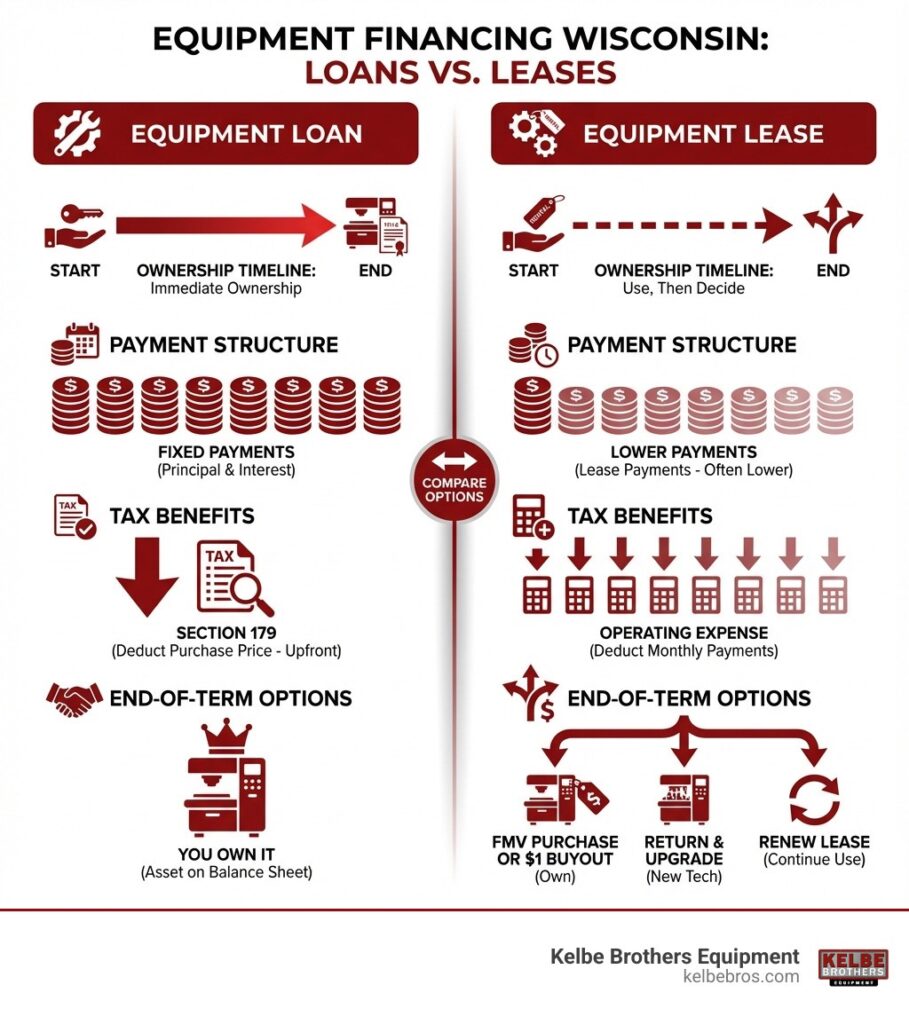
When considering equipment financing Wisconsin, our businesses have two primary paths: equipment loans or equipment leases. Both serve the goal of acquiring necessary machinery, but they differ significantly in terms of ownership, financial structure, and end-of-term options. Understanding these distinctions is crucial for making an informed decision that aligns with your operational and financial goals.
Equipment Loans: Ownership from Day One
An equipment loan, often structured as an Equipment Finance Agreement (EFA), is a straightforward way to purchase machinery. With an equipment loan, you borrow a lump sum to acquire the equipment, and then you repay that sum over a set period, typically with fixed monthly payments. The most significant advantage here is that you gain ownership of the equipment from day one. The equipment itself serves as collateral for the loan, meaning the lender can seize it if you fail to repay, but it’s not typically secured by real estate, which can be a relief for many business owners.
This option is ideal if your intention is to own the equipment long-term, build equity, and potentially benefit from depreciation for tax purposes. Fixed-rate term loans for equipment are available, providing predictability in your budgeting.
Equipment Leases: Flexibility and Modernization
Equipment leasing, on the other hand, is essentially renting equipment for a specified period. While you don’t own the equipment outright during the lease term, this option often comes with lower monthly payments compared to a loan, as you are only paying for the depreciation of the equipment during your usage. This can significantly preserve your cash flow, allowing you to allocate capital to other critical areas of your business.
Leases offer remarkable flexibility, especially at the end of the term. Two common types of leases are:
- Fair Market Value (FMV) Lease: With an FMV lease, you have the option at the end of the term to purchase the equipment at its current fair market value, continue leasing it, or simply return it and upgrade to newer models. This is particularly beneficial for businesses that rely on rapidly updating technology, allowing them to stay current without the burden of owning outdated assets.
- Capital Lease (or Finance Lease): Despite the “lease” in its name, a capital lease functions much like a loan. You make regular payments throughout the term, and at the end, you can purchase the equipment for a nominal fee. This option combines the lower upfront investment of a lease with the ultimate goal of ownership, often with similar tax implications to a loan.
Leasing can be structured to meet tax objectives and may offer variable payment terms, which are a godsend for seasonal businesses in Wisconsin. Financial partners often emphasize the effectiveness of leasing for accessing necessary machinery without large upfront investments.
For more insights into leasing options, we recommend exploring further details provided by financial institutions.
Revolving Credit Lines: For Ongoing Needs
Beyond traditional loans and leases, some lenders offer revolving credit lines specifically for equipment-related expenses. These are incredibly useful for managing ongoing operational needs rather than just new equipment purchases. For example, some manufacturers offer revolving accounts, which provide an exclusive line of credit for parts, service, attachments, and rentals. This offers increased purchasing power and financial flexibility, often with no annual fees and grace periods for payments, helping you maintain cash flow without dipping into your main operating funds.
Sale Leaseback: Opening Up Capital from Your Assets
A Sale Leaseback agreement is a clever financial tool for businesses that already own equipment but need to free up capital. With this option, you sell your existing equipment to a lender for a lump sum cash payment, and then you lease it back for continued use in your operations. This allows you to convert a depreciating asset into immediate working capital while still having access to the machinery you need. This can be a strategic move to fund business expansion or manage cash flow.
To help you visualize the differences, here’s a quick comparison:
| Feature | Equipment Loan (EFA, Capital Lease) | Equipment Lease (FMV Lease) |
| Ownership | You own the equipment from the start. | The lender owns the equipment; you use it. |
| Upfront Investment | May require a down payment, though 100% financing is possible. | Often requires minimal to no down payment. |
| Monthly Payments | Generally higher as you’re paying off the full equipment value. | Generally lower as you’re paying for usage/depreciation. |
| Tax Implications | Can deduct depreciation (Section 179) and interest. | Lease payments are often fully deductible as an operating expense. |
| End-of-Term Options | You own the equipment outright. | Purchase at FMV, renew lease, or return equipment. |
WHAT EQUIPMENT CAN YOU FINANCE?
The beauty of equipment financing Wisconsin is its versatility. Whether you’re a seasoned contractor in Milwaukee or a growing agricultural business in De Pere, financing options exist for a vast array of machinery, both new and used. Our financing partners offer solutions for new and used equipment across various sectors.
Specifically, for our construction-focused clients, we’re talking about the workhorses that build Wisconsin: excavators, wheel loaders, compact track loaders, and more. For those in related fields, agricultural equipment also benefits greatly from custom financing solutions.
HITACHI EQUIPMENT
Hitachi is synonymous with powerful and reliable heavy machinery. We understand that acquiring these top-tier machines is a significant investment, and our financing solutions are designed to make it accessible for your business.
Our financing options cover:
- Hitachi Excavators
- Hitachi Compact Excavators
- Hitachi Wheel Loaders
For detailed information on how these machines can benefit your projects in Wisconsin, check out our dedicated pages:
- Hitachi Excavators Wisconsin
- Hitachi Wheel Loaders Wisconsin
- Understanding the right dealer partner can also make a huge difference in your financing journey: Finding the Right Hitachi Heavy Equipment Dealer Matters
LINK-BELT EQUIPMENT
Link-Belt equipment is known for its robust performance and efficiency, essential qualities for any demanding construction site in Wisconsin. We offer flexible financing to bring these machines to your fleet.
Our financing options cover:
- Link-Belt Excavators
- Link-Belt Material Handlers
To learn more about Link-Belt solutions and financing options, visit:
NEW HOLLAND EQUIPMENT
New Holland Construction provides a wide range of reliable and innovative equipment that is perfect for various applications, from site prep to landscaping. Our financing programs are custom to help you get the New Holland machinery you need.
Our financing options cover:
- New Holland Skid Steer Loaders: 200 Series
- New Holland Compact Track Loaders: 200 Series
- New Holland Compact Wheel Loaders
- New Holland Mini Excavators
- New Holland Tractor Loaders Backhoes
Find more about our New Holland offerings and how we can assist with financing:
TAKEUCHI EQUIPMENT
Takeuchi is a leader in compact equipment, renowned for its performance, durability, and operator comfort. For businesses needing agile yet powerful machines in Wisconsin, Takeuchi is an excellent choice, and we have financing solutions to support your acquisition.
Our financing options cover:
- Takeuchi Compact Excavators
- Takeuchi Compact Track Loaders
Find out more about our Takeuchi equipment and financing expertise:
THE STEP-BY-STEP GUIDE TO SECURING EQUIPMENT FINANCING IN WISCONSIN
Navigating equipment financing Wisconsin might seem daunting, but with our experienced staff and streamlined process, it’s designed to be hassle-free. Here’s a typical journey from identifying your need to acquiring your equipment:
Step 1: Determine Equipment Needs
Before diving into financing, clearly identify the specific Hitachi, Link-Belt, New Holland, or Takeuchi equipment that will best serve your project requirements. Consider whether new or used equipment is appropriate, and whether you’re looking for a short-term solution or a long-term asset. Our team is always here to help you assess your needs and select the right machinery for the job.
Step 2: Gather Documentation
Lenders will require certain documents to assess your financial health and the viability of your request. While specifics can vary, generally you’ll need:
- Business financial statements (profit & loss, balance sheet)
- Business tax returns
- Bank statements
- Personal financial statements (for owners)
- A detailed quote for the equipment you wish to finance
Having these documents ready will significantly speed up your application process.
Step 3: Submit Application
Once your documentation is in order, it’s time to apply. Many of our financing partners offer convenient online application processes, making it easy to submit your request from anywhere in Wisconsin – be it Madison, Green Bay, or Butler. We work closely with our lending partners to ensure your application is comprehensive and accurate.
Step 4: Review & Sign Agreement
After submission, lenders will review your application and provide a credit decision. Local lenders are known for making quick decisions, often within 24 hours, with some approvals happening the same day. Once approved, you’ll receive the financing agreement. We encourage you to review all terms carefully. Many agreements now allow for electronic signatures, simplifying the final steps. This is a key benefit offered by many local lenders.
Step 5: Fund & Acquire Equipment
This is the exciting part! With the agreement signed, funds are disbursed, and you can acquire your Hitachi, Link-Belt, New Holland, or Takeuchi equipment. Our goal is to ensure a rapid turnaround. For example, funding times can be as fast as 48 hours. This efficiency means less downtime for your operations and quicker access to the machinery you need to keep your projects moving forward.
Our commitment to quick credit decisions from local lenders ensures that your business can respond swiftly to opportunities. Quick credit decisions from local lenders are a cornerstone of effective equipment financing Wisconsin.
KEY BENEFITS OF FINANCING FOR WISCONSIN BUSINESSES
For Wisconsin businesses, strategic equipment financing Wisconsin isn’t just about getting the machinery; it’s about smart business growth. We’ve seen how the right financing strategy can transform operations, offering benefits far beyond simply owning a piece of equipment.
Preserve Cash Flow
One of the most compelling reasons to finance equipment is to keep your working capital free. Instead of tying up a large sum in an outright purchase, financing allows you to spread the investment over time. For instance, “100% financing with no down payment” is often an option, meaning you can acquire essential Hitachi excavators or New Holland skid steer loaders without touching your liquid assets. This conserved cash flow can then be used for day-to-day operations, payroll, unexpected expenses, or other growth opportunities. This is a crucial benefit for maintaining business agility.
Tax Advantages
The U.S. tax code offers significant incentives for businesses that invest in equipment, and financing allows you to leverage these.
- Section 179 Deduction: This allows businesses to deduct the full value of qualifying equipment from their gross income in the year it’s put into service, up to a certain limit. For a Wisconsin contractor investing in Link-Belt excavators, this can result in substantial tax savings. While we always recommend consulting with a tax professional, financing equipment can make it easier to take advantage of this deduction without a massive upfront expenditure.
- Operating Expense Write-Offs: For leases, payments are often treated as a deductible operating expense, which can reduce your taxable income. Leases can also be structured to meet specific tax objectives.
Predictable Budgeting
Financing options, particularly fixed-rate loans and leases, provide predictable monthly payments. This stability makes budgeting and financial forecasting much simpler. You know exactly what your equipment investment will be each month, allowing for better financial planning and reducing stress about fluctuating expenses. Fixed rates for lease terms help ensure consistency.
Flexible Repayment Terms
Wisconsin’s diverse economy includes many seasonal businesses, from agriculture to certain construction sectors. Our financing partners understand this and offer flexible repayment terms to match your business’s cash flow cycles.
- Skip Payments: Some programs allow you to pause payments during leaner months.
- Balloon Payments: This involves lower monthly payments throughout the term with a larger lump sum due at the end.
- Delayed First Payments: Some programs allow you to defer your first payment, giving you time to put the new Takeuchi compact excavators to work and generate revenue before payments begin.
- Variable Payment Terms: Variable payment terms are often available specifically for seasonal customers, ensuring your payment schedule aligns with your busiest periods.
These flexible options ensure that your equipment investment supports, rather than strains, your business’s unique operational rhythm.
For a deeper dive into how different equipment options can benefit your projects in Wisconsin, we encourage you to read: Understanding Construction Equipment Options for Wisconsin Projects
FREQUENTLY ASKED QUESTIONS ABOUT EQUIPMENT FINANCING WISCONSIN
We often hear similar questions from Wisconsin businesses exploring equipment financing Wisconsin. Let’s address some of the most common inquiries to help you feel more confident about your options.
WHAT ARE THE TYPICAL ELIGIBILITY REQUIREMENTS FOR EQUIPMENT FINANCING WISCONSIN?
Eligibility for equipment financing Wisconsin can vary among lenders, but several common factors are assessed:
- Credit Score: Many lenders look for a solid credit score. A stronger credit history generally leads to more favorable terms.
- Time in Business: Lenders prefer to see a stable business history, often requiring a business to be in operation for a certain period. However, some lenders might offer solutions for start-ups.
- Annual Revenue: A demonstrated capacity for revenue generation is key. Lenders may review your annual revenue to ensure the business has the financial activity to support repayment.
- Collateral Requirements: The good news is that the equipment you’re financing typically serves as its own collateral. This means your real estate or other significant assets usually aren’t tied up in the financing.
- Start-up Financing: While a longer operating history is preferred, some lenders understand the needs of new businesses. If you’re a start-up in Wisconsin needing a New Holland compact track loader, it’s worth exploring options, as some financing partners specialize in helping newer ventures get off the ground.
WHAT ARE THE AVERAGE LOAN TERMS AND RATES FOR EQUIPMENT FINANCING WISCONSIN?
It’s natural to wonder about the specifics of loan terms and interest rates for equipment financing in Wisconsin. While these can fluctuate based on market conditions, the lender, the borrower’s creditworthiness, and the type of equipment, we can provide some general insights:
- Typical Loan Terms: For most equipment, loan terms are flexible, commonly ranging over several years and sometimes aligned with the expected life of the equipment.
- Interest Rates: Interest rates are highly variable. Your specific rate will be determined during the application process based on several factors.
- Loan Amount Flexibility: Financing is available for a wide spectrum of equipment values, with some lenders offering to finance up to 100% of the equipment’s value. This flexibility means that whether you need a single Takeuchi compact excavator or a fleet of Hitachi wheel loaders, there are options.
- Down Payment Options: Many financing solutions aim to minimize your upfront investment. Options for 100% financing with no down payment are available from some lenders, while other competitive programs may include small or low down payments. This helps preserve your cash flow for other operational needs.
SHOULD I WORK WITH A LOCAL WISCONSIN LENDER OR A NATIONAL ONE?
This is a common dilemma for businesses seeking equipment financing Wisconsin. Both local Wisconsin lenders and national providers have their unique advantages:
Local Lender Advantages:
- Faster Decisions: Local banks and credit unions often pride themselves on quick, local decisions. This rapid turnaround is invaluable when you need equipment quickly to meet project deadlines.
- Community Knowledge: Local lenders have an intimate understanding of the Wisconsin business landscape, including specific industry challenges and opportunities in areas like Milwaukee, Madison, and Green Bay. They are often more attuned to the needs of local construction and agricultural businesses.
- Personalized Service: Working with a local lender often means a more personalized, relationship-driven approach. You’re more likely to work with lending experts who understand your business’s unique history and future goals.
For businesses that value a close relationship and rapid, custom service, exploring local financing options is highly recommended.
National Provider Advantages:
- Wider Reach and Specialization: National providers often have a broader range of products and can handle larger, more complex financing needs. They might specialize in certain types of financing or industries.
- Competitive Offerings: Their larger scale can sometimes translate into unique structuring options, especially for high-value equipment.
- Streamlined Processes: Many national lenders have highly optimized online application and approval processes, which can be very efficient.
The best choice depends on your specific needs, the size of the equipment investment, and your preference for a lending relationship. Many businesses find a hybrid approach beneficial, leveraging local expertise for day-to-day needs and specialized national providers for unique or very large projects.
CONCLUSION: POWERING YOUR WISCONSIN BUSINESS WITH THE RIGHT EQUIPMENT
In the dynamic world of construction and agriculture, having the right equipment is not just an advantage—it’s a necessity. Equipment financing Wisconsin provides the essential tools to acquire Hitachi excavators, Link-Belt material handlers, New Holland loaders, and Takeuchi compact equipment without straining your balance sheet. We’ve explored how both loans and leases offer unique benefits, from preserving cash flow and offering significant tax advantages to providing flexible repayment terms that cater to the seasonal nature of many Wisconsin businesses.
The ability to make quick, local decisions, as highlighted by our trusted lending partners, ensures that your projects in Milwaukee, Madison, Green Bay, Butler, or De Pere can move forward without unnecessary delays. Our experienced staff at Kelbe Brothers Equipment is dedicated to providing quick turnaround and hassle-free service, ensuring you get the machinery you need with the financing that fits your business best.
Whether you’re looking to modernize your fleet, expand your capabilities, or simply replace aging machinery, understanding your equipment financing Wisconsin options is your first step toward greater efficiency and profitability. We are here to guide you through every step, from selecting the perfect Hitachi wheel loader to securing the ideal financing solution.
Don’t let equipment acquisition be a hurdle to your success. Reach out to our team today, and let us help you power your Wisconsin business with the right equipment and the right financing.
Contact Us to discuss your needs, or explore your Equipment Financing Options to get the tools you need to succeed.