




Building layout tools are the foundation of every successful construction project, translating digital plans into physical reality with precision. Whether marking foundation lines, setting grades, or aligning structural elements, the right tools prevent rework and keep projects on schedule.
Quick comparison of building layout tool categories:
| Tool Category | Best For | Key Advantage | Typical Use |
| Traditional Tools | Small projects, simple jobs | Simple to acquire, easy operation | Chalk lines, tape measures, spirit levels |
| Laser Tools | Interior work, multi-level alignment | One-person operation, visible reference lines | Line lasers, rotary lasers, point lasers |
| Digital Tools | Complex layouts, high precision | Data integration, reduced errors | Laser measures, digital levels |
| GPS/Robotic Systems | Large sites, earthmoving | Long-distance accuracy, real-time positioning | Total stations, GNSS receivers |
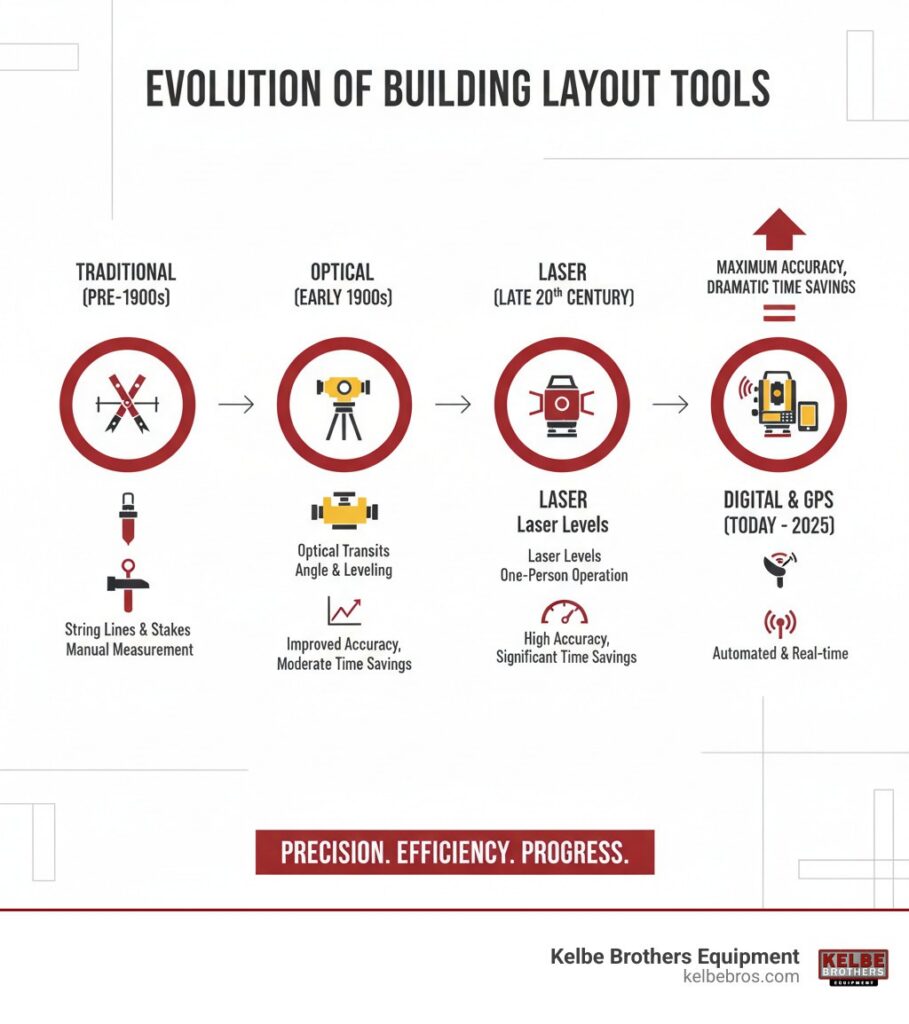
The principle of “measure twice, cut once” is more achievable than ever. Modern layout tools have evolved from string lines and plumb bobs to sophisticated GPS-guided systems that communicate with heavy equipment. This evolution means faster project completion, fewer errors, and better coordination.
Why layout precision matters:
- Ensures structures meet design specifications and local codes
- Prevents rework and material waste
- Keeps safety standards intact
- Maintains project schedules
- Improves communication between design and field crews
Accurate layout is critical when coordinating with heavy machinery. Precise grade stakes guide operators of excavators and wheel loaders during site preparation, while digital data can direct compact track loaders for exact trenching and grading.
I’m Jeffrey J. Miller, an equipment industry expert. Over decades in the industry, I’ve seen how the right layout tools transform project outcomes. My experience has shown me that the tools you choose for layout are just as important as the heavy machinery executing the work.
The Spectrum of Layout Tools: From Traditional to Digital
Every construction project, from a small addition in Racine to a major development in Milwaukee, depends on building layout tools. They are the bridge between the blueprint and the built reality, ensuring accuracy, boosting efficiency, and maintaining safety.
The industry has evolved from simple string lines to sophisticated GPS-guided systems that communicate with equipment operators. This shift has fundamentally changed how quickly and accurately crews can work. Today’s landscape includes a range of tools, and understanding each category helps create a smoother workflow. The move to digital has brought faster setup times, one-person operation for many tasks, fewer errors, and seamless data integration. This is especially true when coordinating with heavy machinery like Hitachi Excavators during site grading.
Traditional Layout Methods
Long before lasers, builders used simple yet effective tools that still have a place on modern job sites. Many Wisconsin contractors keep them on hand for their reliability.
- Tape measures are essential for quick linear measurements.
- Chalk lines snap straight reference marks on foundations, floors, and walls.
- Plumb bobs use gravity to establish true vertical alignment for walls and columns.
- Spirit levels confirm that surfaces are level or plumb, crucial for everything from door frames to floor joists.
The appeal of these tools is their simplicity. They are straightforward, require minimal training, and don’t rely on power or software. However, they can be labor-intensive and are more susceptible to human error, as a misread measurement can cause issues later. For smaller-scale projects or straightforward framing, these traditional building layout tools provide the necessary accuracy without added complexity.
Modern Digital and GPS Tools
On modern commercial sites in Green Bay or Madison, digital and GPS-based tools have transformed construction precision.
- Laser levels project sharp reference lines. Rotary lasers establish consistent elevations with a 360-degree beam, while line and point lasers handle interior work with equal precision.
- Robotic total stations combine angle and distance measurement with automated tracking. A single operator can lay out hundreds of points in a day with high accuracy, reducing the time and labor for staking.
- GNSS receivers (including GPS) use satellite signals for precise positioning. For large-scale earthmoving, these tools are transformative, as digital site plans guide operators in real time.
The practical benefits are clear. Tasks that took hours now take minutes, accuracy is improved, and one person can often handle work that previously required a crew. Digital tools also integrate with project data, connecting the design office to field operations. This precision is invaluable when guiding New Holland Wheel Loaders during site grading, as the operator knows exactly where to cut and fill. For the demanding Wisconsin construction environment, modern digital tools deliver the speed and accuracy to keep projects on track.
A Closer Look at Essential Building Layout Tools
Understanding which building layout tools to use can mean the difference between a smooth project and one with errors and delays. Here are the essential tools contractors use across Wisconsin, from simple marking tools to advanced digital systems.
Manual Measuring and Marking Tools
Manual tools are the workhorses of many job sites in Green Bay, Madison, and across the state.
- Measuring wheels are ideal for quickly measuring long distances, like a site perimeter.
- String lines provide reliable straight reference lines for masons and foundation crews to ensure everything is square and level.
- The speed square is a versatile carpenter’s tool, serving as a square, protractor, and saw guide for fast, accurate framing.
These tools contribute to foundational accuracy, preventing problems that can compound as a project progresses. Their straightforward nature means there’s no learning curve or power source required, making them a practical choice for quick measurements and smaller-scale jobs. A wide range of quality layout hand tools are available that stand up to professional demands.
Laser and Optical Layout Tools
For larger spaces or when reference lines must be consistent over distance, laser and optical building layout tools are invaluable. They often turn multi-person tasks into one-person operations.
- Line lasers project bright, visible lines on surfaces, providing an instant level or plumb reference for aligning outlets, tile, and more.
- Point lasers project dots, useful for transferring points vertically, such as marking ceiling locations directly above floor points.
- Rotary lasers spin a beam 360 degrees, creating a level plane of light across an entire job site. A single person with a receiver can establish elevations for foundations and concrete floors.
Many modern laser tools include self-leveling features that automatically ensure accuracy and speed up setup. Some technologies also boost laser visibility, making the beam easier to see in bright conditions. For interior finishing, electrical, and HVAC work, laser tools bring efficiency and precision that manual methods can’t match.
Advanced GPS and Robotic Building Layout Tools
For large-scale earthmoving and complex site layouts, advanced GPS and robotic building layout tools represent the cutting edge.
- Robotic Total Stations (RTS) are high-precision instruments that measure angles and distances, automatically tracking a prism to lay out hundreds of points per day with a single technician.
- GNSS/GPS systems use satellite signals for real-time positioning with centimeter-level accuracy. This technology is transformative for earthmoving, as it integrates with digital site models to guide equipment operators.
The power of these systems is their integration with digital models. Designs are uploaded directly to the field instrument, guiding the work and eliminating transcription errors. For example, an operator in a Hitachi Excavator with GPS can see exactly how much to cut or fill. GPS guidance with New Holland Compact Track Loaders allows for precise grading in a single pass. For trenching with Takeuchi Compact Excavators, it ensures consistent depth and slope. These technologies are essential for large or complex projects where accuracy and efficiency are paramount. To learn more about this type of machinery, see what makes compact equipment so versatile.
Integrating Layout Technology into Your Workflow
The real power of building layout tools is realized when they are combined with construction software and heavy machinery in a seamless workflow. This synergy of digital plans (the brain), layout tools (the nervous system), and heavy equipment (the muscle) delivers a new level of precision and speed on job sites across Wisconsin.
How Different Trades Use Layout Tools
On any construction site in Green Bay or Madison, nearly every trade uses layout tools adapted to their specific needs.
- Framing and drywall crews use laser levels to keep walls plumb and ceilings level, verifying their work against laser-projected lines.
- Concrete and foundation teams use robotic total stations and GPS to mark foundation lines and grade levels with pinpoint accuracy.
- Electrical and plumbing professionals rely on line lasers to align conduit, junction boxes, and pipe routing with perfect reference lines.
- HVAC technicians use the same tools to align ductwork and equipment, ensuring proper system performance.
This precise layout work directly guides heavy equipment. For instance, when an operator uses one of our Takeuchi Compact Excavators for trenching, exact data from the layout crew ensures the job is done right the first time, saving time and material.
The Role of Software in Modern Layout
Today, construction software is the backbone of modern layout. The process begins with digital plan creation using Building Information Modeling (BIM) or CAD software to create detailed 3D models.
The key breakthrough is the BIM-to-field process, where these digital models are uploaded directly to robotic total stations and GPS systems. A surveyor can then lay out points on site that match the design with millimeter precision. This direct data transfer eliminates errors and speeds up the entire process.
Accessible building design software allows contractors of all sizes, from Milwaukee to De Pere, to create professional plans and share data with field crews. Different software serves different needs, from complex BIM programs for large projects to simpler plan creators for basic designs.
Most importantly, software improves communication across teams. When the superintendent, equipment operators, and trade crews all work from the same digital model, everyone is on the same page. Coordinating a Hitachi Excavator doing site grading with a layout crew becomes a smooth, integrated process. This workflow scales from small residential jobs to major commercial developments, all following the same principle: digital plans, precise tools, and capable equipment working together.
Choosing the Right Tools and Preparing for the Future
Picking the right building layout tools is a critical decision that impacts your project’s timeline and quality. We help contractors across Wisconsin select equipment that fits their specific needs.
Factors for Selecting Your Equipment
When deciding which layout tools to use, consider these factors we discuss with our clients in Green Bay, Milwaukee, and Madison.
- Project Scale: For a residential addition in Butler, traditional tools and a laser level may suffice. For a major commercial development, robotic total stations and GPS systems are essential for efficiency on a large scale.
- Accuracy Requirements: A project’s specifications dictate the level of precision needed. A high-tech facility demands more accuracy than a simple structure. We help you match the tool’s capabilities to the job.
- Resource Management: Advanced digital tools can prevent rework and schedule delays. For specific project phases, renting specialized equipment can be a smart move.
- Crew Experience: The best tool is only effective if your team knows how to use it.
Finding the right construction equipment for your project means balancing these factors to create an efficient, accurate workflow.
The Future of Construction Layout
The industry is embracing emerging technologies that will redefine layout and positioning.
- Augmented Reality (AR) layout systems will allow crews to see digital plans overlaid onto the physical job site through AR glasses, catching conflicts before they happen.
- Drone-based site mapping with LiDAR technology can map an entire site in hours, creating detailed 3D models that feed directly into layout systems for monitoring and planning.
- AI-driven positioning will optimize the layout process by analyzing site conditions, predicting potential errors, and suggesting efficient workflows.
These technologies will integrate seamlessly with heavy equipment. Imagine guiding Hitachi Excavators or Link-Belt Excavators with AI-powered positioning. Picture New Holland Compact Track Loaders working in coordination with AR systems. This precision will also transform how Takeuchi Compact Excavators and Hitachi Wheel Loaders are used. Every operation becomes more precise and every project more efficient. We are committed to helping our clients stay ahead of the curve.
Conclusion: Building on a Foundation of Precision
From simple tape measures to advanced GPS-guided systems, building layout tools are essential for turning blueprints into the structures that define Wisconsin’s landscape. Choosing the right tools is a commitment to your project’s success, leading to fewer errors, better timelines, and superior outcomes.
Accurate layout is the unsung hero of construction. It prevents rework and ensures quality craftsmanship, whether you’re guiding a Link-Belt Excavator for trenching, a Hitachi Excavator for grading, or a Takeuchi Compact Excavator for digging.
As a fourth-generation, family-owned company, we’ve seen how precision transforms projects. Serving contractors from Milwaukee to Green Bay, we know your success depends on reliable machinery and effective support.
Your success is our success—our family’s commitment for four generations.