




The case cx26c price is a common search term for contractors and construction managers looking to select compact excavation equipment, but finding clear information can be challenging. The overall worth of a used mini excavator in the CX26C class depends on factors like:
Key Factors for Evaluation:
- Year of manufacture – 2014-2018 models show the widest availability
- Operating hours – Units range from 1,050 to 3,500 hours
- Machine condition – Well-maintained units are highly sought after
- Location – Regional availability affects the selection
- Included attachments – Hydraulic thumbs, quick couplers, and specialized buckets add capability
When you’re searching for compact excavation equipment, understanding what drives performance helps you make smarter equipment decisions. The reality is that many similar-class mini excavators offer comparable specifications and performance.
This isn’t just about finding a machine. It’s about understanding what makes a mini excavator a valuable asset for your specific projects, whether you’re digging foundations, installing utilities, or handling landscaping work across Wisconsin job sites.
I’m Jeffrey J. Miller, President of Kelbe Brothers Equipment, and over my years guiding our company through industry changes, I’ve helped countless contractors evaluate compact equipment selections, including understanding case cx26c price inquiries and finding the right machine for their needs. Let me walk you through what really matters when evaluating mini excavator performance.
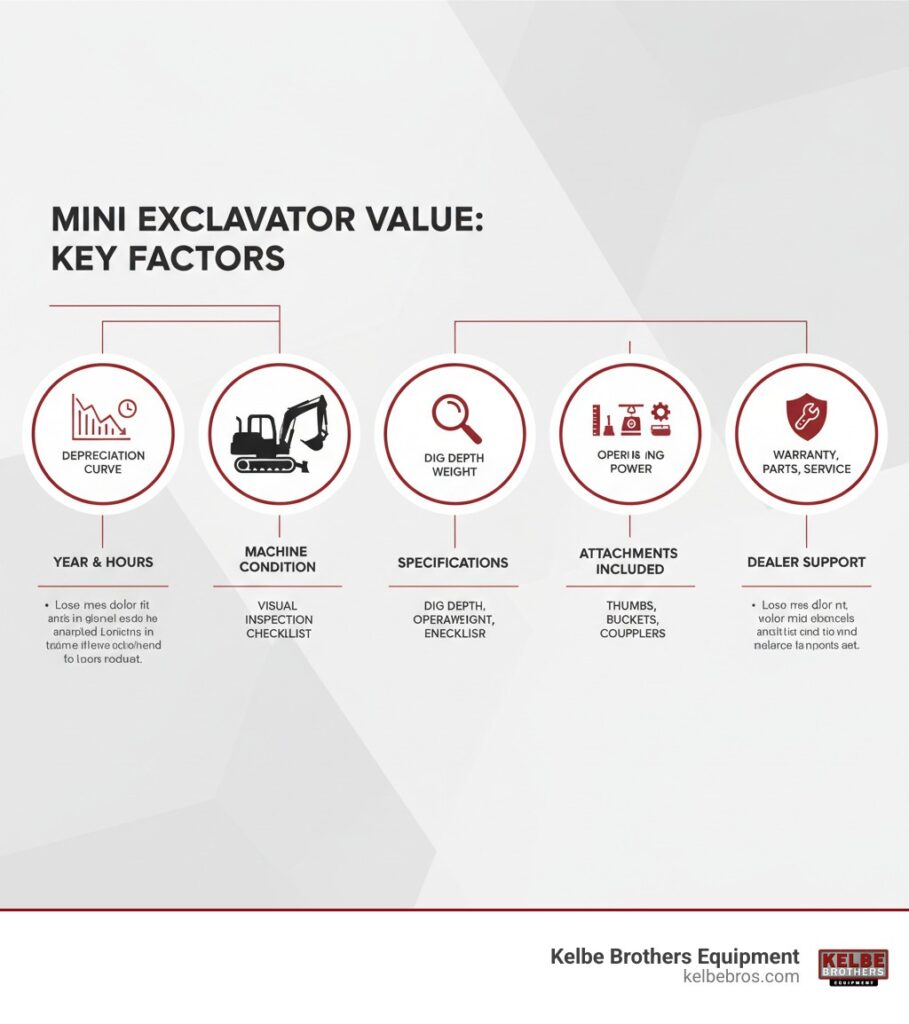
WHAT DETERMINES THE VALUE OF MINI EXCAVATORS?
When you’re evaluating the case cx26c price or any mini excavator, you’re really asking: “What will this machine deliver over the long haul?” The answer isn’t just about initial specifications—it’s about understanding how different factors combine to create lasting performance for your operation.
After working with Wisconsin contractors for generations, we’ve learned that smart buyers look at the complete picture. A mini excavator’s true worth comes from its ability to show up, perform reliably, and keep working year after year without causing constant maintenance headaches or leaving you stranded on a job site.
Several critical factors determine whether a machine represents a solid choice or a future headache. Let’s walk through what really matters when you’re comparing options, like those you might find among used construction equipment for sale.
HOW AGE AND HOURS AFFECT VALUE
Think of operating hours like mileage on a truck—they tell part of the story, but not everything. A 2017 model with 3,277 hours has lived a different life than a 2018 machine with only 1,200 hours. Both might still have plenty of productive years ahead, but their current condition will vary significantly.
Here’s what makes this interesting: a well-maintained older machine can sometimes outperform a neglected newer one. We’ve seen 2017 models that were babied by meticulous operators outlast newer equipment that was run hard and serviced irregularly. The hours matter, absolutely—but they’re just one chapter in the machine’s story.
Generally, machines with lower hours are often preferred in the used market. But high-hour machines shouldn’t be automatically dismissed if they’ve received consistent care. The sweet spot often lies in finding equipment that’s been properly maintained throughout its working life, regardless of whether it’s logged 1,000 hours or 3,000.
Understanding these nuances helps you spot genuine quality in the used construction equipment for sale in the Wisconsin market. Age and hours create the framework, but the real story emerges when you dig deeper.
THE ROLE OF CONDITION AND MAINTENANCE HISTORY
Walk up to any mini excavator, and you can learn a lot just by looking. Fresh paint might hide problems, but worn components always tell the truth. A thorough visual inspection should be your first step—check for leaking hydraulics, examine undercarriage wear, and look for signs that the machine has been respected rather than abused.
The undercarriage deserves special attention because replacement can be a major undertaking. Look for excessive wear on tracks, rollers, and idlers. These components take a beating in normal operation, so some wear is expected—but severe deterioration signals either high hours in tough conditions or deferred maintenance.
Hydraulic system health separates good machines from great ones. All cylinders should operate smoothly without jerking or hesitating. Check for leaks around seals and connections. The hydraulic fluid should be clean, not contaminated with water or debris. These systems are the heart of excavator performance, and problems here cascade into significant downtime and repairs.
But here’s what really matters: service records are incredibly insightful. A complete maintenance history tells you the previous owner took pride in their equipment. Regular oil changes, filter replacements, scheduled inspections—these aren’t just receipts, they’re proof that someone invested in keeping the machine healthy.
When you’re comparing options, a machine with a documented maintenance history should rank higher than one without, even if the latter looks cleaner. Records demonstrate preventive care, which dramatically reduces your risk of unexpected breakdowns after acquiring the machine.
For more guidance on keeping equipment running strong, check out our insights on heavy equipment maintenance best practices. These same principles apply whether you’re evaluating a machine or maintaining your current fleet.
KEY SPECIFICATIONS THAT DEFINE A MINI EXCAVATOR’S VALUE
When you’re looking into the case cx26c price or any mini excavator, the specifications tell you what performance you can expect. These aren’t just numbers on a spec sheet—they’re the features that determine whether a machine will handle your daily workload efficiently or leave you frustrated on the job site.
The performance metrics that matter most include zero tail swing capability for working in tight spaces, dig depth for reaching utility lines and foundations, operating weight that balances stability with transportability, engine power for tackling tough soil conditions, and auxiliary hydraulics for running attachments smoothly. Each of these specifications directly impacts how productive your crew will be and how many different jobs the machine can tackle.
UNDERSTANDING THE IDEAL MINI EXCAVATOR VALUE THROUGH ITS FEATURES
A mini excavator in this class really shines when it combines power with precision. The benchmark we look for includes an engine around 25 HP—enough muscle to break through compacted soil and lift heavy loads without guzzling fuel. A dig depth of approximately 7’11” gives you the reach needed for most trenching work, whether you’re running electrical conduit or installing drainage systems.
But here’s what many buyers overlook: operator comfort isn’t a luxury feature—it’s a productivity multiplier. When your operator is comfortable, they work more efficiently and make fewer mistakes. Features like an enclosed cab with climate control, a heated suspension seat, and intuitive controls with a clear display mean your crew can work longer without fatigue. Safety features, including a ROPS/FOPS canopy, travel alarms, and proportional hydraulic controls, protect your most valuable asset—your people—while keeping the machine running smoothly year after year.
These features work together to create a machine that’s not just powerful, but practical for Wisconsin’s demanding construction environment. For more insights on matching machine size to your specific projects, explore our guide on why mini excavator sizes matter for Wisconsin construction projects.
ATTACHMENTS THAT INCREASE VERSATILITY AND VALUE
Here’s where a good mini excavator becomes a great asset: its ability to transform from one tool into many. The right attachments can turn a single machine into an entire fleet’s worth of capabilities, which means you’re getting far more operational flexibility.
Hydraulic thumbs let you grab irregularly shaped materials—perfect for sorting debris on demolition sites or moving rocks during landscaping work. Quick couplers are game-changers for efficiency, allowing your operator to swap between different tools in minutes instead of losing half an hour to manual pin changes. Different bucket configurations—from narrow trenching buckets to wide grading buckets—optimize your digging for specific tasks.
When you need to break through concrete or bedrock, hydraulic breakers deliver the impact force without the vibration and noise of handheld jackhammers. Augers make foundation work and fence installation dramatically faster, drilling clean holes in a fraction of the time manual methods require.
The broader your attachment inventory, the more jobs you can bid on confidently and the more versatile your operation becomes. A mini excavator that can handle excavation, demolition, drilling, and material handling essentially replaces multiple specialized machines. That’s the kind of versatility that keeps your equipment working and your crews productive across different project types. Find more ways to maximize your equipment’s capabilities on our page on equipment attachments.
HIGH-PERFORMANCE MINI EXCAVATORS AND COMPACT EQUIPMENT TO CONSIDER
When you’re evaluating options beyond the Case CX26C, it’s worth looking at the broader landscape of compact equipment that might serve your needs even better. Finding the right machine isn’t about settling for what’s available—it’s about finding equipment that truly fits your project demands and delivers reliable performance year after year.
We’ve seen countless contractors come to us initially focused on one specific model, only to find that a different machine better matched their actual workflow. That’s why we take the time to understand your projects, your challenges, and your long-term goals before recommending equipment.
NEW HOLLAND MINI EXCAVATORS & COMPACT EQUIPMENT
If you’re working on tight residential sites, navigating urban construction zones, or handling precision landscaping projects, New Holland mini excavators bring remarkable versatility to the table. These machines pack serious digging force into a compact footprint, making them ideal when space is at a premium but performance can’t be compromised.
What our customers consistently tell us is that the operator experience matters more than they initially expected. When your crew is comfortable with intuitive controls, clear visibility, and a well-designed cab, productivity naturally increases. Fatigue drops. Mistakes become less common. The machine becomes an extension of the operator rather than something they’re fighting against all day.
New Holland’s compact equipment lineup extends beyond mini excavators to include skid steer loaders in their 200 Series, compact track loaders, compact wheel loaders, and even track loader backhoes for those needing true multi-function capability. Their wheel loaders and crawler dozers round out a comprehensive range that can handle everything from site preparation to final grading.
As your local New Holland dealer in Wisconsin, we stock parts, provide service, and know these machines inside and out—which means you’re never left waiting when you need support.
TAKEUCHI COMPACT EXCAVATORS & LOADERS
There’s a reason Takeuchi excavators have earned such a loyal following in Wisconsin and beyond. Their engineering philosophy centers on building machines that simply don’t quit, even when conditions get tough. Advanced hydraulic systems deliver the kind of precise, responsive control that makes delicate work possible while still providing the muscle for heavy digging.
The undercarriages on Takeuchi machines are built exceptionally robust—a detail that matters tremendously when you’re working on uneven terrain or in abrasive conditions. We’ve seen these machines continue performing reliably long after others would have required significant repairs or replacement.
Takeuchi’s lineup includes compact excavators, zero swing excavators for the tightest spaces, compact track loaders for maximum traction, and compact wheel loaders for material handling tasks. Each category reflects the same commitment to durability and smooth operation that defines the brand.
When you work with us as your dealer for Takeuchi excavators in Wisconsin, you’re tapping into decades of experience with this equipment and a parts network that keeps your machines running.
LINK-BELT AND HITACHI EXCAVATORS & WHEEL LOADERS
For larger-scale projects requiring more substantial power and capacity, Link-Belt excavators and Hitachi excavators represent the next tier of capability. These aren’t just bigger machines—they’re engineered with sophisticated hydraulic systems and fuel-efficient engines that maximize productivity while keeping operational needs manageable.
Link-Belt’s material handlers add specialized capability for scrap yards, demolition sites, and material processing operations where versatility matters as much as power. Meanwhile, Hitachi’s compact excavators bring that renowned reliability to smaller footprints, while their wheel loaders handle material movement with impressive efficiency.
The cabs on these machines reflect serious thought about operator comfort during long shifts—spacious, ergonomic, and equipped with technology that improves both control and awareness of your surroundings. When you’re running equipment for eight, ten, or twelve hours at a stretch, these details make a measurable difference in productivity and safety.
As both a Link-Belt dealer in Wisconsin and Hitachi excavator dealer in Wisconsin, we provide the full spectrum of support these machines deserve—from initial selection through parts, service, and that 24/7 emergency support when you absolutely can’t afford downtime.
UNDERSTANDING LONG-TERM RELIABILITY AND PERFORMANCE
When you’re looking into the case cx26c price or considering any mini excavator, the initial selection is just the beginning. The real question isn’t just about the machine’s features today—it’s about how it will perform over its entire working life.
Think about it this way: a mini excavator that seems adequate at first can cause significant downtime through frequent breakdowns or hard-to-find replacement parts. On the other hand, a machine that is built for efficiency and reliability often proves to be the smarter choice.
The factors that shape your long-term experience include maintenance requirements, unexpected repair needs, fuel efficiency over thousands of hours, and the availability of replacement parts. Each of these factors compounds over time and determines the machine’s true operational effectiveness.
We’ve watched contractors learn this lesson the hard way over our four generations in the Wisconsin construction equipment industry. The machines that deliver the best performance aren’t necessarily the newest—they’re the ones that keep working, day after day, without surprises that shut down your job site.
Regular, preventive maintenance is your best defense against performance degradation. Skip those routine oil changes or filter replacements, and you’re essentially accelerating the wear on critical components. What starts as a minor oversight can quickly become a major repair—not to mention the lost productivity while your machine sits idle.
Fuel efficiency deserves serious consideration, too. Even a modest difference in consumption adds up dramatically over a machine’s lifetime. When you’re running equipment for thousands of hours, those gallons multiply fast. For practical guidance on protecting your equipment and maximizing its lifespan, explore our comprehensive resource on preventive maintenance.
THE IMPORTANCE OF GENUINE PARTS
Here’s where many equipment owners make a critical choice. When your mini excavator needs a replacement part, the decision between genuine OEM components and aftermarket alternatives has consequences that extend far beyond the immediate repair.
Genuine OEM parts are engineered specifically for your machine. They fit perfectly, perform exactly as designed, and maintain the integrity of your equipment’s systems. Aftermarket parts might look similar, but they often compromise on materials, precision, and durability. This can lead to premature component failure, additional downtime, and cascade effects that damage other systems.
We’ve seen it happen countless times: a contractor installs an off-brand hydraulic component, only to have it fail within months—sometimes taking other critical parts down with it. The perceived convenience evaporates quickly when you factor in the second repair, the lost productivity, and the frustrated crew standing around waiting.
Remanufactured parts from reputable suppliers offer an excellent alternative. When properly remanufactured to OEM standards, these components can perform like new and provide reliable service. The key is sourcing them from suppliers who stand behind their work and follow rigorous remanufacturing processes.
Whether you need engine components, hydraulic parts, filters, seals, or electrical connections, choosing quality matters. Your mini excavator is only as reliable as its weakest component. For expert guidance on selecting the right components for your specific equipment, our team is ready to help with heavy equipment parts.
At Kelbe Brothers Equipment, we’ve built our reputation over four generations by helping Wisconsin contractors make smart, long-term decisions about their equipment. That means being honest about true long-term performance and steering you toward choices that keep your machines running strong, your crews productive, and your projects on track.
FREQUENTLY ASKED QUESTIONS ABOUT MINI EXCAVATOR VALUE
Over the years, I’ve sat down with countless contractors who are trying to figure out the best path forward when selecting compact equipment. The questions tend to be similar, and they’re all rooted in the same concern: making a smart choice that won’t come back to bite you. Let me address the ones we hear most often.
WHAT DEFINES A QUALITY USED MINI EXCAVATOR?
Here’s the honest truth: there’s no single answer that defines a quality machine for every buyer. When someone asks about the cx26c price or the qualities of similar used mini excavators, my first question is always, “What do you need it to do?”
A machine with 2,500 hours that’s been carefully maintained and comes with a full service history might be a better choice than a lower-hour unit that’s been run hard and put away wet. The sweet spot isn’t just about the hours on the meter—it’s about how well the machine has been cared for, what attachments come with it, and whether it’s the right fit for your specific projects.
We’ve seen well-maintained used mini excavators deliver years of reliable service, while others have turned into constant sources of downtime because the initial selection was based on incomplete information. The key is looking at the complete picture: operating hours, maintenance records, physical condition, and included equipment. Always verify all details with your sales representative to ensure you’re getting accurate information for your specific situation.
HOW DOES BUYING AT AUCTION COMPARE TO BUYING FROM A DEALER?
I’ll be straight with you: auctions can be tempting. But here’s what you might not be seeing—you could be acquiring a machine with an unknown history.
Most auction machines are sold as-is, with no warranty, no inspection, and often no real history. You could be inheriting someone else’s headache. I’ve seen contractors acquire machines at auction only to face significant, unexpected repairs.
When you work with a reputable dealer like Kelbe Brothers Equipment, you’re getting more than just a machine. You’re getting certified inspections, transparent service histories, and often warranty coverage. And when something does need attention down the road, you’ve got a local team who knows your machine and can get you back up and running fast.
That peace of mind and ongoing support? That’s a level of assurance you simply can’t get at an auction. It’s the difference between acquiring equipment and building a partnership.
WHERE CAN I FIND RELIABLE MINI EXCAVATORS FOR SALE?
The best place to find quality used mini excavators is through authorized dealers who stand behind their equipment. We pride ourselves on thoroughly inspecting every machine we sell and maintaining detailed service records. When you buy from us, you’re not just getting a piece of equipment—you’re getting a local team who understands Wisconsin job sites and can support you for the long haul.
Online marketplaces can show you what’s available, but they can’t replace the value of seeing a machine in person, talking through its history, and having experienced professionals guide you through the decision. You want a partner who’ll answer the phone when something goes wrong at 6 a.m. on a Monday morning, not someone who disappears after the sale.
For guidance on finding the right dealership partners in your area and what to look for, check out our insights on finding reliable construction equipment dealers in your area. Whether you’re considering excavators for sale, mini excavators for sale, or used construction equipment for sale, the relationship you build with your dealer matters just as much as the machine you choose.
FIND YOUR NEXT POWERHOUSE MINI EXCAVATOR IN WISCONSIN
Understanding the case cx26c price and what drives mini excavator performance is just the beginning of finding the right machine for your operation. From the operating hours and maintenance history to the specifications and attachments that make a machine truly versatile, every factor contributes to whether you’re making a smart selection or just acquiring a piece of equipment.
We’ve been in this business for four generations, and we’ve learned that the best choice is a reliable machine backed by people who know it inside and out, can get you parts when you need them, and will answer the phone at 2 AM when something goes wrong on a job site.
That’s what we do at Kelbe Brothers Equipment. We’re a family-owned company right here in Wisconsin, and we understand what local contractors face every day. Our experienced staff knows these machines because they work on them, sell them, and rent them. We offer rapid response and 24/7 emergency support because we know your projects don’t stop at 5 PM.
Whether you’re looking at New Holland mini excavators for their compact power and operator comfort, Takeuchi compact excavators for their industry-leading durability, or the fuel-efficient performance of Link-Belt and Hitachi excavators, we have the inventory and expertise to help you make the right choice. We’re not here to push you toward any particular machine. We’re here to understand your projects and match you with equipment that will serve you well for years to come.
For a wide selection of reliable and powerful compact equipment, explore our inventory of mini excavators for sale in Wisconsin. Stop by our location, give us a call, or browse online. We’re ready to help you find the perfect machine to power your next project, with the local support that makes all the difference.