




Mini excavator repair is something every Wisconsin construction manager will face — and how fast you respond makes all the difference between a minor fix and a costly shutdown.
Here’s a quick overview of the most important mini excavator repair tasks:
| Repair/Maintenance Task | Frequency |
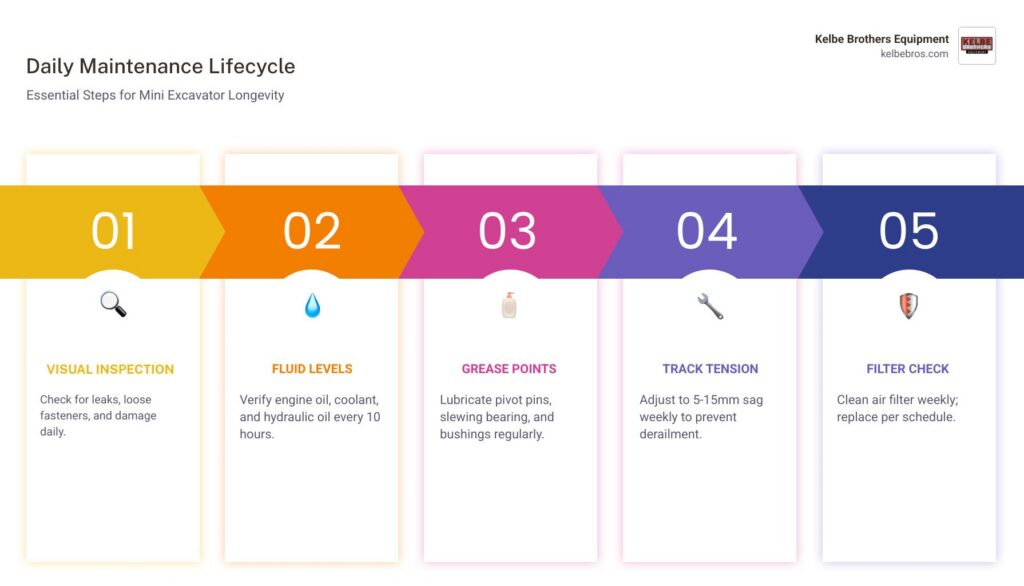
| Check fluid levels (engine oil, coolant, hydraulic oil) | Daily / every 10 hours |
| Inspect for leaks, loose fasteners, safety features | Daily |
| Grease pivot points, pins, and slewing bearing | Daily / every 10 hours |
| Clean air filter | Weekly / every 50 hours |
| Change engine oil and filters | Monthly / per manufacturer schedule |
| Adjust track tension (target 5–15 mm sag) | Weekly or as needed |
| Replace hydraulic filters | Every 500 hours |
| Change final drive motor oil | Yearly or every 100 hours |
The word “mini” can be misleading. These machines take a serious beating — digging, swinging, and tracking across rough terrain every single day. Skipping maintenance doesn’t just shorten their lifespan. It turns a straightforward repair into an expensive, time-consuming breakdown that stalls your whole project.
The good news? Most mini excavator problems give you early warning signs. Catching them early — a small drip, a slight noise change, a little sluggishness in the boom — can be the difference between a quick fix and a major overhaul.
I’m Jeffrey J. Miller, President of Kelbe Brothers Equipment, and I’ve spent years helping Wisconsin contractors navigate mini excavator repair and maintenance challenges across our fleet of Hitachi, Takeuchi, and New Holland equipment. In this guide, I’ll walk you through everything you need to keep your machine running at peak performance — from daily checks to knowing when it’s time to call in a professional.
Why Regular Maintenance is the Foundation of Mini Excavator Repair
In construction, we often say that machines don’t fix themselves—though wouldn’t that be nice? When we talk about mini excavator repair, the conversation actually starts long before a part breaks. It starts with Preventive Maintenance. Think of it like brushing your teeth; it’s a small daily effort that prevents a massive, painful bill later on.
A well-maintained machine, whether it’s a Hitachi Compact Excavator or a New Holland Mini Excavator, can significantly outlast one that is neglected. Statistics show that fleets that digitalize their service and stick to schedules can reduce overdue maintenance cases significantly, directly cutting unplanned downtime. By maintaining your mini compact excavator properly, you aren’t just cleaning it; you are protecting the high-tolerance components that make these machines so precise.
Identifying Early Signs Your Mini Excavator Needs Repair
Your machine is constantly “talking” to you through noises, vibrations, and even smells. If you listen closely, you can catch a small problem before it becomes a major disaster.
Common warning signs include:
• Visual Leaks: Wet spots on hoses or puddles under the chassis are never “normal.”
• Unusual Noises: High-pitched whines from the pump often indicate cavitation or air in the system. Grinding during a swing usually points to issues with the slewing bearing.
• Jerky Movements: If your boom or bucket is stuttering, your hydraulic system is likely struggling.
• Smoke Signals: Blue smoke typically means you’re burning oil, while white smoke can indicate unburned fuel or cooling issues.
At Kelbe Brothers, we also recommend Fluid Analysis to catch microscopic wear particles before they cause a total system failure.
Essential Tools for DIY Mini Excavator Repair
You don’t need a factory-grade shop for basic mini excavator repair, but you do need the right kit. If you’re a local Wisconsin contractor looking to handle minor fixes in-house, ensure you have:
1. High-Quality Grease Gun: For daily lubrication of pivot points.
2. Torque Wrench: Essential for ensuring fasteners on the undercarriage and engine are set to manufacturer specs (often ranging from 5-200 Nm).
3. UV Dye Kits: A lifesaver for finding those “ghost” hydraulic leaks that only appear under pressure.
4. Digital Service Logs: To track intervals and ensure you never miss a 500-hour filter change.
Having a reliable source for Heavy Equipment Parts is equally vital to ensure you aren’t using “will-fit” parts that don’t actually fit.
Essential Daily Inspections and Troubleshooting
The daily walkaround is the most important 10 minutes of an operator’s day. Whether you’re running a Takeuchi Compact Excavator or a Link-Belt Excavator, checking the basics prevents the “sudden stops” that ruin productivity.
Focus on fluid transparency. Engine oil should be clean, and hydraulic oil should be clear—not milky (which indicates water) or dark and burnt-smelling. Following a guide for Maintaining Your Compact Excavator ensures nothing is missed.
Daily Walkaround Checklist
Before you turn the key, perform these checks:
• Leak Detection: Check the ground and the engine compartment for oil, fuel, or coolant.
• Loose Fasteners: Vibrations can loosen bolts over time. A quick visual check can save a component from falling off mid-dig.
• Safety Features: Ensure the seatbelt is functional and the travel lock engages properly.
• Battery Terminals: Look for corrosion that could lead to starting failures.
Even though we specialize in brands like Takeuchi and New Holland, the principles found in technical documents emphasize that daily inspections are universal across all compact machinery.
Lubrication and Greasing Points
Greasing is the “secret sauce” of longevity. Every major pivot point, including the boom, arm, and bucket bushings, needs attention. We recommend using an NLGI 2 lithium complex EP grease.
Don’t forget the slewing bearing. This allows the house to rotate on the undercarriage and is often neglected. Apply 4 to 8 pumps per week daily until you see fresh grease purging out. This flushes out abrasive dirt and prevents friction-related wear. For a deeper dive, see our Greasing Best Practices.
Mastering Hydraulic and Engine System Fixes
The hydraulic system is the heart and muscles of your excavator. When it fails, the machine is just a very heavy paperweight.
Troubleshooting Engine Overheating and Starting Issues
Overheating is often caused by something simple: a clogged radiator. In Wisconsin, dust, leaves, and cottonwood seeds can quickly plug up the cooling fins. Use low-pressure air to blow out the radiator—never high-pressure water, which can bend the delicate fins.
If the engine won’t start, check the fuel water separator. Modern diesel engines have incredibly tight tolerances, and even a tiny amount of water can ruin an injector. Also, ensure you are using Preventive Maintenance With Filters that meet OEM standards to prevent air restriction.
Diagnosing Hydraulic Leaks and Pressure Drops
If you notice slow cycle times or a loss of lifting power, you might have a pressure drop. This could be a simple O-ring replacement or a more complex relief valve adjustment.
One common culprit is a blocked suction filter. If the pump is making a high-pitched “screaming” sound, it’s likely starving for oil. For complex issues, our On-Site Hydraulic Services can bring the shop to your job site in Milwaukee or Madison. Don’t forget to check your Hydraulic Hoses for abrasions; a small scuff today is a blowout tomorrow. Proper Fluid Maintenance is your best defense here.
Undercarriage and Track Maintenance Best Practices
The undercarriage can account for nearly 50% of your machine’s total maintenance costs over its lifetime. Ignoring it is a fast way to burn through your profits.
Preventing Track Derailment
Nothing stops a job faster than a “thrown” track. To prevent this, you must maintain proper track tension. For most mini excavators, you’re looking for 5–15 mm of deflection (sag) at the center of the track.
• Too Loose: The track will flop and likely derail during a sharp turn or in mud.
• Too Tight: This puts immense strain on the final drive motors and rollers, causing premature wear.
Regularly remove packed mud and debris, as dried clay can act like concrete, straining the drive system. For more on this, read our Undercarriage Maintenance Tips.
Extending Rubber Track Lifespan
High-quality rubber tracks on machines like the Takeuchi Compact Track Loaders or New Holland Mini Excavators typically last between 1,000 and 1,500 hours. To hit that upper limit:
• Avoid Sharp Turns: Especially on abrasive surfaces like concrete or jagged rock.
• Minimize Counter-Rotating: This “spinning on a dime” creates massive friction.
• Proper Storage: If you aren’t using the machine in the Wisconsin winter, park it on planks to prevent the tracks from freezing to the ground.
Our Heavy Equipment Service team often sees tracks destroyed in 500 hours simply due to poor operating techniques.
When to Choose Professional Mini Excavator Repair Services
We love a good DIY fix as much as anyone, but some jobs require the heavy hitters. If you’re dealing with internal hydraulic pump failures, electrical control module glitches, or engine rebuilds, it’s time to call the experts.
The Importance of Genuine OEM Parts
When it comes to mini excavator repair, “cheap” parts are often the most expensive. Genuine New Holland, Hitachi, or Takeuchi parts are engineered to exact tolerances. An aftermarket filter might look the same, but if it allows microscopic dirt through, it can ruin a fuel injection system.
Using genuine components ensures System Integrity and keeps your warranty intact. Our Shop Service uses only the best components to ensure your machine returns to the field in “like-new” condition.
Safety Precautions During Major Repairs
Safety isn’t just a checkbox; it’s how you make sure you get home at the end of the day.
• Three-Point Contact: Always use two hands and one foot (or vice versa) when entering the cab.
• Pressure Release: Never “crack” a hydraulic line without first relieving the system pressure.
• Battery Isolation: Disconnect the battery before working on electrical systems or near the engine.
• Lock-Out/Tag-Out: If you’re working under the boom, use mechanical supports. Never trust the hydraulics alone.
Understanding Why Reliable Equipment Service Matters starts with a commitment to safety and Factory Trained Technicians.
Frequently Asked Questions about Mini Excavator Repair
How often should I grease my mini excavator?
For standard operation, you should grease major pivot points every 10 operating hours (daily). If you are working in extremely wet or muddy conditions, you may need to grease twice a day to flush out contaminants. Always pump until you see clean grease emerge from the joint.
Why does my excavator track to one side?
The most common cause is uneven track tension. Check if one side is significantly looser than the other. If tension is correct, the issue might be a worn final drive motor or an internal leak in the hydraulic swivel joint (center joint). Proper Undercarriage Maintenance can prevent most tracking issues.
What are the signs of hydraulic pump failure?
Keep an ear out for excessive whining or growling. Other signs include a noticeable loss of lifting power, jerky movements of the boom or bucket, and hydraulic oil that gets hot very quickly. If you suspect pump issues, stop the machine immediately to prevent metal shavings from contaminating the entire system.
Conclusion
At Kelbe Brothers Equipment, we understand that your mini excavator is the backbone of your operation. Whether you’re looking for Takeuchi Excavators for a new project or need a rapid-response mini excavator repair in Milwaukee, Madison, or Green Bay, we are here to help.
As a fourth-generation, family-owned Wisconsin company, we pride ourselves on providing the “hassle-free” service local contractors need. From responsive service support to flexible financing on New Holland Mini Excavators, our goal is to keep your downtime to an absolute minimum.
Ready to get your machine back in peak shape? Contact our Heavy Equipment Service team today and let’s get to work.